Beauty salon marketing has one job: keeping your diary full of paying clients. But between Instagram algorithms, Google profiles, reviews, emails and ads, most owners either do everything badly or nothing at all. This guide is the complete UK playbook for marketing a beauty salon, built around the six jobs your marketing must do: get found, get seen, get trusted, get rebooked, get recommended and get measured. Written for UK beauty salon owners, with copy-paste templates, honest costs, UK legal guardrails and no invented statistics. Read it once, then work through it section by section.
Key takeaways, the six jobs at a glance
- Get found: a complete Google Business Profile with prices, photos and recent reviews (about 45 minutes of setup).
- Get seen: Instagram and TikTok content that shows real work with real prices, one hook, one treatment, one booking instruction.
- Get trusted: a review engine that asks every happy client within 24 hours, and replies to every review.
- Get rebooked: rebooking at the chair, legal email/SMS and a win-back system for lapsed clients.
- Get recommended: referrals, local partnerships and the UK seasonal calendar (Mother’s Day to Christmas party season).
- Get measured: five numbers, checked monthly, so you know what is actually bringing bookings.
Want a second pair of eyes on your marketing before you start? Book a free 30-minute strategy call, we will tell you which of the six jobs to fix first.
The six jobs of beauty salon marketing
Instead of a random list of tactics, think of beauty salon marketing as six jobs. If a job is missing, there is a hole in your diary, and you can usually feel which hole it is.
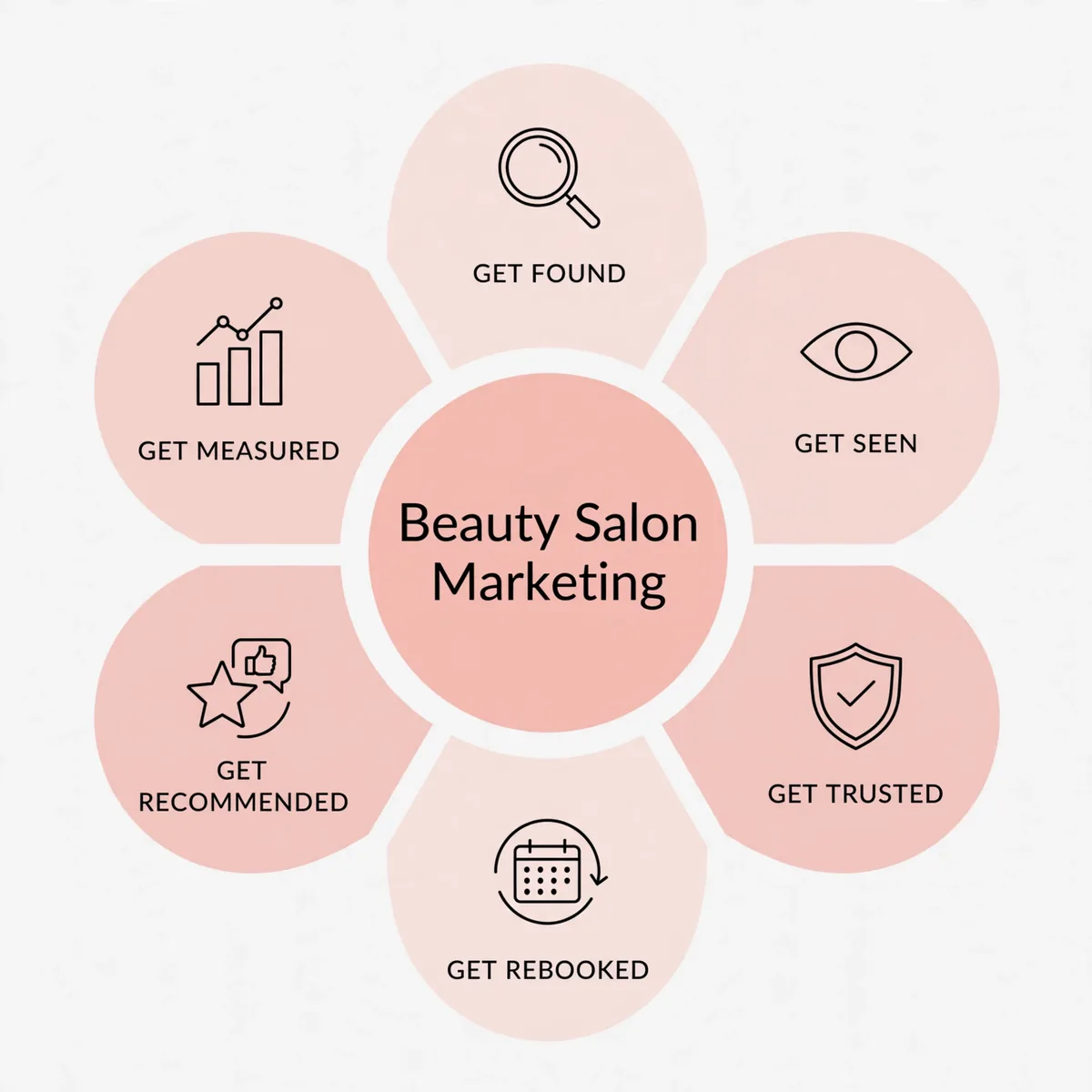
- Get found, when someone nearby searches “facial near me” or your treatment + town, you appear.
- Get seen, people who have never heard of you discover your work on Instagram and TikTok.
- Get trusted, reviews and proof convince a stranger you are the safe choice.
- Get rebooked, clients come back, and lapsed clients come back again.
- Get recommended, clients and neighbours send you their friends.
- Get measured, you know which of the above is actually producing bookings.
Where should you start?
Do not try all six at once. Start with the job that matches your situation:
| Your situation | Start with these jobs |
|---|---|
| New salon, no reviews yet | 1 (Get found) + 3 (Get trusted) |
| Diary half empty, established salon | 1 (Get found) + 4 (Get rebooked) |
| Busy but attracting the wrong clients | 2 (Get seen) + 5 (Get recommended) |
| Fully booked but want better clients | 3 (Get trusted) + 2 (Get seen, premium positioning) |
| No time for marketing at all | 1 (Get found) + 3 (Get trusted), then get help |
Read the whole guide once, then go deep on your two starting jobs. Come back for the rest.
Get found on Google
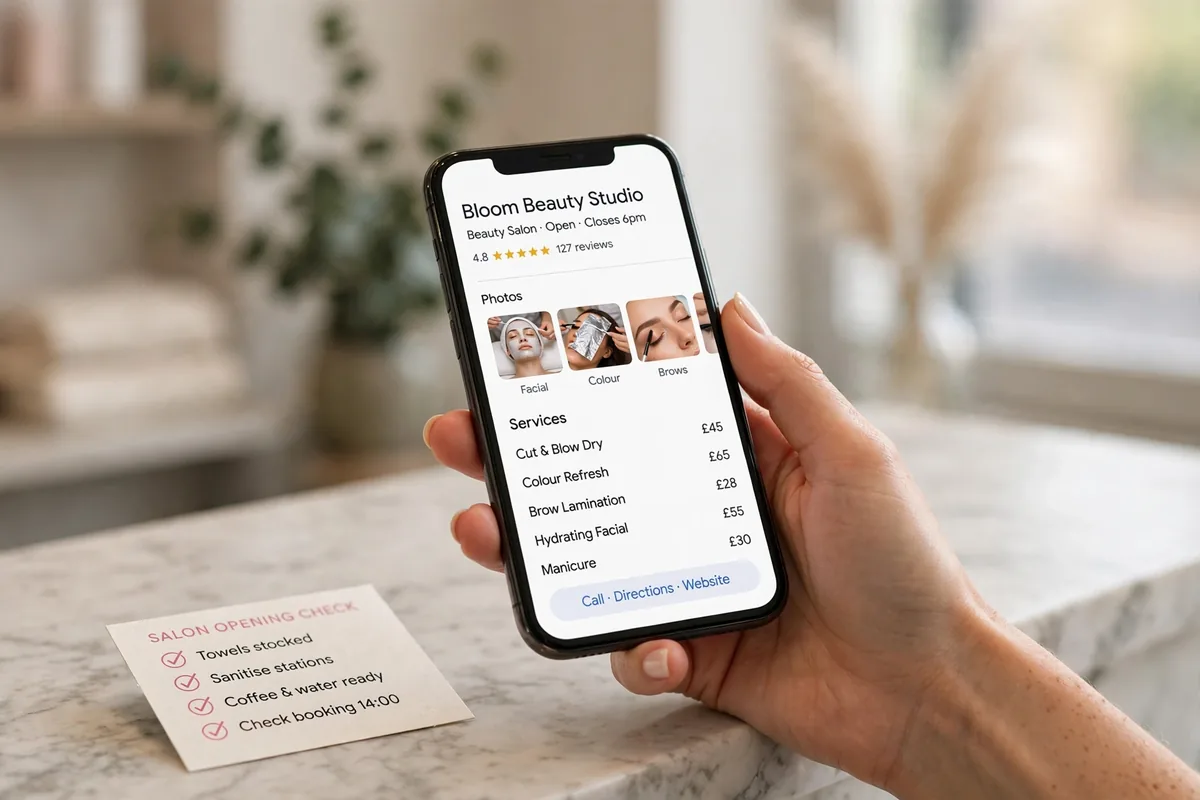
When someone in your town searches “brow lamination near me” or “best facial in [your town]”, your Google Business Profile is what they see first, before your website, before your Instagram. Marketing beauty salon treatments on Google starts here, and most salons leave it half-finished. A complete profile beats an expensive website every time for local searches.
The 45-minute setup (do it this week)
- Claim and verify your profile. Use Google’s official Business Profile help to claim your listing and complete verification (usually a video verification or postcard in the UK).
- Pick the most specific primary category, “Beauty salon”, “Nail salon” or “Day spa”, not just “Salon”. Add secondary categories for your main treatments.
- List every service with a price. “Signature facial, from £65, 60 minutes” will out-book a profile with no prices every single time. Clients will not call to ask; they will just pick the salon that shows prices.
- Add 10+ real photos, your treatment rooms, your team at work, real results (with client permission). No stock photos; people can tell.
- Write your business description like a client reads it, treatments, who you are for, and your town name. Skip the mission statement.
- Turn on messaging and reply to every review within 48 hours, good and bad. Google watches this, and so do clients.
- Add your booking link as the primary action button, not your homepage.
For the full deep dive, read our guide to local SEO for salons.
What usually goes wrong
The most common failure we see: the profile exists but has no prices, three-year-old photos and four reviews. That is not a presence; it is a warning sign. If keeping yours current sounds like a second job, our local SEO for salons service keeps profiles, rankings and reviews handled for you.
Get seen on social media
Instagram and TikTok do not book appointments. They create the “I want that” feeling that sends someone to Google your name. Marketing your beauty salon on social works when every post answers three questions: what is it, what does it cost, and how do I book.
The content that actually books
- Real work, real prices. Before-and-afters and treatment videos with the price and duration in the caption. “Signature facial, £65, 60 minutes, link in bio to book” beats any hashtag strategy.
- Answer questions in short Reels. “How long does brow lamination actually last?” “Does a HydraFacial hurt?” One question, one 30-second answer, filmed on your phone. This is the content that gets saved, and saved posts reach strangers.
- Show the salon, not just the treatments. A 10-second pan of a calm, clean treatment room sells more than a paragraph of copy. Clients are buying trust as much as treatments.
- Stories for daily life. Same-day gaps, new retail arrivals, a quick poll. Stories keep you in front of existing followers between the big posts.
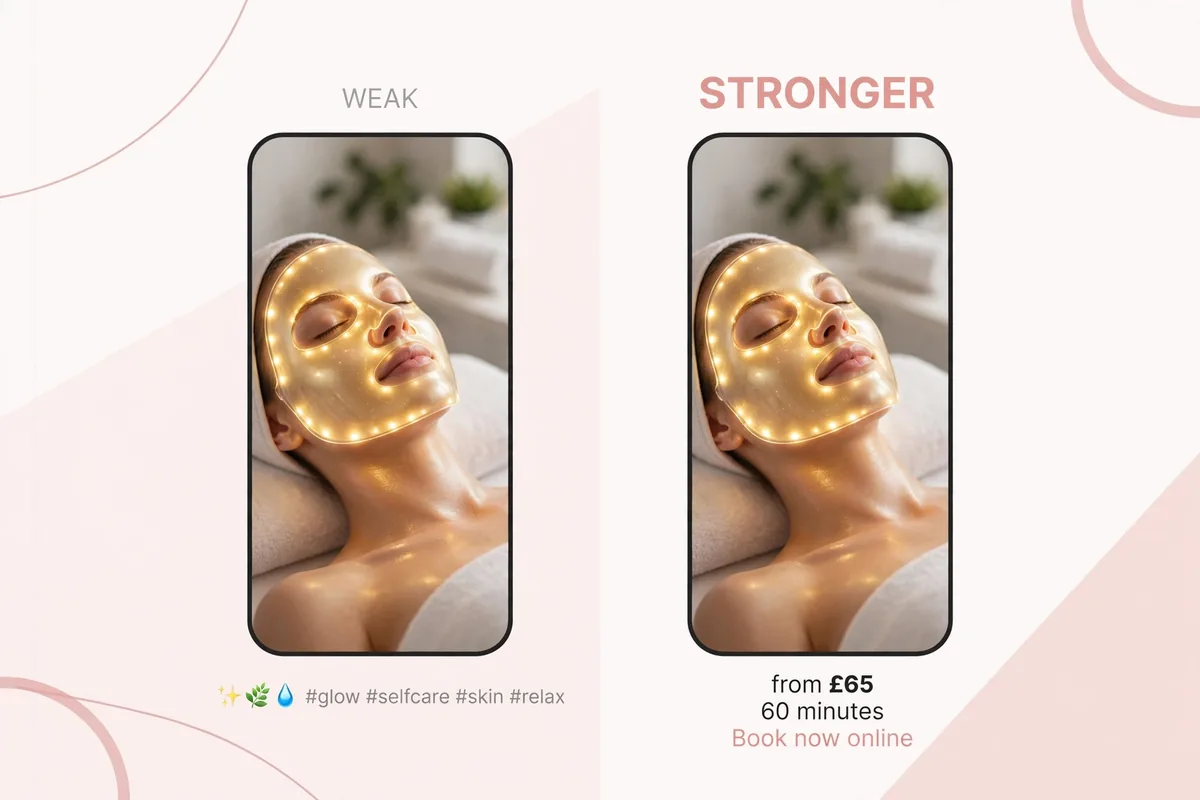
Before-and-after: the caption rewrite
Weak caption: “Glowing skin”
Better caption: “Signature glow facial, from £65, 60 minutes. This client wanted her skin party-ready before a wedding; we did a deep cleanse, enzyme peel and LED. Two facial slots left this week, book through the link in bio.”
The better version answers price, time, the problem it solves and exactly how to book. The image earns the scroll-stop; the caption earns the booking.
How much to post
Three feed posts a week and daily Stories is the realistic target for a working owner, two treatment showcases and one educational Reel. If even that feels impossible alongside clients, our social media management for salons takes it off your plate: content planned, filmed around your diary and posted for you.
Get trusted with reviews
A client choosing between two salons picks the one with 80 recent reviews over the one with 12 old ones, even if the second is better. Reviews are free advertising that works while you sleep, but only with a system. Hope is not a system.
The review engine (copy and paste)
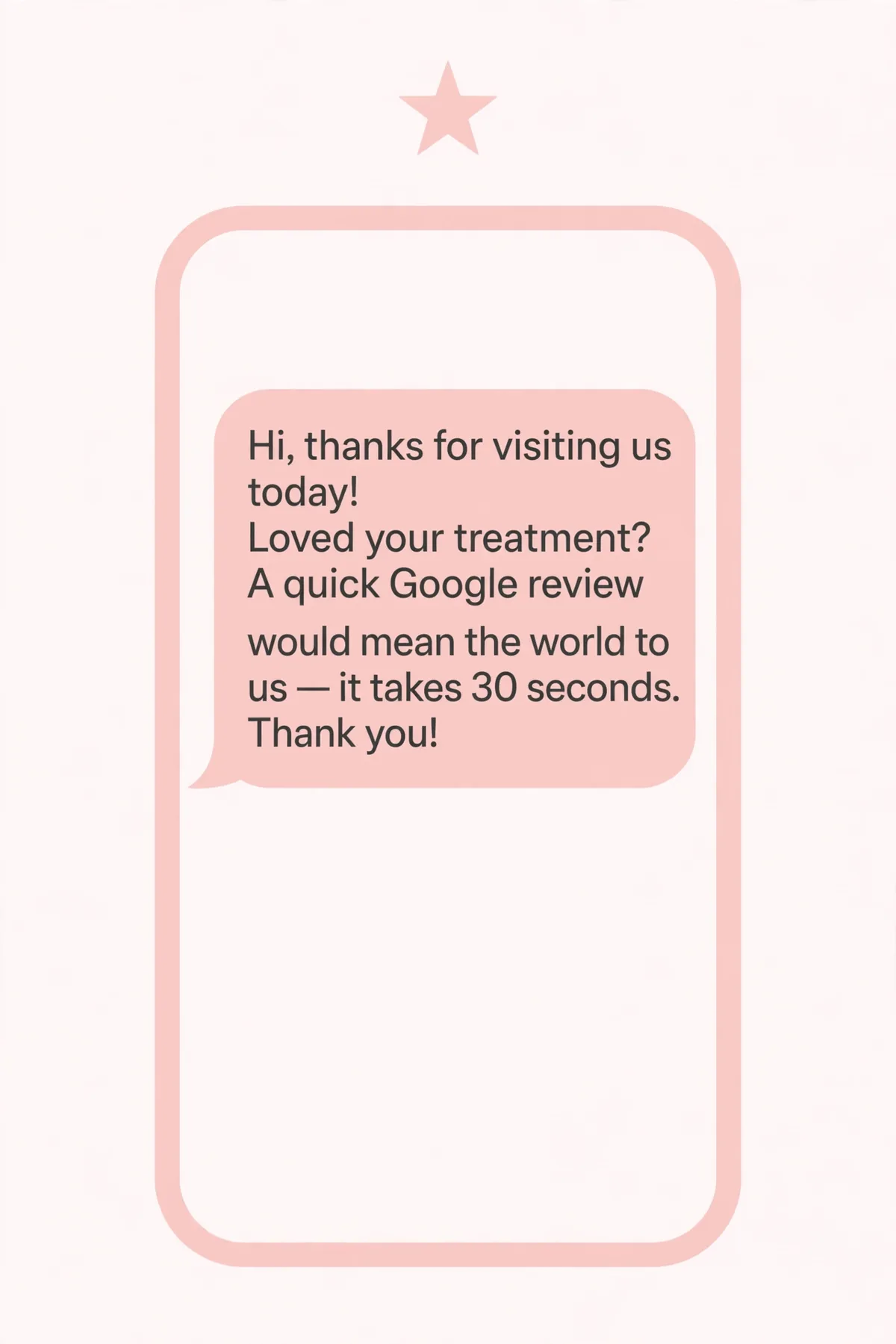
Within 24 hours of every appointment, send this by WhatsApp or SMS:
Hi [name], thanks for coming in today! If you loved your [treatment], would you leave us a quick Google review? It takes 30 seconds and it really helps our salon: [your review link]
Say it in person at checkout too: “If you loved your facial today, a Google review would mean the world, I’ll text you the link.” Aim for two to three new reviews a week. Steady and believable beats a sudden burst of 30 (which looks bought, because it usually is).
Reply to every review, especially the bad ones
Thank every reviewer by name and mention the treatment. For negative reviews: reply once, calmly, without arguing, and invite them to resolve it privately. Future clients read your replies more carefully than the review itself, a graceful reply to a complaint is worth five five-star reviews. Never offer incentives for positive reviews on Google; it breaches Google’s policy.
Get rebooked with email and SMS
The cheapest booking you will ever take is from someone who has already trusted you with their face. Rebooking, reminders and win-backs is where most salons leave money on the table.
Rebook at the chair
At the end of every appointment: “Your facial results will peak in about four weeks, shall I book your next one for [date]?” Twenty seconds, the single best retention habit in the business.
Win back lapsed clients
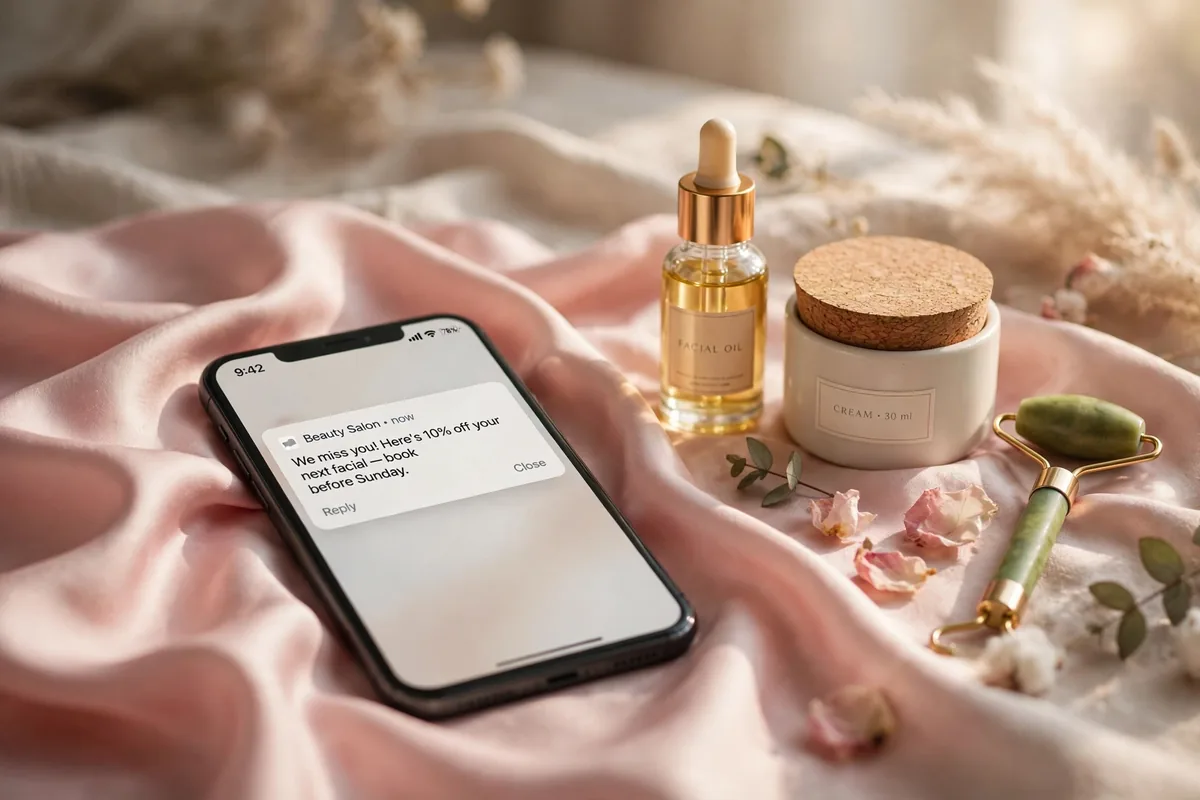
Send this to clients who have not booked in 3+ months (marketing consent required, see the legal note below):
Hi [name], it’s [your name] from [salon]. We haven’t seen you in a while and we’d love to have you back. Here’s 10% off any treatment booked before [date]: [booking link]. Reply STOP to opt out.
The legal bit (do not skip this)
Under PECR, the UK’s electronic marketing rules, you need consent (or the “soft opt-in” for existing customers buying similar services) before sending marketing texts or emails, and every message must offer an opt-out. Bought lists almost never carry the consent PECR requires. Build your list from real clients and collect consent at booking. The ICO’s direct marketing guidance explains it plainly. This is general information, not legal advice.
Get your rebooking system built for you
These work, but only if they happen every week without fail. Book a free 30-minute strategy call and we will map the retention system that fits your salon and your diary.
Free, 30 minutes, no obligation. We reply within one working day.
Get recommended
Word of mouth is powerful; a system is more powerful: referrals, partnerships and the UK seasonal calendar.
A referral reward that runs itself
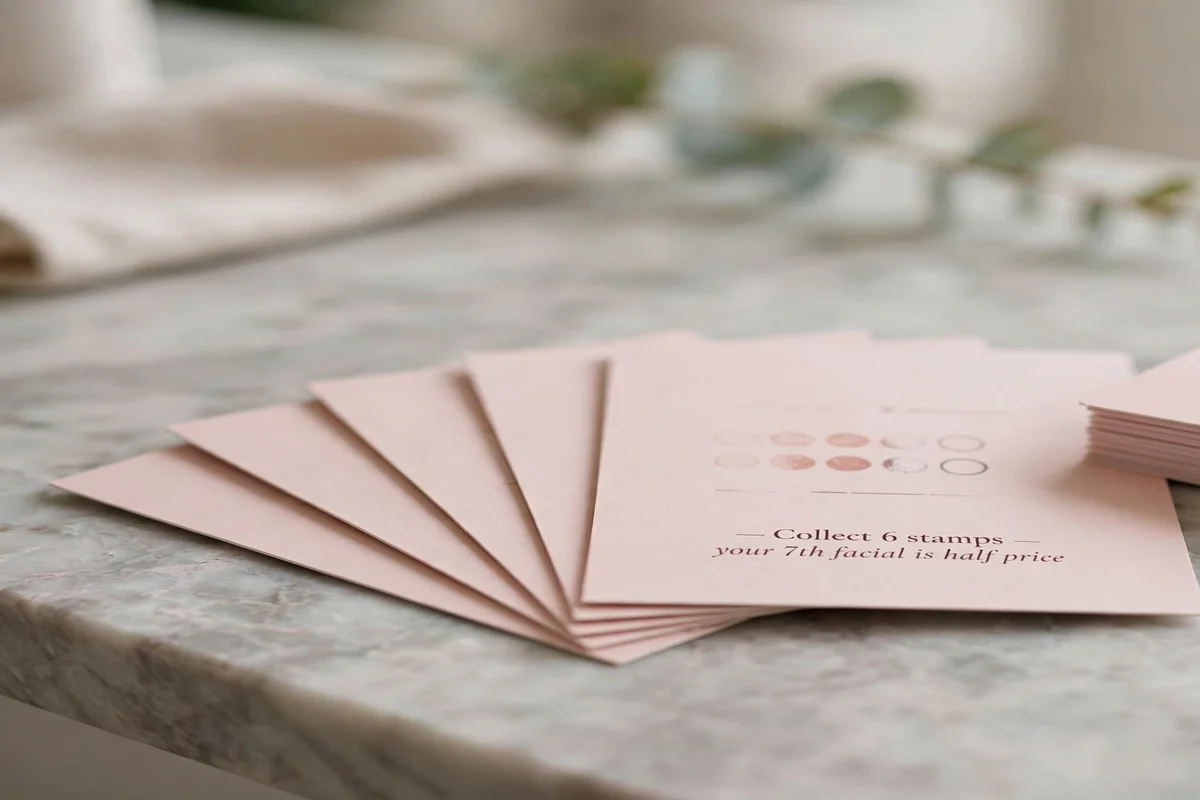
Keep it simple and write it on a card at reception: “Refer a friend, you both get £10 off your next visit. No limit.” Then do the maths so the reward never hurts you. Example (illustrative, not a client result): if your average treatment is £55 and delivery costs you roughly £30, a £10 reward that brings a new £55 client leaves you ahead, and that client may rebook for years. Run your own numbers before you set the amount.
Team up with local businesses
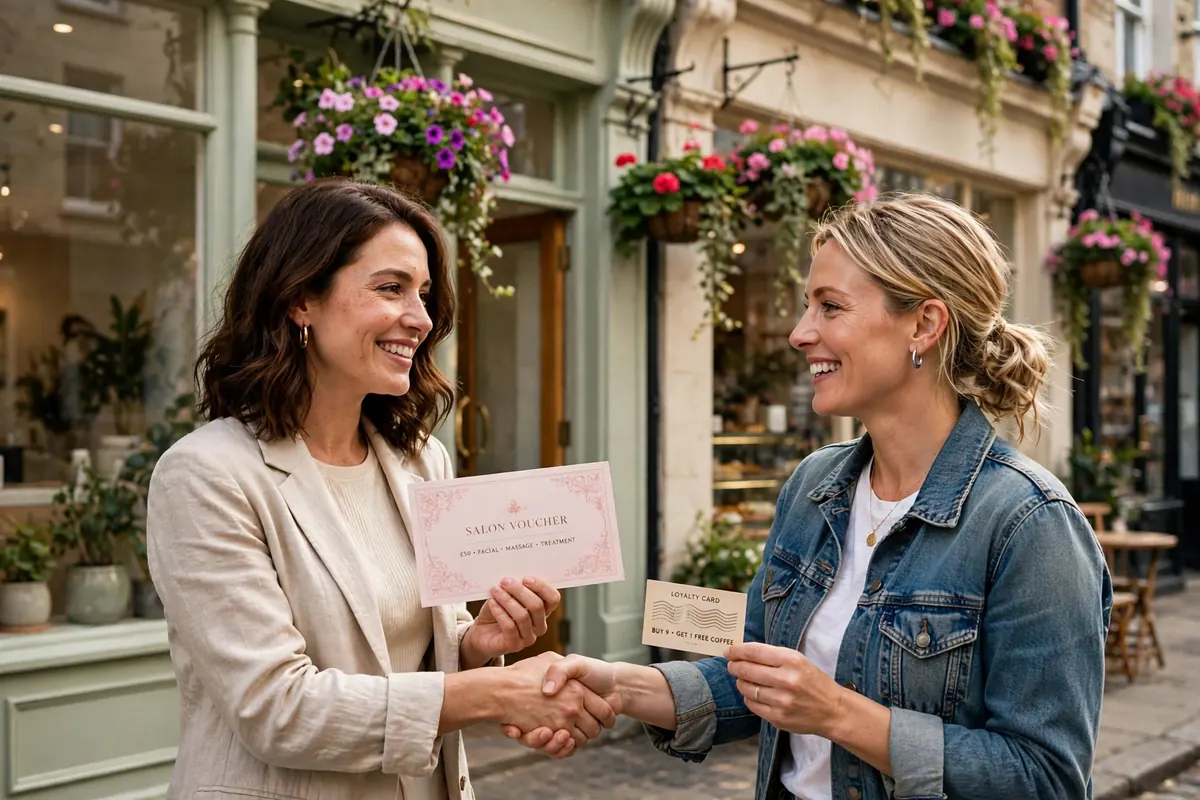
Find three nearby businesses whose clients look like your clients, a bridal boutique, a gym, a café. Offer something simple and mutual: they display your cards, you display theirs, each offering 10% off a first visit. Start with one partnership this month, not ten.
Plan around the UK calendar
Beauty demand follows the seasons. Plan one campaign per quarter:
- January: “new year, new skin” refresh packages and course bookings
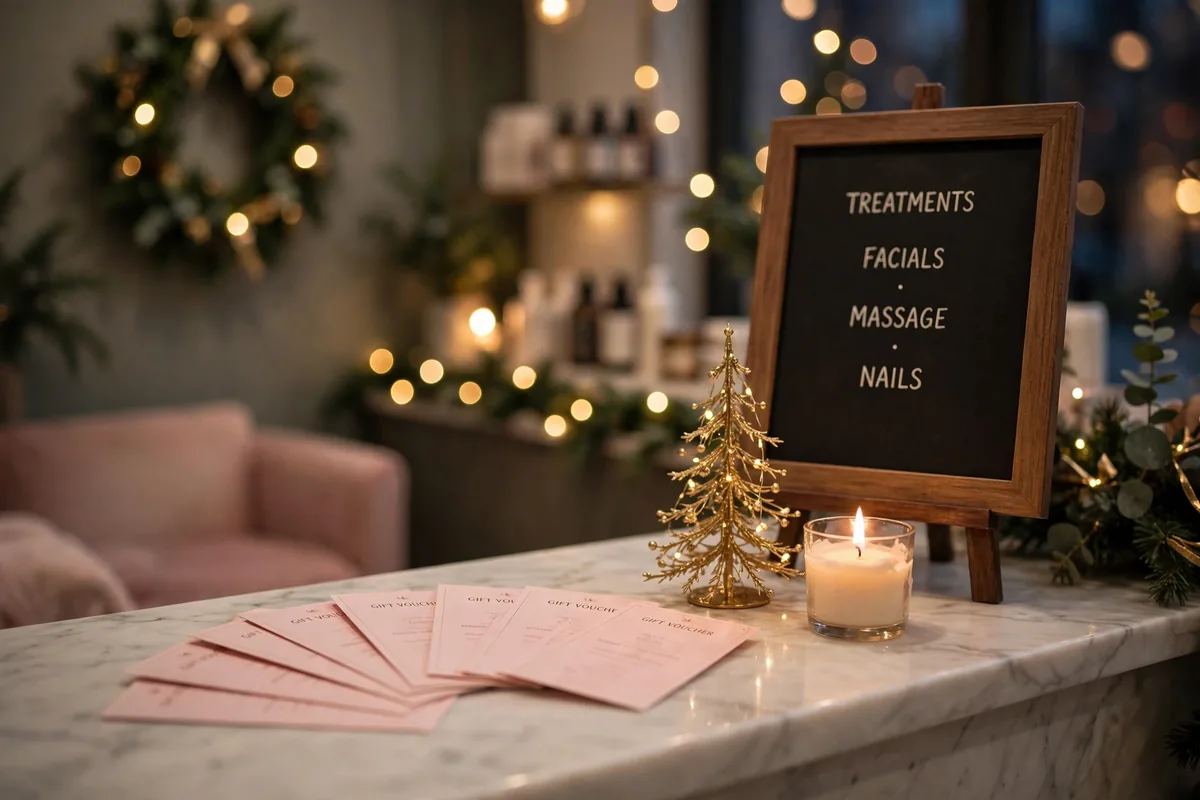
- Mother’s Day: gift vouchers and mum-and-me packages (sell from February)
- Summer: wedding and holiday prep, bridal trials, tanning, nails
- Black Friday: your one genuine sale of the year, planned and priced
- Christmas party season: book-ahead campaigns in October, not December
One seasonal campaign done well beats twelve random discounts.
Paid ads
If you are marketing a beauty salon with paid ads, here is the honest order of operations: profile first, content second, ads third. Running ads to a half-finished Google profile or a website with no prices is paying to send people somewhere that cannot convert them.
The only ad most salons need to start
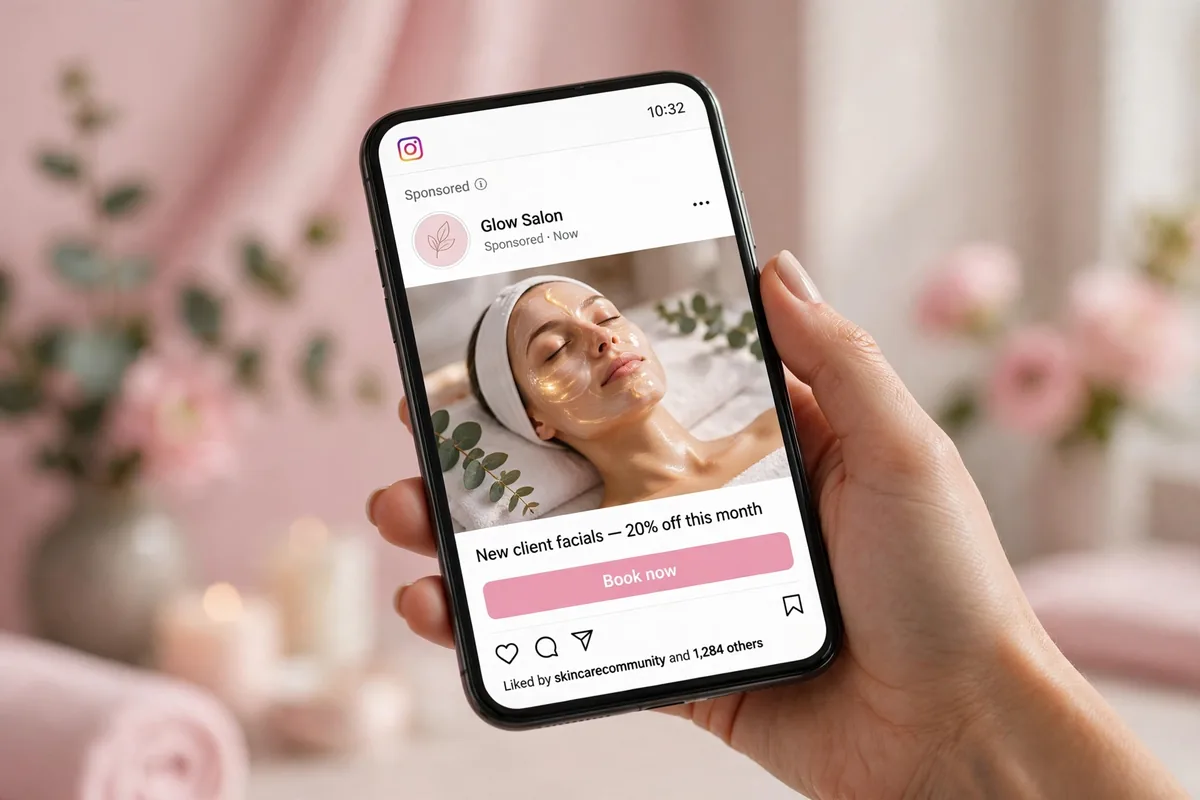
One Instagram/Facebook campaign, one clear offer, one booking link: “New clients: 20% off your first signature facial this month, book online.” Target a tight radius around your postcode (5 to 10 miles for most towns). Set a budget you can afford to lose while learning, £150 to £300 for a first month, a deadline, and a booking link you can track. If you cannot say what one booking cost you, you cannot say the ad worked.
A worked example (illustrative, not a client result)
Say you spend £200 on Instagram ads in a month. The ads send 400 clicks to your booking page at 50p a click. If 5% of visitors book, that is 20 bookings. At an average treatment value of £55, that is £1,100 of revenue against £200 of spend. In practice, the booking page, not the ad, is where the money usually leaks: if the page is slow or hides prices, that 5% can easily become 1%. Fix the page before you raise the budget.
Keep your offers ASA-safe
Under UK advertising rules, any discount claim must be genuine and provable, the ASA has banned brands for “was/now” prices they could not substantiate (Pinsent Masons summary of ASA rulings). Safe practice: genuine first-visit offers with clear dates, bundles instead of slashed prices, and never “up to 50% off” unless you can prove a meaningful number of treatments are actually discounted that much.
Your website: the booking machine behind it all
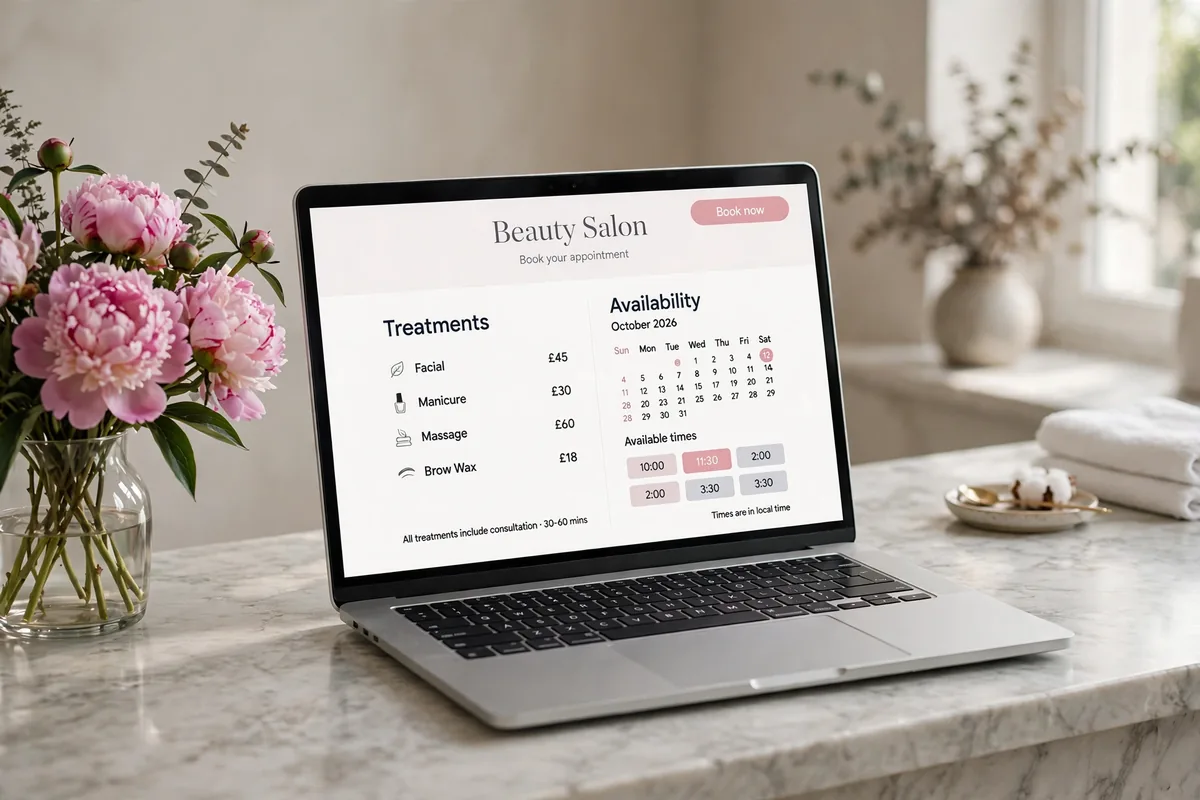
Everything above sends people somewhere. That somewhere is usually your website, and it has exactly one job: turn a visit into a booking in under a minute. Most salon websites fail this test. Check yours on your phone right now:
- Services, prices and location visible without scrolling
- A booking button above the fold that works on mobile
- Loads in under 3 seconds on 4G
- Real photos of your salon and work, not stock images
If your site fails two or more of these, every pound you spend on marketing works half as hard as it should. See what a website built to take bookings looks like, and if you take bookings through Fresha or Treatwell, make sure your Google profile’s booking button points there, because that is where most local clients will click.
The five numbers that tell you if it is working
Marketing without measurement is decoration. Once a month, spend 30 minutes with these five numbers:
- Google profile actions, calls, direction requests and bookings from your profile (free in your Business Profile dashboard).
- Website booking rate, bookings divided by visitors. Under 2% means the page is the problem, not the traffic.
- New vs returning clients, from your booking system. Healthy is a steady mix; all-new means retention is broken.
- Review count and rating, total reviews gained this month and your average rating.
- Rebooking rate, what percentage of clients book their next appointment before leaving.
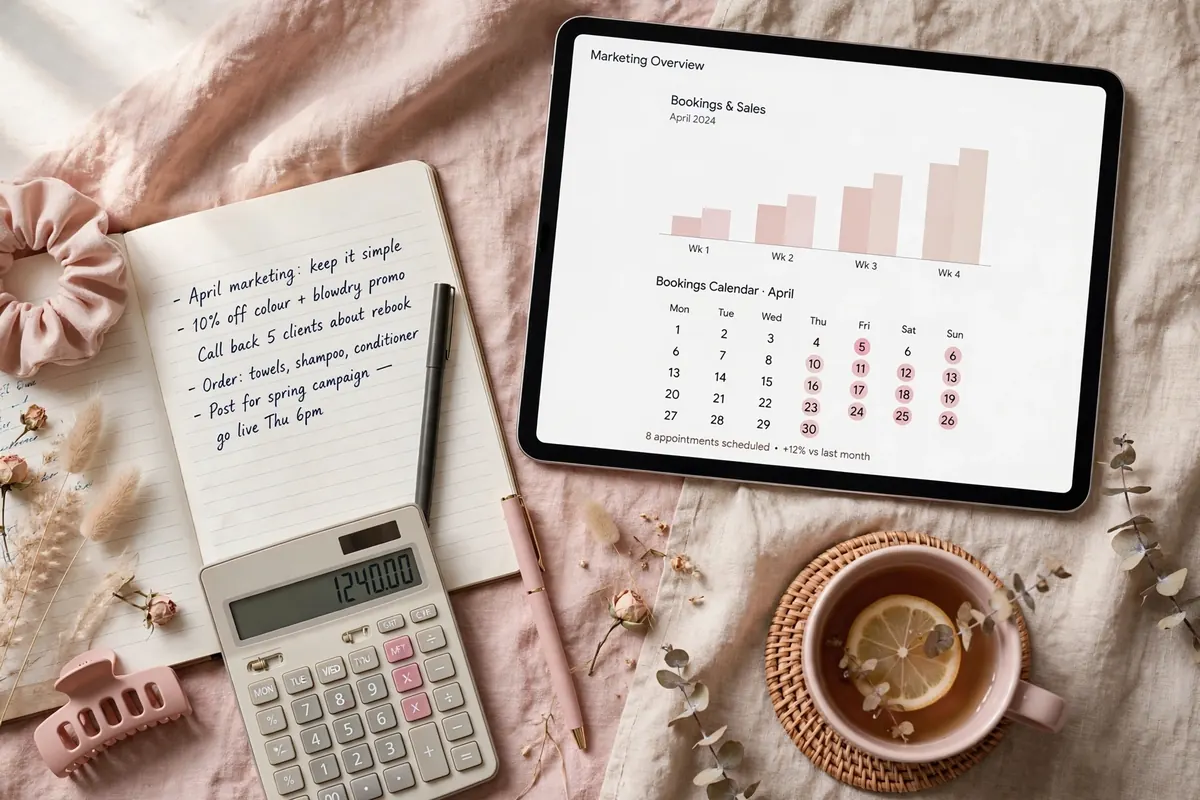
Write the five numbers down monthly. Trends beat snapshots, three months of data will tell you more than any agency report.
What will this cost? An honest breakdown
Marketing for beauty salon owners is mostly time, not money:
| Job | Cost | Time to set up | Ongoing time |
|---|---|---|---|
| Get found (Google profile) | Free | 45 min | 10 min/month |
| Get seen (social content) | Free | 2 to 3 hrs/week | |
| Get trusted (review engine) | Free | 30 min | 5 min/day |
| Get rebooked (email/SMS) | Free to £20/month for software | 2 hrs | 1 hr/month |
| Get recommended (referrals, partnerships) | Reward cost only | 2 hrs | 30 min/month |
| Paid ads | £150 to £300/month to start | 2 hrs | 1 hr/week |
| Website fixes | £0 to £2,000 one-off | Varies |
Do the free jobs first, in the decision-table order. Spend only on what you can measure, and never spend what you cannot afford to lose while learning.
Five mistakes that cost beauty salons bookings
- Discounting so often that nobody pays full price. If there is always a sale on, clients learn to wait. Discount with a reason and a deadline, or bundle instead of slashing.
- “Up to 50% off” claims you cannot prove. The ASA requires documentary evidence for price claims. One complaint can mean your ad gets banned and your name published in a ruling.
- Buying a marketing list and texting it. Bought lists almost never carry the specific consent PECR requires for texts and emails. Build your own list from real clients.
- Boosting Instagram posts with no tracking. If you cannot say what one booking cost you, you cannot say the ad worked. Budget, deadline, booking link, or do not run it.
- Marketing with no prices anywhere. No prices on Google, none on Instagram, none on the website. Clients will not call to ask, they book the salon that shows prices.
Frequently asked questions
What is the most effective marketing for a beauty salon in the UK?
The combination of a complete Google Business Profile with prices and reviews, Instagram content showing real work with prices, and retention habits like rebooking at the chair and win-back messages. Paid ads help once these foundations exist, advertising a half-finished profile wastes money.
How much should a beauty salon spend on marketing each month?
Start with the free jobs in this guide, most cost nothing but time. When you spend, budget £150 to £300 for a first month of tracked Instagram ads with a booking link, and spend only what you can afford to lose while learning. Never commit to a big retainer before the free foundations work.
How can I market my beauty salon for free?
Complete your Google Business Profile, post real work with prices on Instagram three times a week, ask every happy client for a Google review within 24 hours, rebook at the chair, and message lapsed clients. These five cost nothing and beat most paid campaigns for a growing salon.
Does a beauty salon need a website in 2026?
Yes, but it needs to do one job: turn searches into bookings. Services, prices, location and a working booking button above the fold on mobile, loading fast. If your site does not do that, it is costing you clients every week, whatever you spend on marketing.
How long does beauty salon marketing take to work?
Google profile fixes and rebooking scripts can fill gaps within weeks. Reviews and local rankings typically take two to three months of steady work. Social content compounds over months, not days. Anyone promising a full diary in a fortnight is selling something, this guide is the honest version.
The bottom line
Beauty salon marketing is not complicated: be easy to find on Google, show real work with real prices on Instagram, earn reviews systematically, rebook before clients leave, and measure five numbers monthly. Do those jobs consistently and the quiet gaps start filling. Prefer to hand it to specialists? Salon Socials is a salon marketing agency in the UK working only with beauty businesses.
If you want help doing it properly, Google presence, content and reviews handled for you, book a free 30-minute strategy call, or get in touch if you prefer email.
Book My Free Strategy Call Free, 30 minutes, no obligation. We reply within one working day.
Last updated: October 2026
Last updated: October 2026