Salon marketing has one job: keeping your chairs full of paying clients, whether you run a hair salon, a barbershop, a nail studio or a beauty salon. If you are searching for salon marketing, you want the complete picture: what actually works in the UK, what it costs, and where to start. This guide gives you all of it, built around the 4 Ps of marketing for a salon, product, price, place and promotion, the classic framework, rebuilt for UK salons in 2026. Expect channel-by-channel tactics, a 90-day plan, copy-paste templates, honest costs and UK legal guardrails.
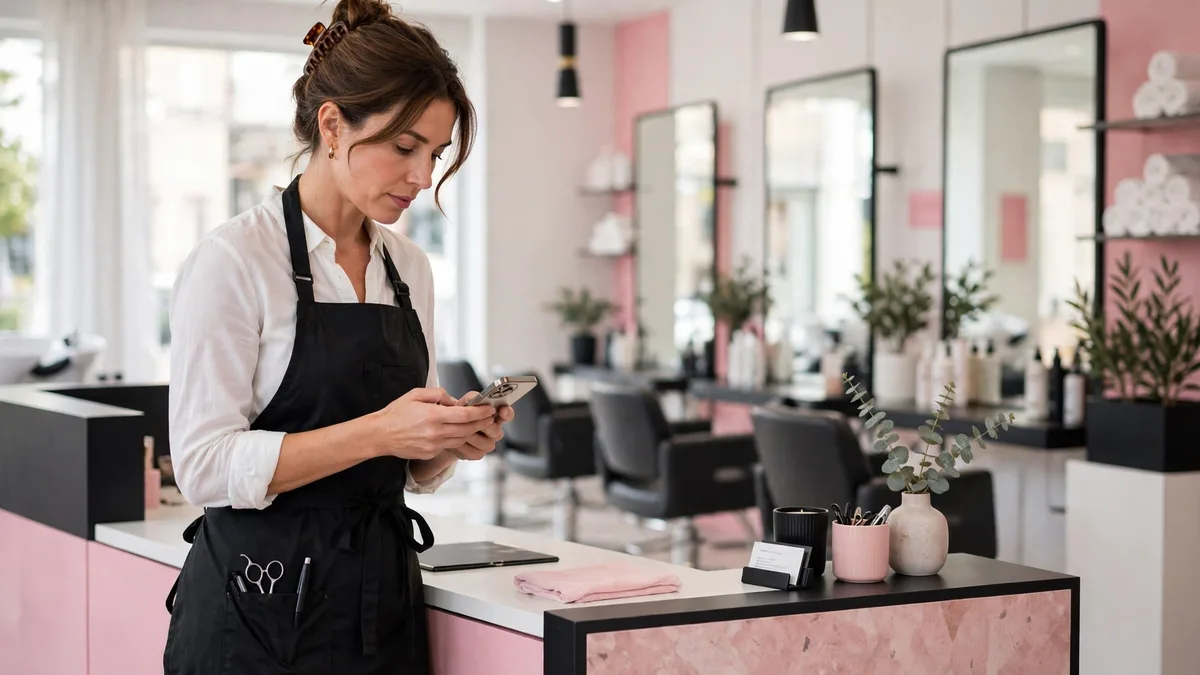
Key takeaways, the 4 Ps at a glance
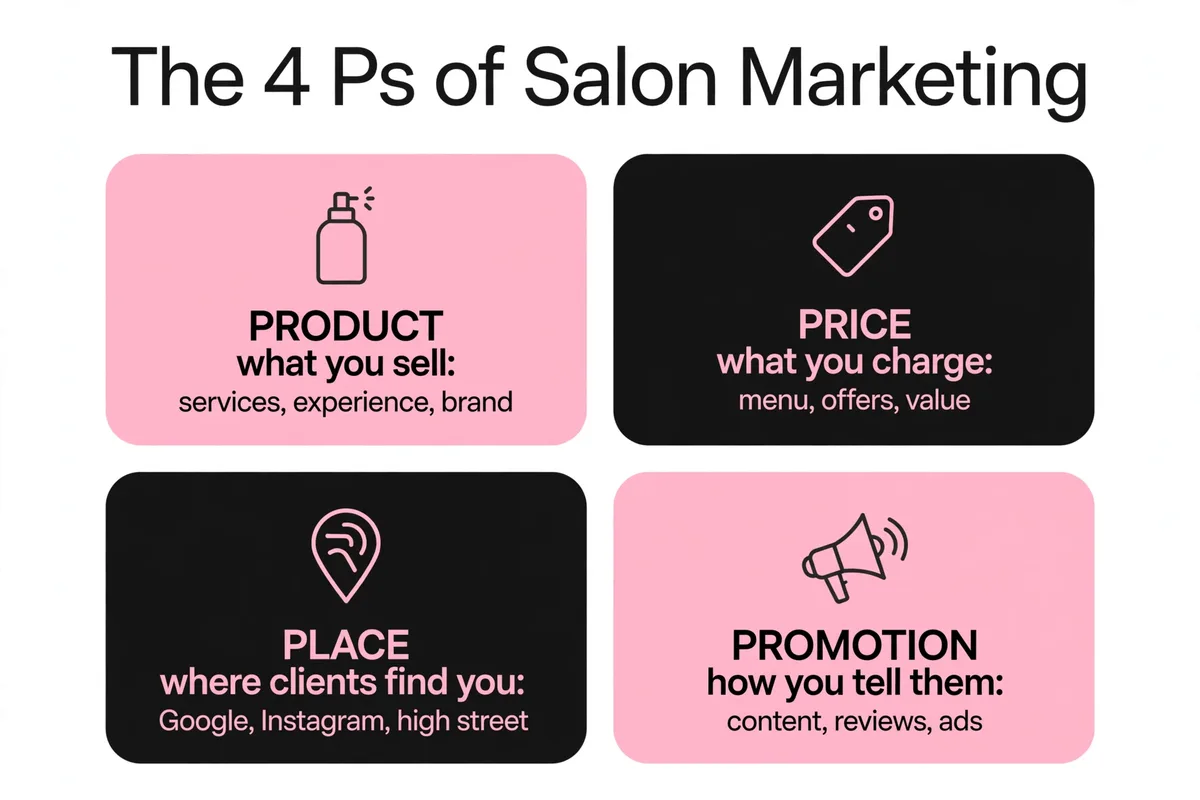
- Product: your services, experience and brand. Get the offer right before promoting it.
- Price: a clear menu in pounds, honest bundles, ASA-safe offers. Hidden prices cost you bookings.
- Place: be where clients already look, Google, Instagram and your high street.
- Promotion: content first, then reviews, then email and SMS, then one tracked ad, in that order.
- The plan: 90 days, foundations, visibility, growth, kept alive with twenty minutes a day.
Want a second pair of eyes on your marketing before you start? Book a free 30-minute strategy call, we will tell you which of the 4 Ps to fix first.
What is salon marketing?
Salon marketing is everything you do to attract new clients and keep existing ones coming back: your Google profile, your Instagram, your reviews, your prices, your emails, your shopfront. It is not one thing. It is the whole system that turns a stranger searching “balayage near me” into a client who rebooks every six weeks for years.
Marketing for salon owners is different from marketing most businesses in three ways. It is local, almost nobody travels more than 20 minutes for a haircut. It is visual, clients buy what they can see. And it is repeat, a colour client should visit six to eight times a year, so keeping clients matters as much as finding them.
This guide is for UK owners and managers of hair salons, barbershops, nail studios and beauty salons.
The 4 Ps of marketing for a salon
The 4 Ps, product, price, place, promotion, is the oldest framework in marketing, and it fits salons perfectly: most salon marketing fails on the first two Ps, not the last one. Owners spend months on Instagram while their price menu confuses people and their offer matches every salon on the street. Fix the Ps in order and promotion gets dramatically easier.
P1, Product: what you actually sell
You do not sell haircuts. You sell the result, the experience and the feeling of walking out confident. Two salons can offer the same balayage; the one with the clearer promise, “lived-in colour specialists”, wins. Three moves sharpen your product:
- Name three hero services. The treatments you are best at and that pay best. Everything in your marketing should point at these three first.
- Make the experience part of the product. Clients remember how the appointment felt, not just how it looked.
- Make your brand match your prices. If your logo and shopfront look budget, clients will not believe premium prices. See what brand design for salons involves before you brief a designer.
P2, Price: what you charge (and show)
Price is where UK salons quietly lose bookings, not by being too expensive, but by hiding prices. A client choosing between two salons will not ring to ask; they book the one showing “Balayage from £110”.
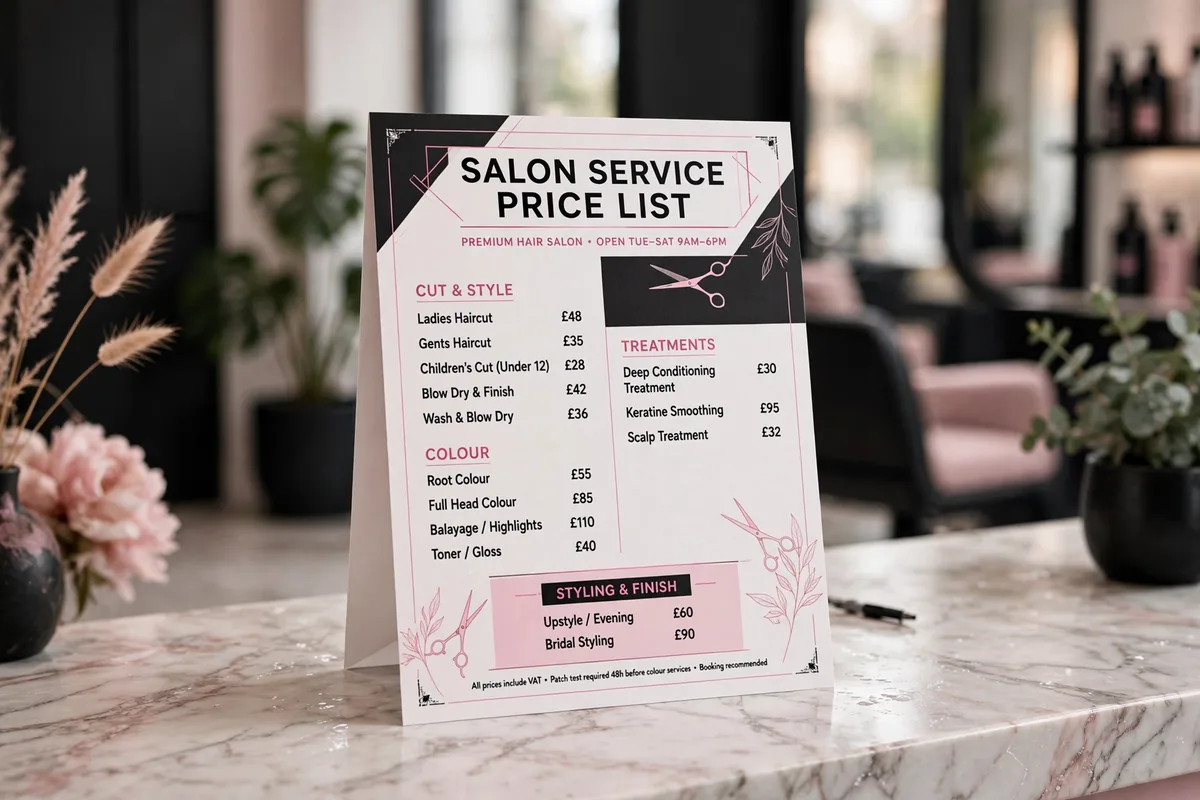
Rules that work:
- Show every price, everywhere, Google, Instagram highlights, website, reception. “From £X” is fine; silence is not.
- Bundle, don’t slash. “Cut, colour and treatment, £95 package” protects value; permanent 20%-off trains clients to wait.
- Price hero services with confidence. Your best work should be your most profitable, not your cheapest.
- Keep offers ASA-safe. Discount claims must be genuine and provable, the ASA has banned brands for “was/now” prices they could not substantiate (Pinsent Masons summary of ASA rulings).
Worked example, pricing a hero service (illustrative, not a client result): say your signature balayage takes 3 hours. Colour costs roughly £18, the stylist’s time roughly £45, £63 in direct cost. At £110 the appointment contributes £47 toward rent, bills and profit. At £85 “to stay competitive”, it contributes £22 and you need twice the bookings for the same return. Run your own numbers, most salons price on instinct.
P3, Place: where clients find you
For a salon, “place” is every place a client encounters you: Google, Instagram, TikTok, Treatwell, Fresha and your high street. Be findable and bookable in all of them, in this priority order.
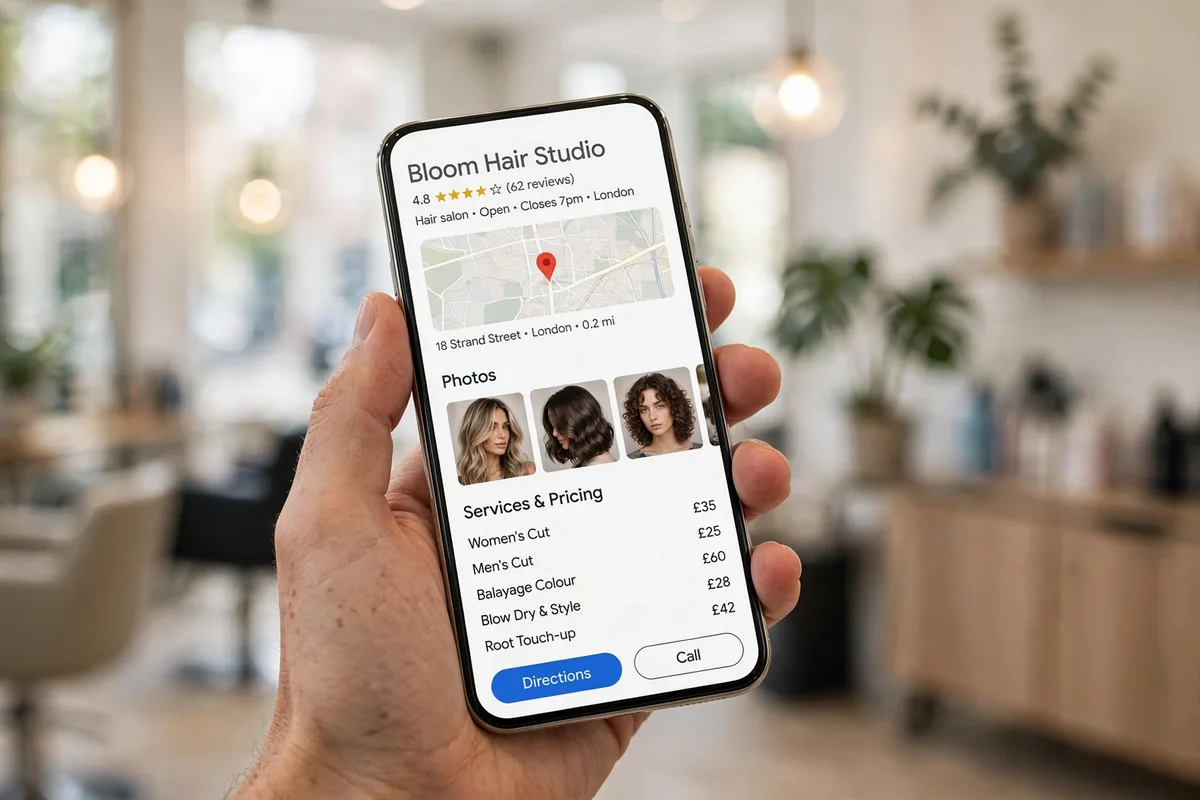
- Google first. When someone searches “hair salon near me”, your Google Business Profile is the result, the advert and the booking page in one. Google’s official help covers setup; our guide to local SEO for salons covers the full walkthrough.
- Instagram and TikTok second, they create desire; Google captures it.
- Your shopfront third, your window is free advertising to every passer-by.
If keeping your Google presence current feels like a second job, our local SEO for salons keeps it handled for you.
P4, Promotion: how you tell them
Promotion is the P everyone starts with and should finish with. The honest order: content (real work, real prices), then reviews (a system, not luck), then email and SMS to existing clients, then one tracked ad, only once the first three exist. Follow this order and marketing your salon stops feeling like guesswork.
Putting the 4 Ps to work: your channel playbook
The framework is the thinking; this is the doing, each channel mapped to its P.
Google: be the salon Google shows first (Place)
Your Google Business Profile decides who gets the call when someone searches “nails in [your town]”. The 45-minute setup: claim and verify; pick the most specific category (“Hair salon”, not just “Salon”); list every service with a price; add 10+ real photos; write your description like a client reads it, services, town, prices, booking.
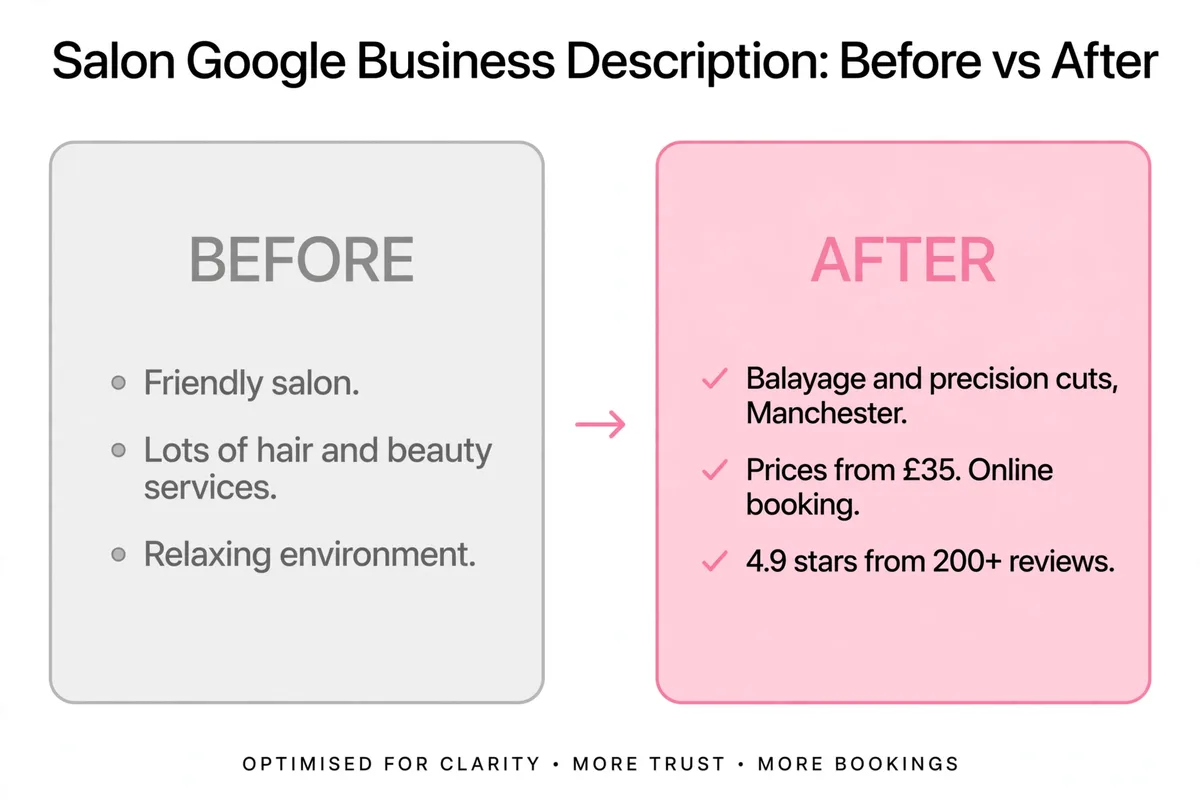
Weak: “We are a friendly salon offering a wide range of hair and beauty services in a relaxing environment.”
Better: “Balayage, lived-in colour and precision cuts in Manchester. Prices from £35, online booking, 4.9 stars from 200+ reviews.”
Then turn on messaging, add your booking link as the primary button, and reply to every review within 48 hours.
Instagram and TikTok: show the work, sell the booking (Promotion)
Social does not book appointments; it creates the “I want that” feeling. Every post should answer three questions: what is it, what does it cost, how do I book. That means real work with real prices (“Balayage, £110, 3 hours, two slots left this week, link in bio”), 30-second Reels answering client questions, and a bio that books.
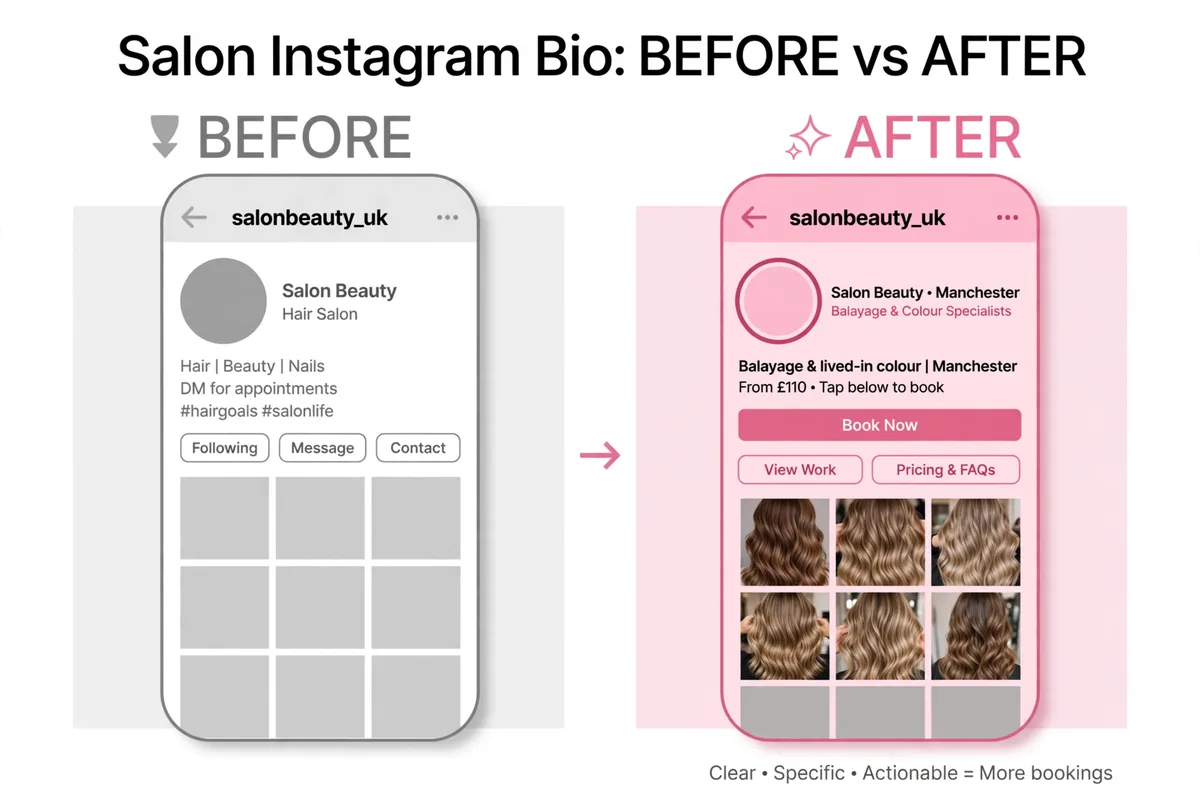
If creating this content every week feels like a second job, our social media management for salons exists for exactly that.
Reviews: build the engine (Promotion)
A salon with 80 recent reviews beats one with 12 old ones. Reviews are free advertising that works while you sleep, but only as a system. Copy, paste and send this within 24 hours of every appointment:
Hi [name], thanks for coming in today! If you loved your [service], would you leave us a quick Google review? It takes 30 seconds and it really helps our salon: [your review link]
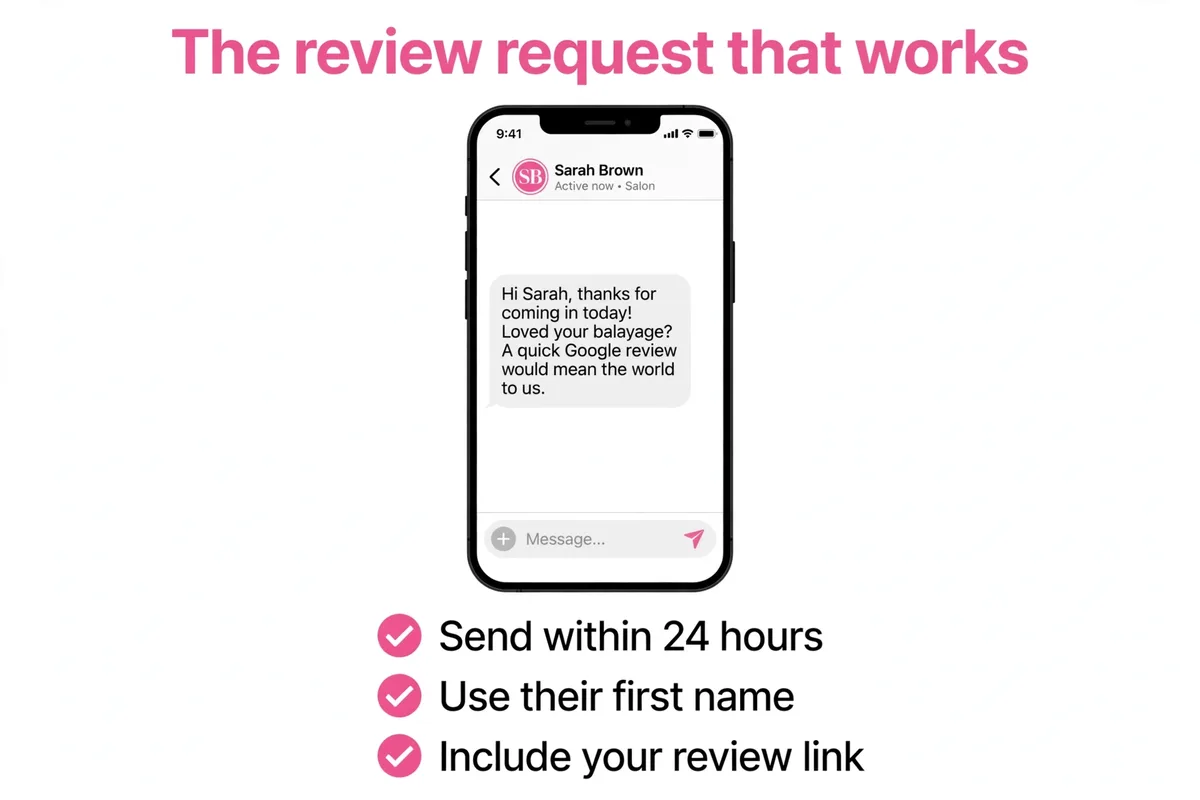
Say it at checkout too. Aim for two to three new reviews a week, steady beats a sudden burst. Never offer incentives for Google reviews; it breaches Google’s policy.
Email and SMS: market to people who already trust you (Promotion)
The cheapest booking you will ever take is from an existing client. Two systems cover it: rebook at the chair (“Your colour will need refreshing in about 6 weeks, shall I book you in?”), and win back lapsed clients:
Hi [name], it’s [your name] from [salon]. We haven’t seen you in a while and we’d love to have you back. Here’s £10 off any service booked before [date]: [booking link]. Reply STOP to opt out.
Legal note: under PECR you need consent (or the “soft opt-in” for existing customers) before marketing texts or emails, and every message must offer an opt-out. Bought lists almost never carry that consent, build your list from real clients. The ICO’s direct marketing guidance explains it plainly. This is general information, not legal advice.
Your website: the booking machine (Place)
Every channel above sends people somewhere, usually your website, whose one job is turning a visit into a booking in under a minute. Check yours on your phone: services, prices and location without scrolling; a booking button above the fold; fast on 4G; real photos. Fail two and every pound of marketing works half as hard. See what a website built to take bookings looks like.
Paid ads: last, not first (Promotion)
One Instagram/Facebook campaign, one clear offer, one booking link: “New clients: 20% off your first cut and finish this month, book online.” Tight radius around your postcode, a budget you can afford to lose while learning (£150 to £300 for a first month), a deadline, a trackable booking link. If you cannot say what one booking cost, you cannot say the ad worked.
Offline: the high street still counts (Place)
Leaflets within a 10-minute walk, a sandwich board with today’s gap (“Cut and blow-dry, 2pm today, £35”), partnerships with neighbouring businesses. Unfashionable, cheap, and it works because competitors stopped doing it.
Marketing a salon by type: hair, barber, beauty and nails
“Salon” covers very different businesses. The 4 Ps are the same; the emphasis shifts:
| Salon type | Lead with (Product) | Price signal | Where clients look (Place) |
|---|---|---|---|
| Hair salon | Specialism, colour, curls, extensions | Show “from £” per service; bundles for cut + colour | Google + Instagram equally |
| Barbershop | Craft and atmosphere, the experience is the product | Simple, visible board; walk-in price clear | Google + high street footfall |
| Nail studio | Design portfolio, your Instagram is your menu | Set prices per set; charge for art time | Instagram first, Google second |
| Beauty salon | Trust and results, treatments need explaining | Packages and courses; consultation-led pricing | Google first, Instagram second |
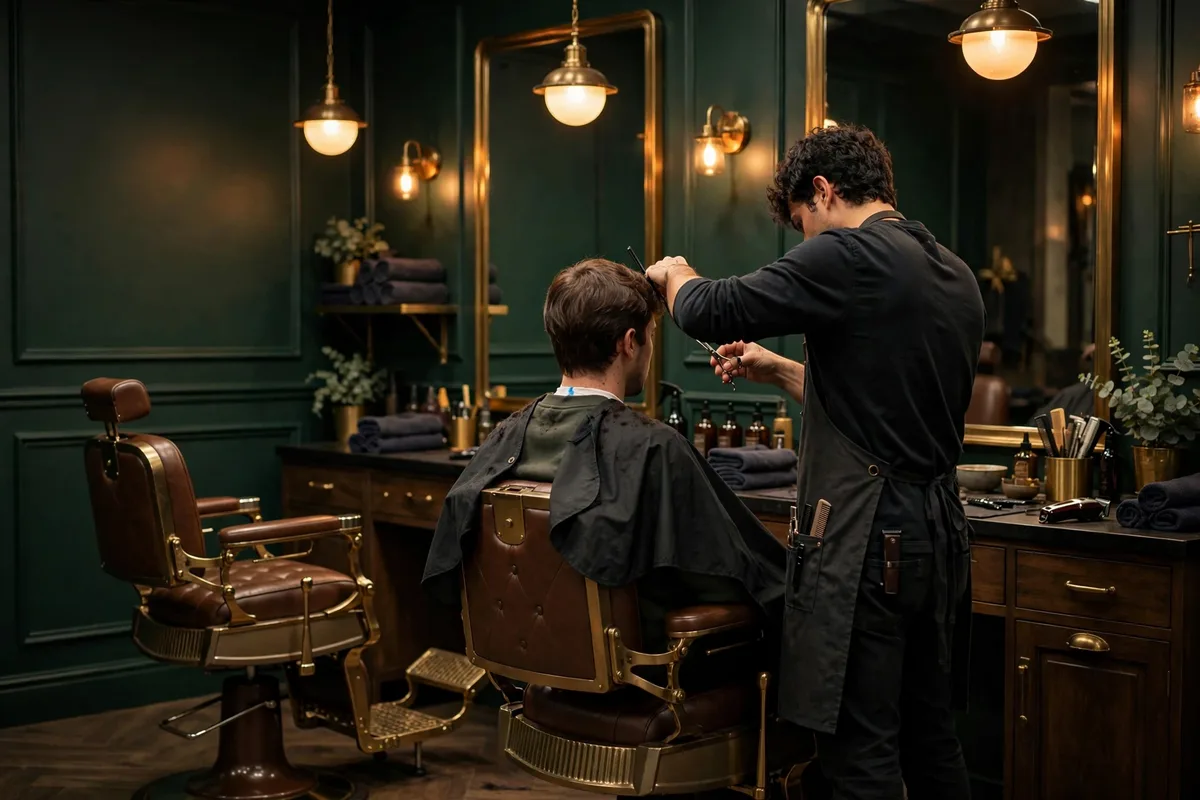
Same framework, different sharp end: a barber needs opening hours and a price board everywhere; a colourist needs a priced portfolio.
Salon marketing in London: what changes
Marketing for a salon in London follows the same 4 Ps, but the dials turn up. Competition is denser: a client searching “balayage London” sees dozens of options, so your Google profile and reviews carry more weight than anywhere else. Clients search by neighbourhood, “balayage Shoreditch”, “nails Soho”, so your profile, website and Instagram should name your area explicitly.
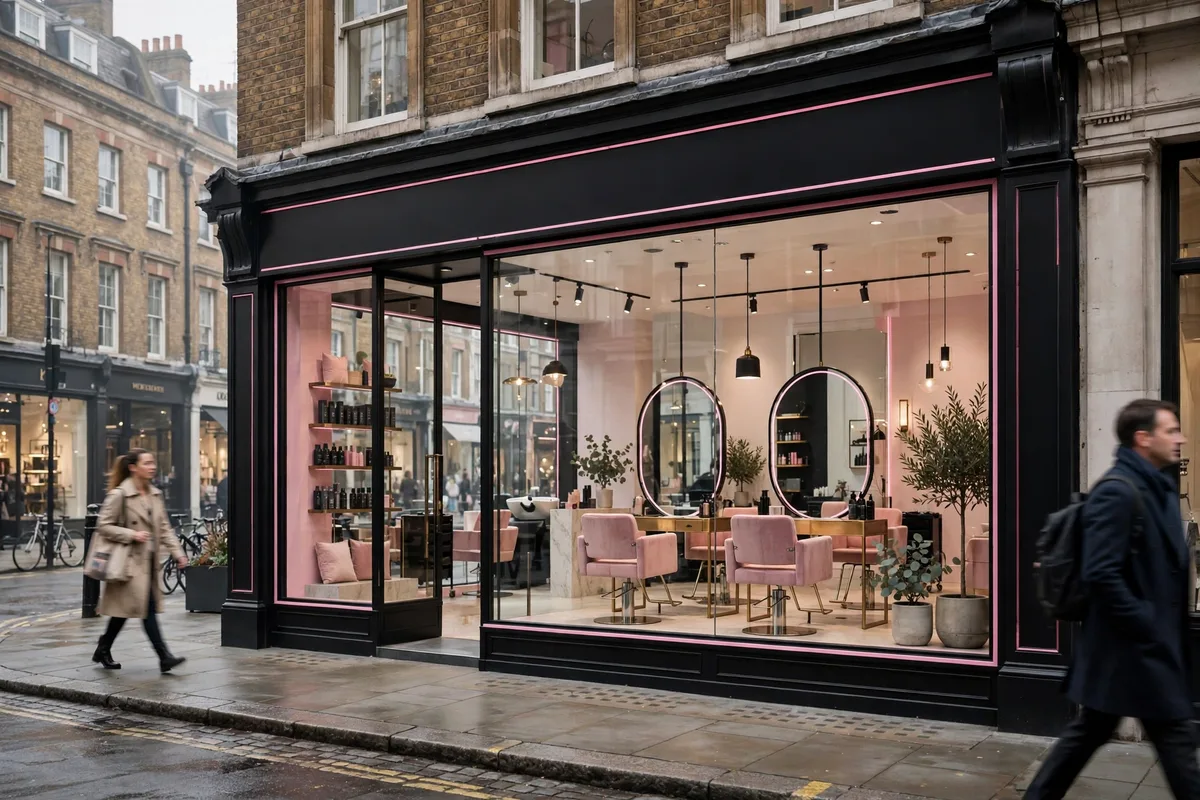
- Own your neighbourhood keywords. Your area in your Google description, website titles and Instagram bio, not just “London”.
- Expect paid ads to cost more. More salons bidding means higher costs per click.
- Split your audience. Commuters book near stations at lunchtime; locals book weekends.
Your 90-day salon marketing plan
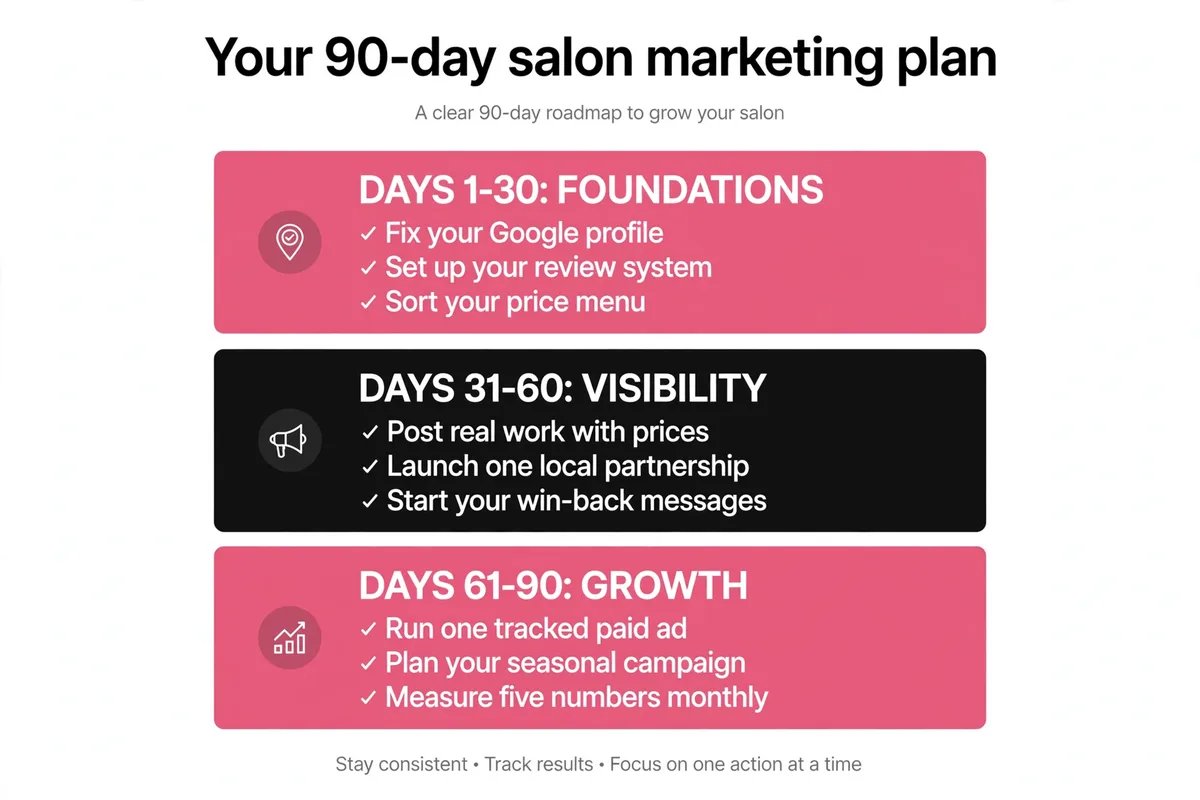
- Days 1 to 30: Foundations. Fix your Google Business Profile. Start the review engine. Publish your price menu everywhere.
- Days 31 to 60: Visibility. Post real work with prices three times a week. Launch one local partnership. Start win-back messages to lapsed clients.
- Days 61 to 90: Growth. Run one tracked ad campaign. Plan one seasonal campaign. Measure five numbers monthly.
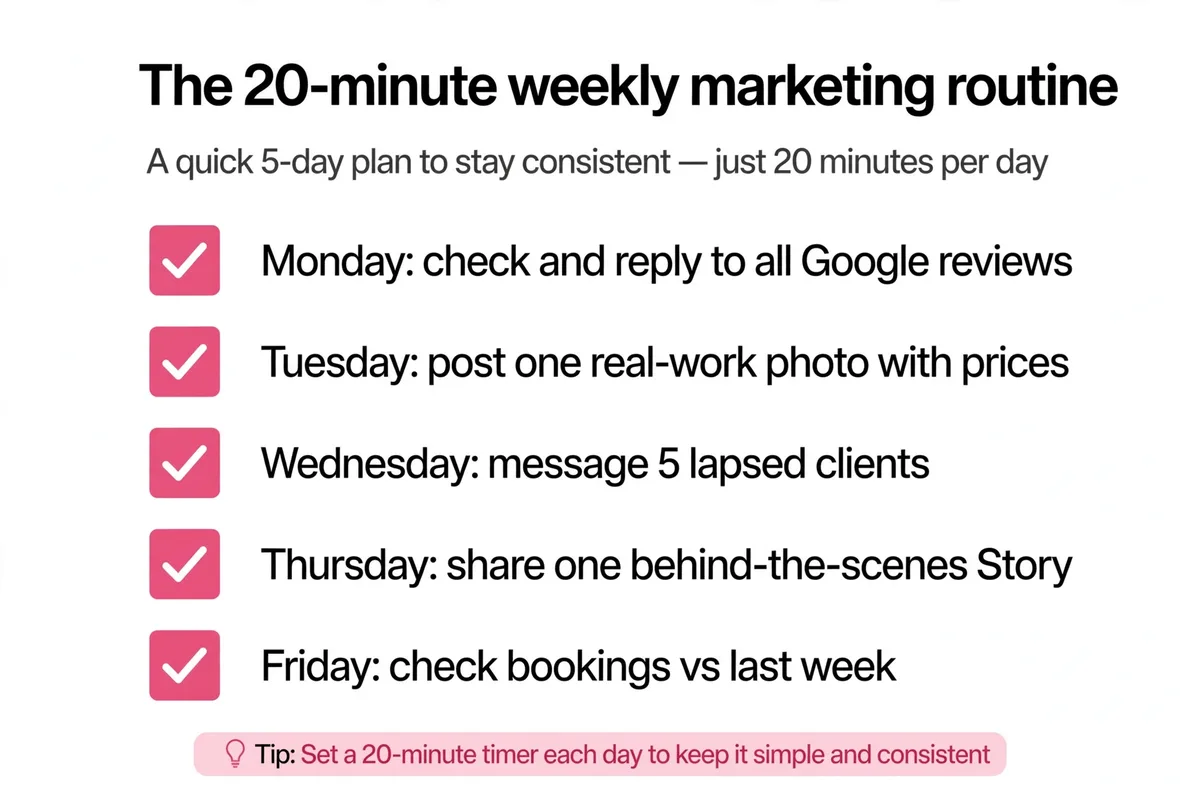
- Monday: check and reply to all Google reviews.
- Tuesday: post one real-work photo with prices.
- Wednesday: message five lapsed clients.
- Thursday: share one behind-the-scenes Story.
- Friday: check bookings vs last week.
Get your 90-day plan mapped for you
The plan works, but faster when built around your salon, prices and diary. Book a free 30-minute strategy call and we will map your next 90 days together.
Free, 30 minutes, no obligation. We reply within one working day.
What marketing for a salon business costs
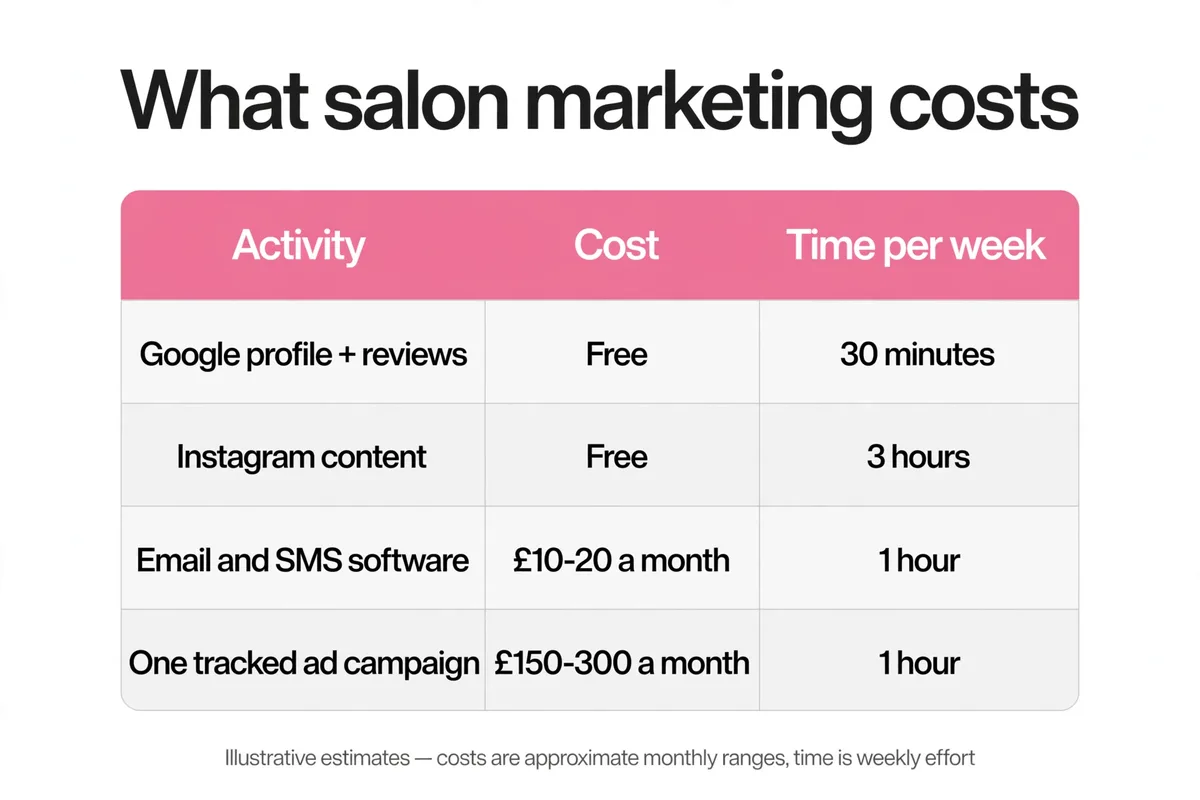
| Activity | Cost | Time per week |
|---|---|---|
| Google profile + reviews | Free | 30 minutes |
| Instagram content | Free | 3 hours |
| Email and SMS software | £10 to £20/month | 1 hour |
| One tracked ad campaign | £150 to £300/month | 1 hour |
Do the free rows first and properly, they beat a £300 ad budget pointed at a half-finished profile.
Five mistakes that cost salons bookings
- Promoting before product and price are right. Ads pointing at a salon with no prices and four reviews fail because of the offer, not the ad.
- Hiding prices everywhere. Clients will not ring to ask, they book the salon that shows prices.
- Discount claims you cannot prove. “Up to 50% off” without evidence breaches ASA rules, one complaint can get the ad banned.
- Texting a bought list. Bought lists almost never carry PECR consent. Build your own list from real clients.
- Boosting posts with no tracking. If you cannot say what one booking cost you, you cannot say the ad worked.
Frequently asked questions
What is salon marketing?
Salon marketing is everything a hair, beauty, barber or nail business does to attract clients and keep them returning: Google presence, social media, reviews, pricing, emails and the shopfront. It is local, visual and repeat-driven, most clients should visit six to eight times a year, so retention matters as much as acquisition.
What are the 4 Ps of marketing for a salon?
Product (your services, experience and brand), Price (a clear menu in pounds with honest offers), Place (where clients find you: Google, Instagram, your high street) and Promotion (content, reviews, email/SMS, then ads). Most salon marketing fails on product and price, fix those before spending on promotion.
How much should I spend on marketing my salon?
Start with the free work: Google profile, reviews, Instagram content and rebooking cost nothing but time. When you spend, budget £150 to £300 for a first tracked ad campaign and £10 to £20 a month for email/SMS software. Never spend what you cannot afford to lose while learning.
What is the best marketing for a hair salon in the UK?
A complete Google Business Profile with prices and reviews, Instagram content showing real work with prices, a review system that asks every happy client, and rebooking at the chair. Paid ads help once these foundations exist, advertising a half-finished profile wastes money.
How do I market my salon in London?
Own your neighbourhood keywords (“balayage Shoreditch”) across your Google profile, website and Instagram bio. Treat reviews as your main differentiator in dense competition, and build the free foundations before paid ads, London clicks cost more, so every free booking matters more.
The bottom line
Salon marketing is sequential: sharpen the product, show the price, be findable, then promote. Work the 90-day plan, keep the 20-minute routine running, and the quiet gaps start filling. If you would rather have it done for you, Salon Socials is a salon marketing agency in the UK that fills salon diaries every day.
If you want help doing it properly, Google presence, content and reviews handled for you, book a free 30-minute strategy call.
Book My Free Strategy Call Free, 30 minutes, no obligation. We reply within one working day.
Last updated: October 2026
Last updated: October 2026