
Most salon owners don’t need more salon marketing strategies. They need one marketing plan they can actually follow. If your marketing right now is random Instagram posts, the odd discount and a Google profile you haven’t touched in months, this guide is for you. It gives you a complete salon marketing plan: how to set a goal you can measure, the five channels worth your time, what each one costs, and a copy-paste monthly calendar template you can start using today. Written for hair and beauty salon owners in the UK, UK rules, £ prices, no jargon, no inflated promises.
TL;DR, the plan on one page
- A salon marketing plan is one measurable goal + five channels + a monthly calendar. One page is enough.
- The five strategies that matter for UK salons, in order: local search, Instagram, reviews, email/SMS, paid ads.
- Most of it costs nothing but 2 to 3 hours a week. Spend money only on what you can measure.
- Copy the monthly plan template below, fill in your numbers, and start with this week’s tasks.
Want a second pair of eyes on your plan before you start? Book a free 30-minute strategy call, we’ll build your marketing plan with you on the call, free.
What a salon marketing plan actually is (and what it isn’t)
A salon marketing plan is a written answer to three questions: how many bookings you need, where will they come from, and what happens each week to make that happen. That’s it. One page is enough for most salons, and one page you actually use beats a 40-page document that lives in a drawer.
What it isn’t:
- A list of tactics with no goal. “Post more on TikTok” is not a plan. “Find 12 extra bookings a week from Google and win-backs” is.
- Something you write once. A marketing plan for a salon is a monthly rhythm, set it, run it for 30 days, review what delivered bookings, adjust.
- One-size-fits-all. A marketing plan for a salon with two chairs looks different from one for a ten-chair salon, but the structure is identical: goal, channels, calendar, review.
Step 1: Set one goal and know your numbers
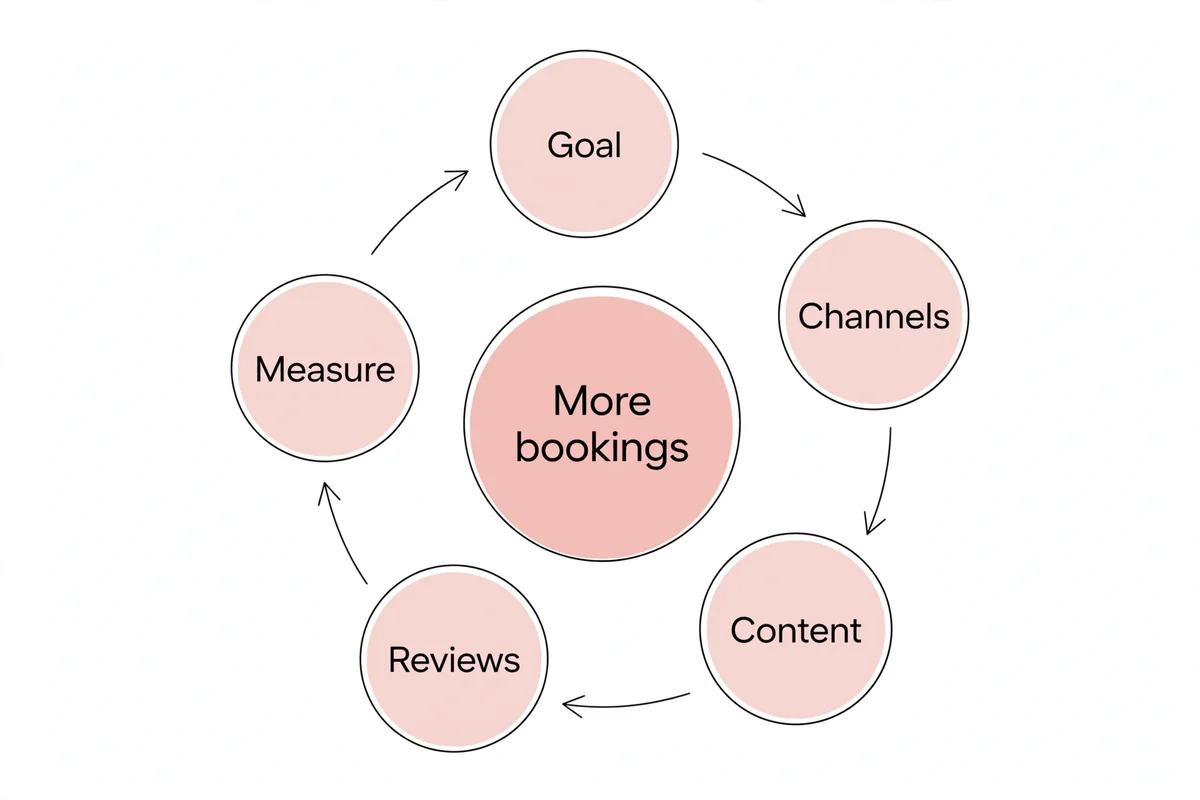
Every strategy below works, but only if you know what “working” means for your salon. Vague goals (“get more clients”) produce vague marketing. One number fixes that.
Do this in 10 minutes, using your booking software:
- How many appointments do you do in an average month now? Write the number down.
- How many more do you need to hit your target? That’s your gap, in appointments, not pounds.
- What’s your average appointment value? Multiply the gap by that value. That’s the revenue your plan is chasing.
Example (illustrative, not a real salon or a result we’ve achieved): Priya runs a 4-chair hair salon in Leeds. Her booking software shows 200 appointments a month at an average of £55, roughly £11,000 a month. She wants £14,000, so her gap is about 55 extra appointments a month, or 13 to 14 a week. Now the plan has a job: find 14 extra bookings a week. She splits it across channels: 5 from Google and reviews, 5 from win-back messages to lapsed clients, 4 from Instagram. If a channel isn’t delivering its share after a month, she changes the channel, not the goal.
Write your goal at the top of your plan in plain words: “55 extra appointments a month by March.”
Step 2: Pick your channels, the 5 salon marketing strategies that matter
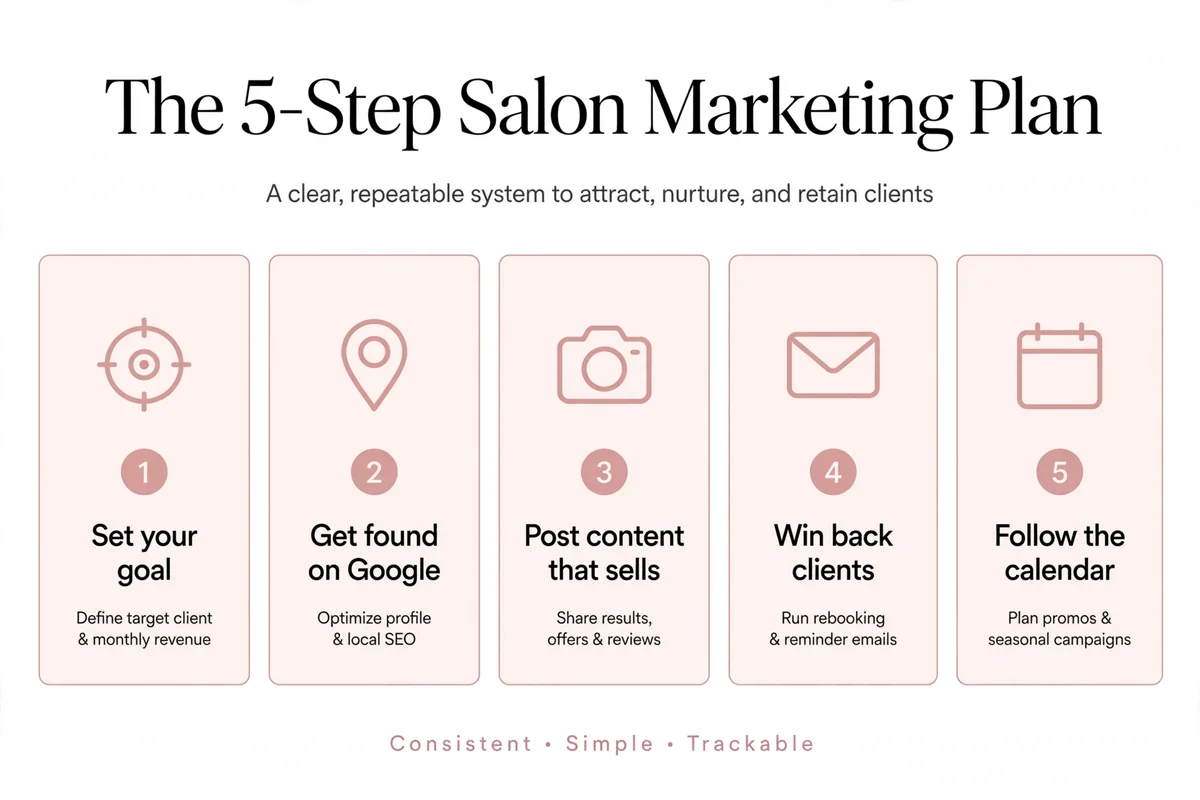
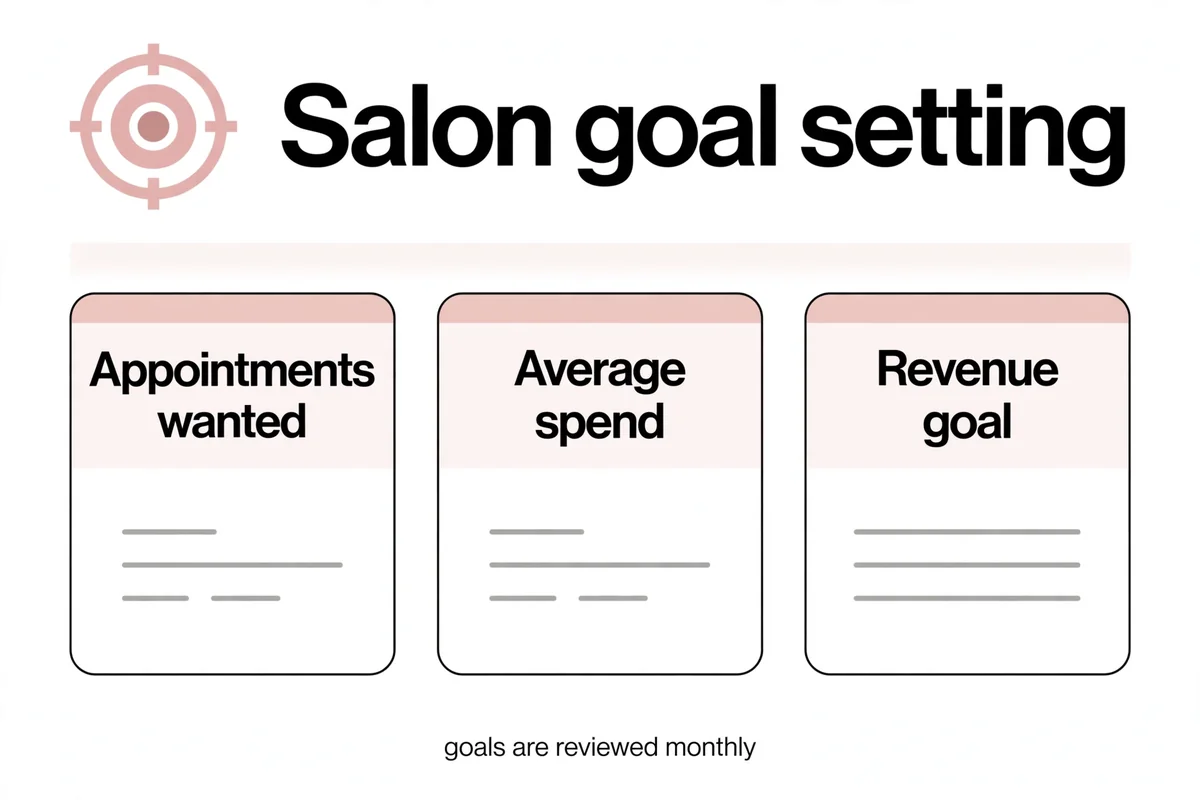
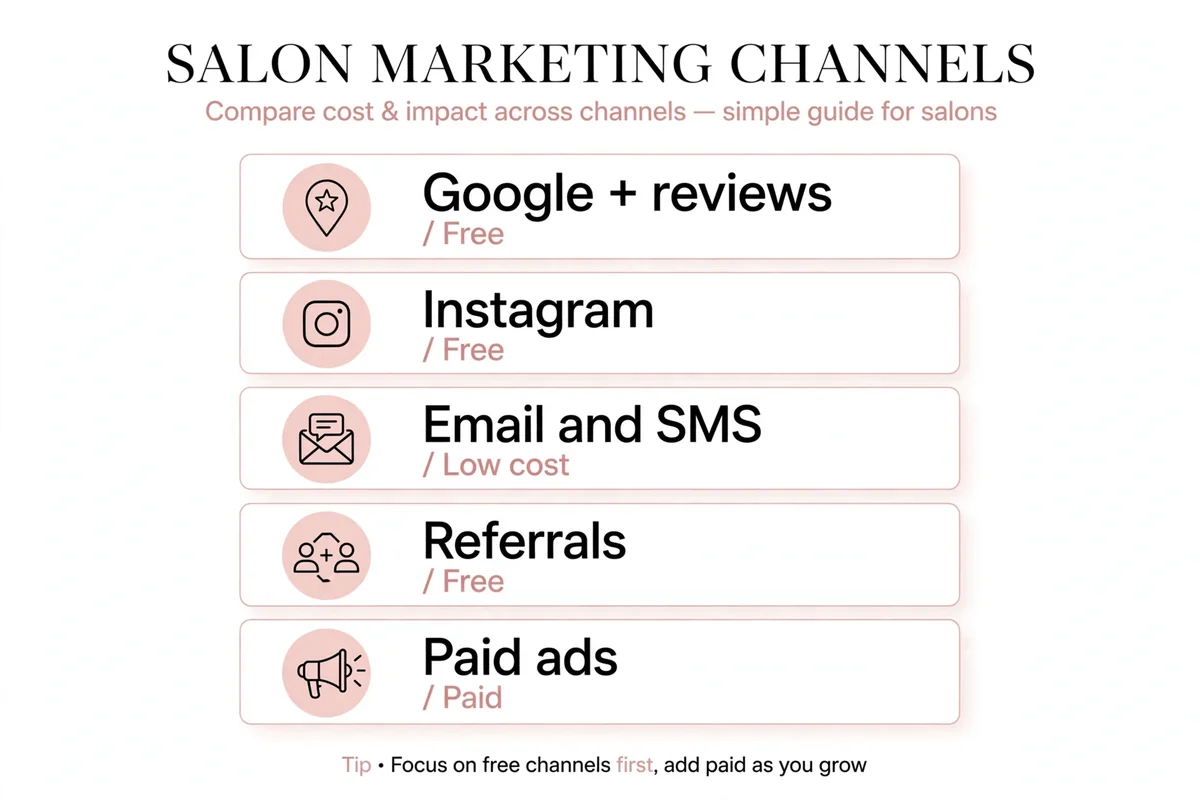
A marketing strategy for salon services isn’t a list of fifty tactics. It’s five channels, done in the right order. Most salons should start with the first three and add the rest only when the foundations are working.
1. Local search: be the salon Google shows first
When someone searches “balayage Leeds” or “nails near me”, your Google Business Profile decides whether you get the call, before your website, before your Instagram. Claim and verify it via Google’s official Business Profile help page, pick the most specific category (“Hair salon”, not “Salon”), list services with prices, add 10+ real photos, and reply to every review within 48 hours. About 45 minutes to fix properly, then 10 minutes a week. Free. For the full walkthrough, see our local SEO guide for salons, or get it handled with our local SEO for salons service.
2. Instagram that sells, not just looks pretty
Before-and-afters are still the highest-converting content a salon can post, but only when the caption answers the three questions every viewer has: what did it cost, how long did it take, and how do I book. Add 30-second Reels answering questions clients already ask you, and use Stories daily to sell same-day gaps. Two to three hours a week. Free. If content is eating your evenings, that’s exactly what social media management for salons takes off your plate.
3. A review system, not review luck
Reviews feed your Google rankings and your clients’ trust at the same time. The system is simple: ask in person at checkout, then text a review link within 24 hours. Respond to every review, good or bad. Aim for 2 to 3 new reviews a week, steady and believable beats a sudden flood. Thirty minutes to set up, five minutes a day. Free, or systematised properly with reputation management for salons.
4. Email and SMS to people who already know you
Your cheapest bookings come from your existing client list: lapsed-client win-backs, birthday messages, last-minute gap alerts, one useful email a month. You need consent before sending marketing texts or emails (see the legal section below), so start collecting it at every booking from today. Free to £25 a month for software, one hour a month to run.
5. Paid ads, last, not first
Meta and Google ads can fill a diary fast, but only when they point at something ready: a finished Google profile, a website with prices and a booking button, and a way to track what each booking cost you. Running ads before that is paying to send people somewhere unimpressive. Add this channel only when channels 1 to 4 are working and measured. Typical test budget: £150 to £500 a month. If you want ads done properly from day one, look at salon ads that turn scrolling into bookings.
Step 3: Build your monthly marketing calendar
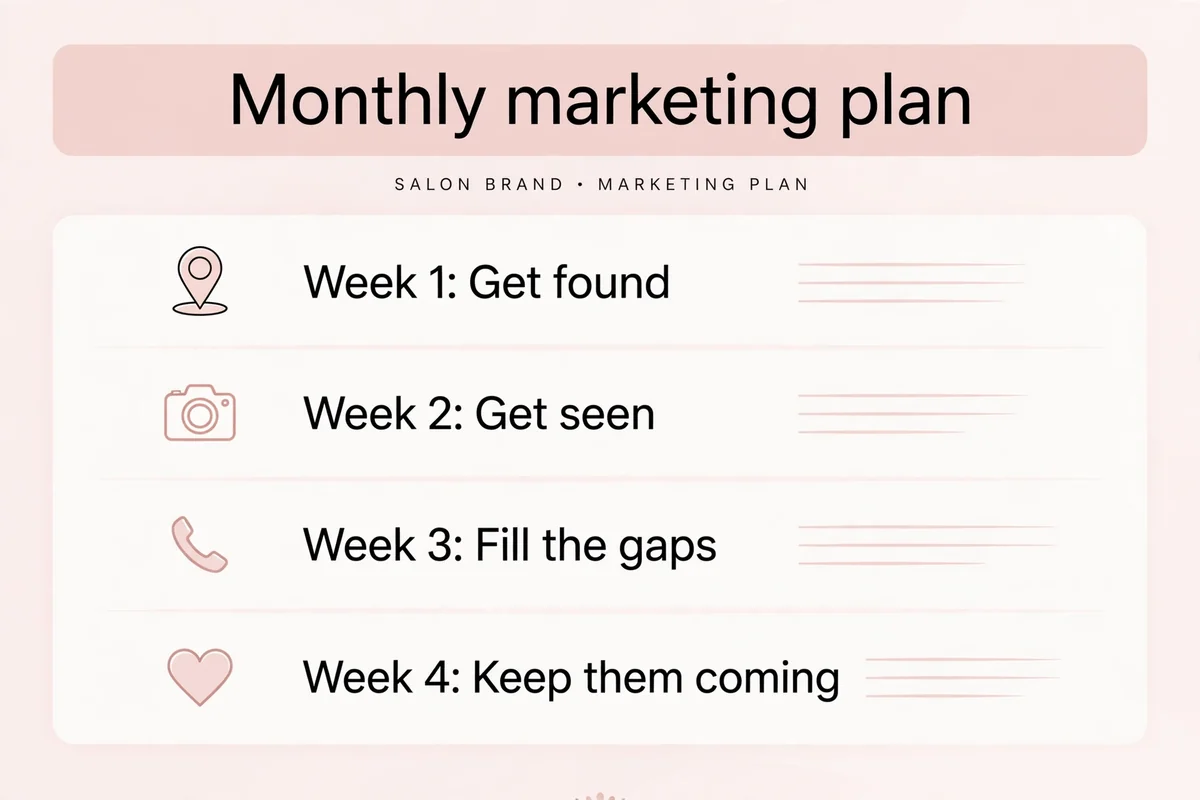
The difference between salons that market and salons that wish they marketed is a calendar. Marketing without scheduled time slots loses to the diary every single week. Here’s the rhythm, about 2 to 3 hours a week total:
- Monday, 30 minutes: plan the week’s posts, check Google messages and reviews, note any gaps in the diary.
- Daily, 10 minutes: Stories, especially same-day gaps (“cut and blow-dry at 2pm today, £35, first DM gets it”).
- Week 1, Get found: Google Business Profile updates, review requests to recent happy clients.
- Week 2, Get seen: two before-and-afters with prices, one Reel answering a client question.
- Week 3, Fill the gaps: win-back messages to lapsed clients, keep a cancellation waitlist and message it the moment a gap appears.
- Week 4, Keep them: one email or SMS to your client list, a loyalty nudge, and 15 minutes reviewing the month.
That waitlist matters more than most owners think. Fresha’s 2026 research, reported by Hairdressers Journal, found salon owners aged 35 to 44 lose an average of 8% of monthly revenue to cancellations and no-shows, on a £12,000 monthly turnover, that’s £960 walking out the door (Hairdressers Journal). A waitlist doesn’t stop cancellations; it stops them costing you.
Your copy-paste salon marketing plan template (monthly calendar format)
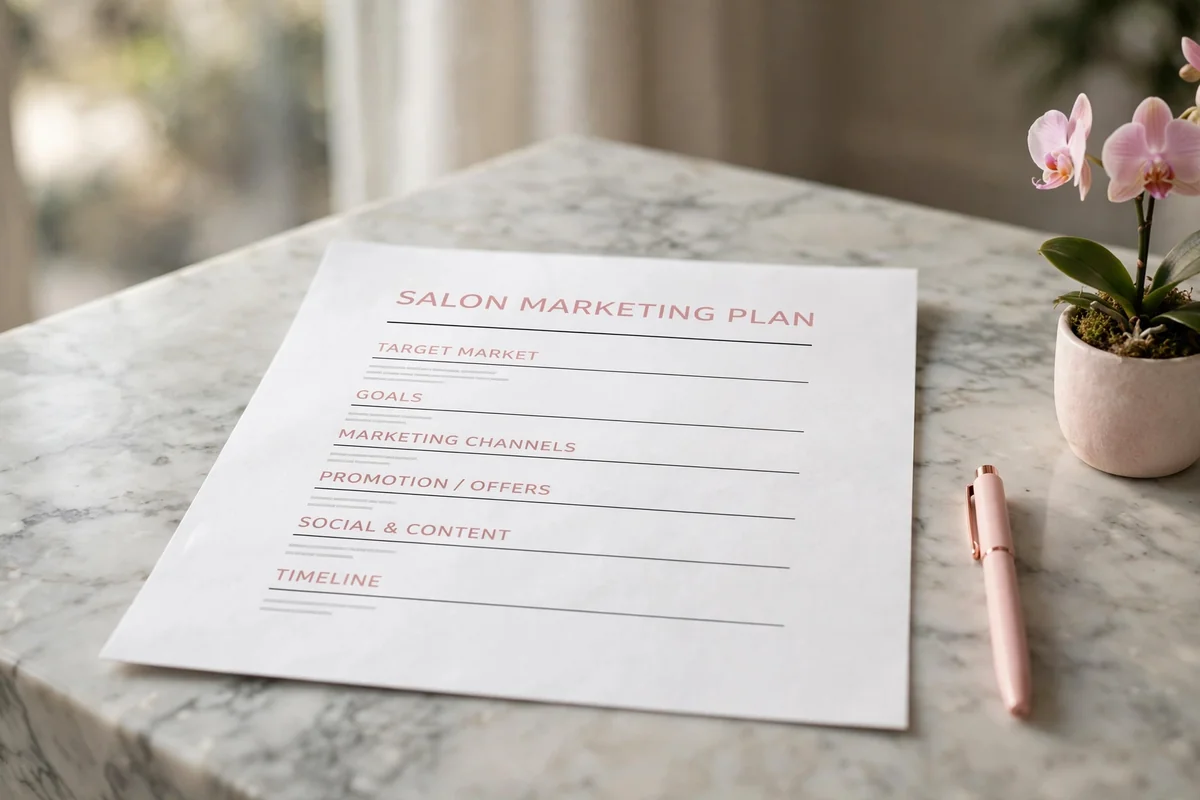
This salon marketing plan example is designed to be copied into a document and filled in today. A marketing plan for a salon doesn’t need to be longer than one page, keep it short enough that you’ll actually open it every Monday.
SALON MARKETING PLAN, [Salon name], [Month / Year]
1. MY GOAL THIS MONTH
 Extra appointments needed: ______
 Average appointment value: £______
 Revenue this plan is chasing: £______
2. WHERE THE BOOKINGS WILL COME FROM
 Google + reviews: ______ bookings/week
 Instagram: ______ bookings/week
 Win-backs / email / SMS: ______ bookings/week
 Referrals: ______ bookings/week
3. WEEKLY CALENDAR
 WEEK 1, GET FOUND
 [ ] Google Business Profile: add 4 new photos, check hours and prices
 [ ] Text a review request to 5 happy recent clients
 [ ] Reply to all new Google reviews
 WEEK 2, GET SEEN
 [ ] Post 2 before-and-afters with price + "tap the link in bio to book"
 [ ] Film 1 Reel answering a question clients ask you
 [ ] Post every same-day gap to Stories
 WEEK 3, FILL THE GAPS
 [ ] Message 20 lapsed clients (only those who agreed to marketing messages)
 [ ] Keep a cancellation waitlist; message it the moment a gap appears
 [ ] Rebook at the chair, put the script by every till
 WEEK 4, KEEP THEM
 [ ] Send one email/SMS to your client list (news, offer or seasonal reminder)
 [ ] Pick next month's seasonal angle
 [ ] 15-minute review: which channel delivered its bookings?
4. BUDGET THIS MONTH
 Free channels: £0 + ______ hours of my time
 Email/SMS software: £______
 Ad spend (only if the free foundations are working): £______
 Total: £______
5. MEASURE (end of month, 15 minutes)
 Extra appointments booked: ______
 Where did they come from? ______
 Keep / change for next month: ______
Want this plan built for your salon?
The template works, but it works faster when it’s built around your numbers, your services and your town. Book a free 30-minute strategy call and we’ll turn this template into a finished 90-day plan together, on the call.
Free, 30 minutes, no obligation. We reply within one working day.
How much should a salon spend on marketing? An honest breakdown
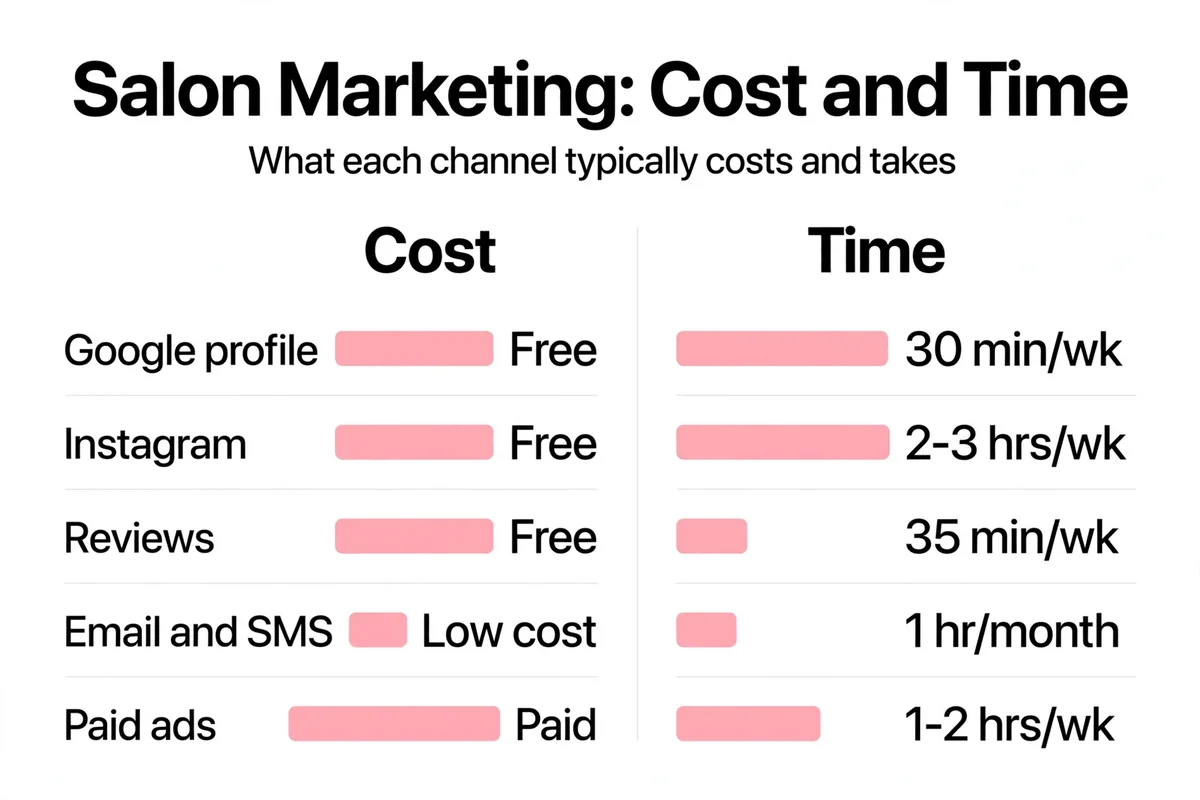
Start with the free rows. Most salon marketing plans fail from neglect, not from under-spending, nearly every tactic in the free section of this plan costs nothing but your time.
| Channel | Typical cost | Time per week | Add it when… |
|---|---|---|---|
| Google Business Profile + reviews | Free | 30 min | Day one, always first |
| Instagram content | Free | 30 min | Day one |
| Email / SMS software | Free, £25/month | 1 hr/month | You have 200+ client contacts |
| Paid ads (Meta / Google) | £150 to £500/month test budget | 1 to 2 hrs | Free channels are working and tracked |
| Agency help | Varies | Marketing takes 5+ hrs/week of your time |
Costs above are typical ranges, not quotes, software prices and ad costs move around. The principle doesn’t: spend money only on what you can measure. If you can’t say what one booking cost you, you can’t say the spend worked.
One honest note: if you have under three chairs and no client list yet, start with the free rows. Paid help won’t fix a missing foundation, it just spends money faster. Build the base first, then get help scaling it.
The legal bits: texts, emails and discount claims (UK)
Two sets of UK rules shape every salon marketing plan. This is general information, not legal advice.
Messages (PECR + GDPR). Before you send marketing texts or emails, you need consent, or the “soft opt-in”: they’re an existing customer, they gave you their details during a sale, you’re marketing similar services, and every message gives them an easy opt-out. Every marketing message must include an opt-out (like “Reply STOP”), and bought lists almost never carry the consent the rules require, build your own list from real clients. The ICO’s direct marketing guidance explains it plainly.
Discount claims (ASA). Promotions are fine; misleading ones aren’t. If you advertise “was £80, now £60”, the £80 must have been your genuine usual selling price for a meaningful period, the ASA actively bans “was/now” claims businesses can’t substantiate, and it polices Black Friday and January-sale pricing closely. Law firm Lewis Silkin’s summary of the discount-claims rules is a clear read on where the line sits. Safer approach for salons: genuine first-visit offers with clear dates, or bundles (“cut, colour and treatment, £95”) instead of slashed prices.
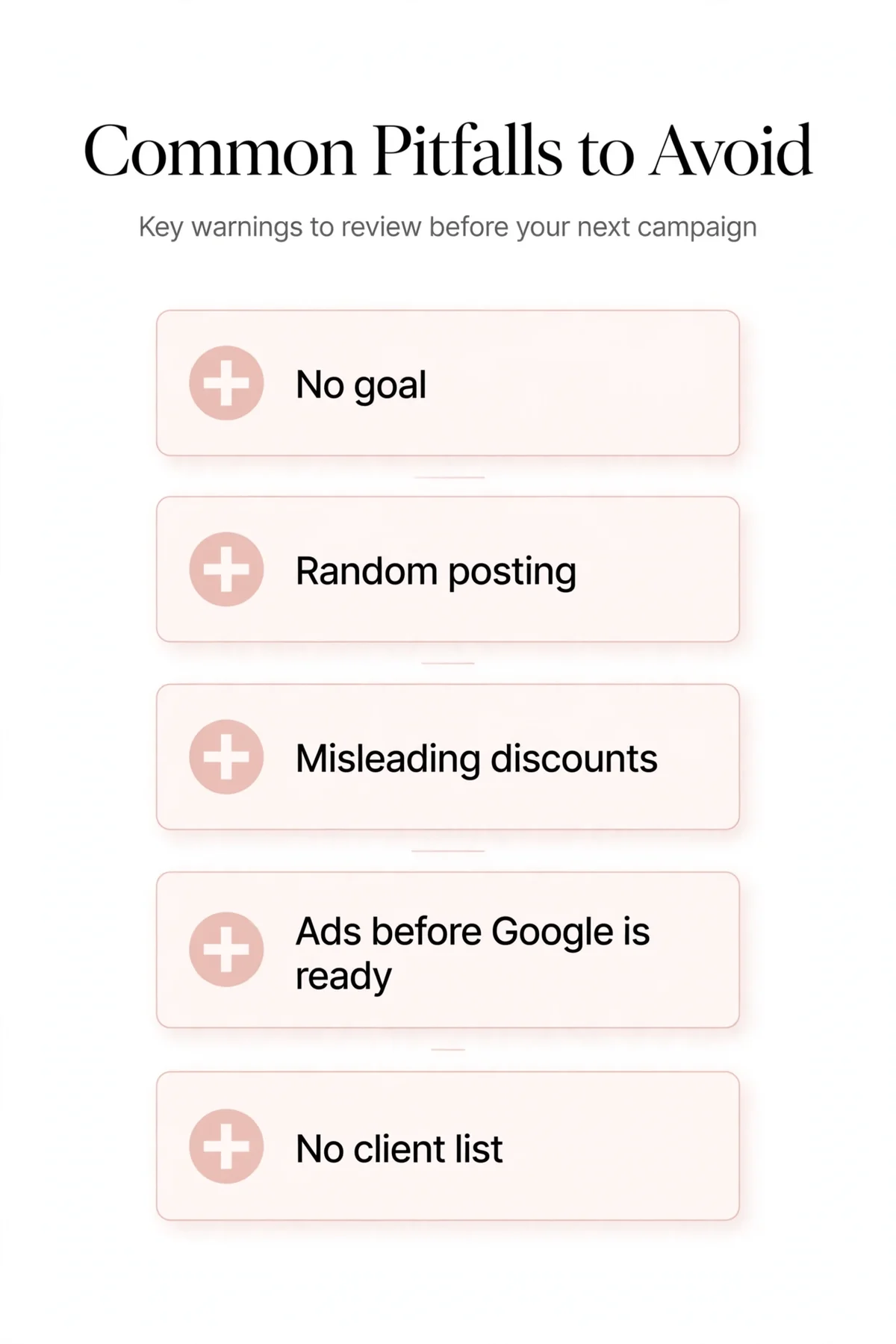
5 mistakes that waste salon marketing budgets
- Posting without a goal or a booking link. Content that doesn’t tell the viewer what to do next is entertainment, not marketing. Every post needs a price (or “from £X”) and a way to book.
- Discounts with no reason and no deadline. Permanent sales train clients to wait for the next one, and “up to 50% off” claims you can’t prove invite an ASA complaint.
- Running ads before the Google profile is finished. Instagram builds desire; Google captures it. A client who sees your ad then finds a half-empty Google profile books with someone else.
- Never building the client list. Every appointment that ends without an email address or mobile number (with consent) is a one-time transaction. The list is the cheapest marketing asset you’ll ever own.
- No rebooking at the chair. The cheapest booking you’ll ever get is the one taken before the client leaves: “Your colour needs refreshing in about six weeks, shall I book you in?” Twenty seconds, no cost.
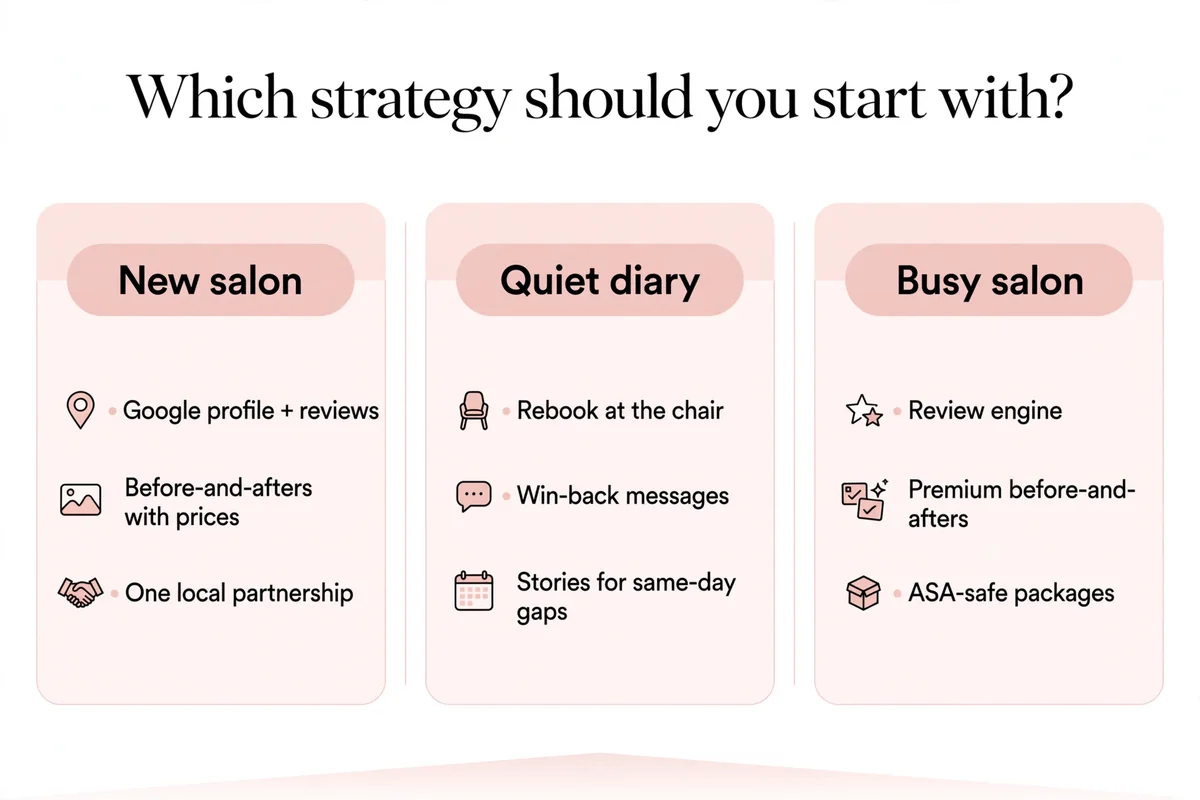
Which salon marketing strategy should you start with?
Don’t try all five channels at once. Pick based on where your salon is right now.
| Your situation | Your first 30 days |
|---|---|
| New salon, few clients | Google Business Profile + reviews, before-and-afters with prices, one local partnership |
| Established, but the diary has gaps | Rebook at the chair, win-back messages, Stories for same-day gaps |
| Busy, but want higher-value clients | Review engine, premium before-and-afters, ASA-safe packages instead of discounts |
| No time for marketing at all | Google profile + the rebooking script, then get help with the rest |
If “no time” is your situation, that’s the honest signal to stop DIY-ing it. Our social media management for salons and local SEO for salons exist for exactly that.
Frequently asked questions
What is a salon marketing plan?
A salon marketing plan is a written answer to three questions: how many bookings you need, which channels will bring them, and what happens each week. For most salons it fits on one page: a monthly goal, a weekly calendar, a small budget, and a 15-minute end-of-month review. Copy the template above to start yours today.
How do I create a marketing strategy for my salon?
Set one measurable goal, extra appointments per month, then pick two or three channels to start. Google Business Profile, Instagram and win-back messages work for most UK salons. Follow a monthly calendar for 30 days, check which channel delivered its bookings, and double down on what worked.
How much should a small salon spend on marketing?
Start with the free channels: Google Business Profile, reviews, Instagram and rebooking cost nothing but 2 to 3 hours a week. Add email software (£0 to £25/month) once you have a client list, and paid ads (£150 to £500/month test budget) only after the free foundations are working and you can track results.
What is the best marketing strategy for salon services?
The combination that keeps working for UK salons: local search (Google Business Profile + reviews), Instagram content with prices and booking instructions, and retention habits like rebooking and win-back messages. Paid ads help once these foundations exist, running them before that wastes money.
Do I need a marketing plan for a salon with only two chairs?
Yes, arguably more so, because every quiet hour costs you directly. The plan just gets smaller: one goal, two channels (Google and Instagram), and the same monthly calendar. The template above works for a two-chair salon exactly as written, with nothing to scale down.
The bottom line
The best salon marketing strategies aren’t complicated: one measurable goal, five channels in the right order, and a monthly calendar you actually follow. Copy the template, fill in your numbers, and start with this week’s “get found” tasks. Salon marketing plans only work when they’re used, so keep yours simple enough to use.
If you’d rather have the plan built with you than figure it out alone, book a free 30-minute strategy call.
Book My Free Strategy Call Free, 30 minutes, no obligation. We reply within one working day.
Last updated: October 2026