Most spa owners did not get into this business to run marketing campaigns. You opened your spa because you love treatments, wellbeing, and watching a stressed client walk out floating. But the quiet Tuesdays, the empty treatment rooms, and the nagging feeling that the spa down the road is busier, those need spa marketing. This is the complete UK guide to marketing a spa: it follows the guest journey, from the moment someone discovers you to the moment they refer a friend. Written for UK spa owners, day spas, health spas, luxury spas and float studios, with copy-paste templates, honest costs, UK legal guardrails and no invented statistics. If marketing for spa businesses has always felt like guesswork, this guide turns it into a system.
Key takeaways, the six stages of the guest journey
- Discover: a complete Google Business Profile with prices, photos and reviews, plus Instagram that shows the space, not just the treatments.
- Choose: a website that wins the comparison in 30 seconds, treatments, prices, photos, and one clear booking button.
- Book: online booking with no friction, answered phones, and gift vouchers that are easy to buy and clearly worded.
- Visit: consultations, your signature scent, spa retail and a rebooking script, the appointment is your best marketing slot.
- Rebook: memberships and packages, legal email/SMS, and a win-back system for guests who drift away.
- Refer: reviews, referral rewards and local partnerships that bring warm new guests.
Want a second pair of eyes on your spa marketing before you start? Book a free 30-minute strategy call, we will tell you which stage of the guest journey to fix first.
Contents
- The six stages of spa marketing (start here)
- Stage 1, Discover: get found before they need you
- Stage 2, Choose: win the comparison in 30 seconds
- Stage 3, Book: make booking effortless
- Stage 4, Visit: the experience is the marketing
- Stage 5, Rebook and refer: the stages that pay for everything
- Marketing a spa by type: day, health, luxury and float
- What spa marketing costs: an honest breakdown
- Five mistakes that cost spas bookings
- Frequently asked questions
The six stages of spa marketing
Most guides to marketing spa services hand you a random list of tactics: post on Instagram, start a newsletter, run an ad. The problem is that tactics fail when the stage before them is broken. A brilliant Instagram account will not save a spa whose website hides its prices. A loyalty scheme will not save a spa nobody can find on Google.
Instead, think of spa marketing as the six stages of your guest’s journey. Each stage feeds the next:
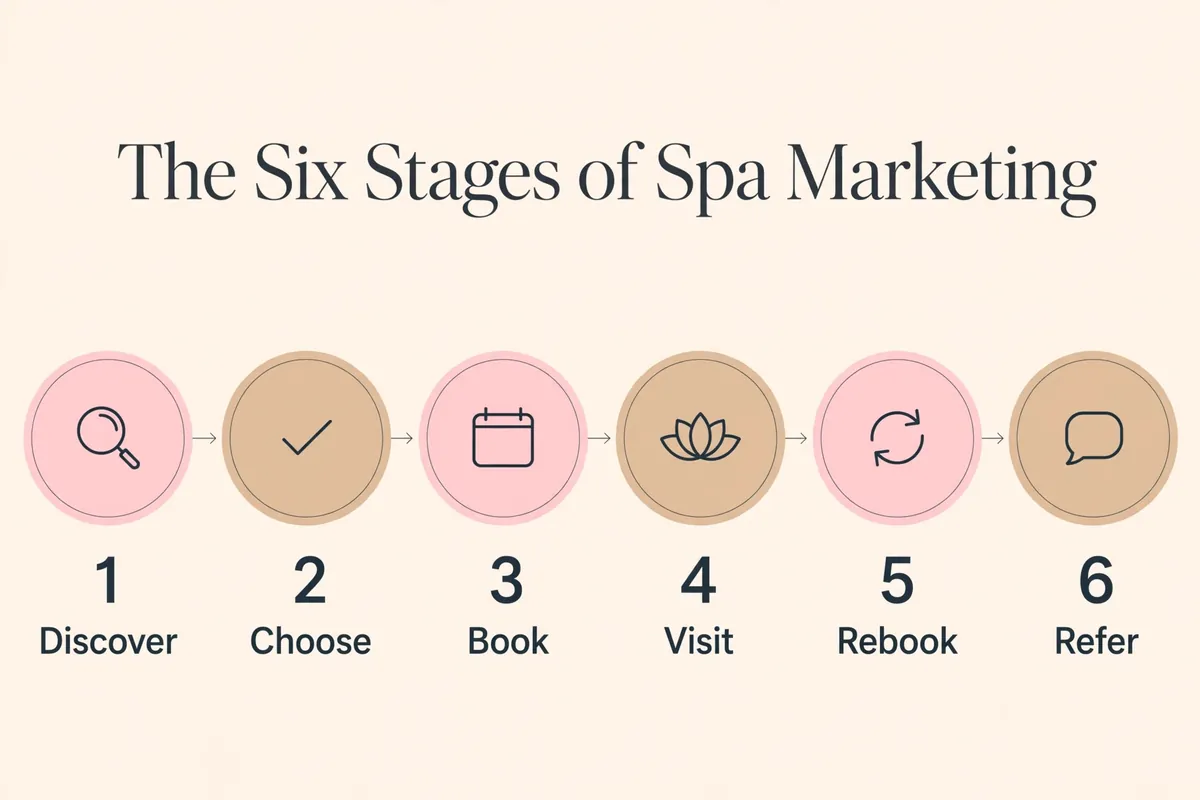
- Discover, someone nearby wants a spa treatment and finds you (Google, Instagram, a friend’s mention).
- Choose, they compare you with two or three other spas in about 30 seconds on their phone.
- Book, they commit. This is where most spas quietly lose people to friction.
- Visit, the appointment itself. Done well, it sells your next appointment.
- Rebook, they come back, buy a package, or join a membership.
- Refer, they review you, recommend you, and bring friends.
Which stage should you fix first?
Do not try all six at once. Start where your diary hurts most.
| Your situation | Fix this stage first |
|---|---|
| New spa, few guests | Discover, Google Business Profile and local visibility |
| People browse but do not book | Choose, website, prices and photos |
| Enquiries never become appointments | Book, online booking, phones, vouchers |
| One-time visitors who never return | Visit, consultations, scent, retail, rebooking |
| Quiet weekdays, busy Saturdays | Rebook, memberships, win-backs, email/SMS |
| Full diary but want better-spending guests | Refer, reviews, referrals, partnerships |
Stage 1, Discover: get found before they need you
When someone searches “spa day near me” or “massage in [your town]”, your Google Business Profile appears before your website, your Instagram and anything else you own. Spa bookings are often one-off treats or gifts, the buyer has no loyalty to you yet, and chooses whoever Google shows first.
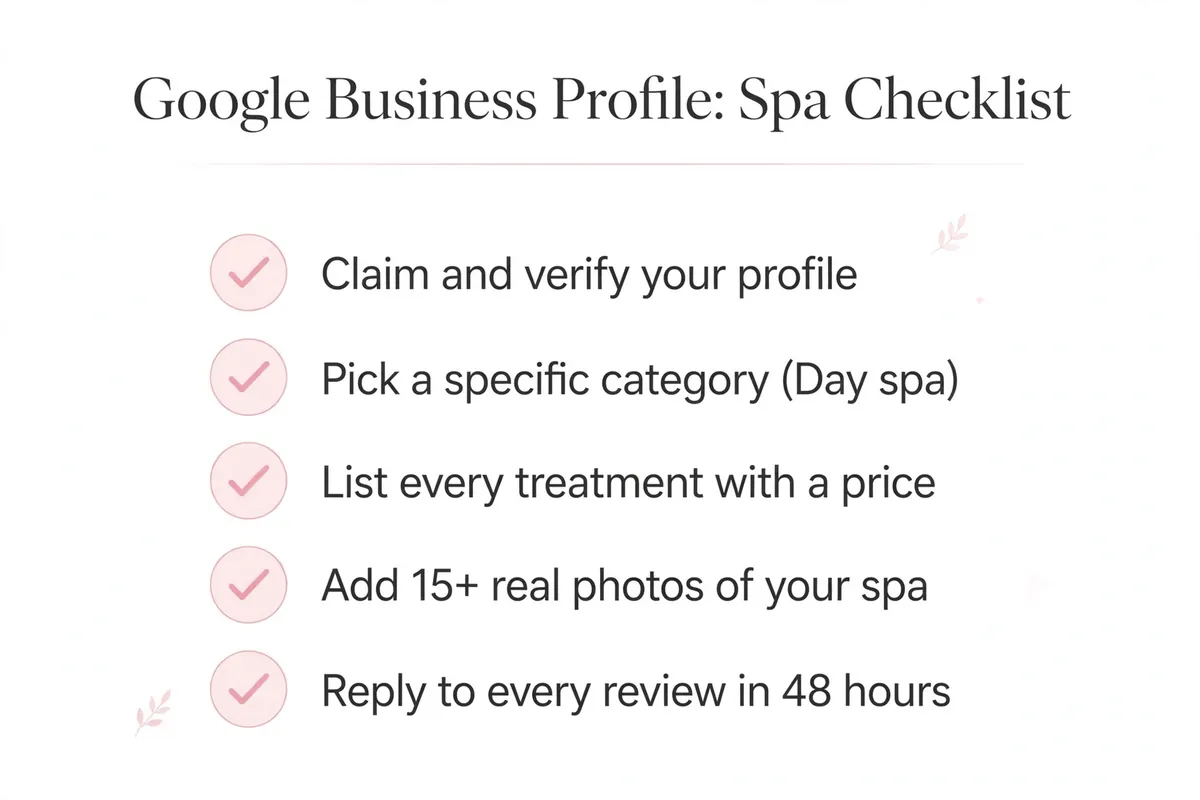
The 45-minute setup (do it this week)
- Claim and verify your profile via Google’s official Business Profile help page.
- Choose the most specific primary category, “Day spa”, “Massage spa” or “Health spa”, not a generic “Spa”.
- List every treatment with a price. “Deep tissue massage, 60 min, £75” beats a menu with no prices.
- Add 15+ real photos: treatment rooms, relaxation lounge, pool or sauna, the entrance, your team. Spa guests buy atmosphere, show it.
- Turn on messaging and reply to every review within 48 hours.
For the full walkthrough, see our guide to local SEO for spas. If doing this properly feels like a second job, our local SEO for spas service takes the whole thing off your plate.
Be discoverable where spa guests actually look
- Instagram and TikTok: spa content that travels is atmosphere content, slow tours of the treatment room, the pool at golden hour, the “unwind with us” Reels. One hook, one treatment, one booking instruction. Our social media management for spas exists for owners who would rather be treating clients than filming.
- Fresha and Treatwell: being listed is not marketing, but an empty or review-free listing is anti-marketing. Complete every field and keep prices identical to your website.
- Google reviews from day one: ask every happy guest (template in Stage 5). A spa with 80 recent reviews beats a spa with 12, every time.
Stage 2, Choose: win the comparison in 30 seconds
Here is what a spa guest does: they open three tabs, you and two competitors, and compare on their phone in under a minute. The winner is almost never the cheapest. It is the one that answers four questions fastest: what do you offer, what does it cost, what does it look like, and how do I book.
The 30-second website test
Open your site on your phone and time yourself:
- Treatments and prices, visible within one scroll, no “prices on request”. Hiding prices does not create luxury; it creates bounced visitors.
- Real photos, your rooms, your therapists, your relaxation area. Stock photos of strangers in robes tell the guest nothing about your spa.
- Location and parking, “10 minutes from [station], free parking” removes a silent objection for every out-of-town guest.
- One booking button, above the fold, on every page, that opens your booking system. Not a contact form. Not “call us”.
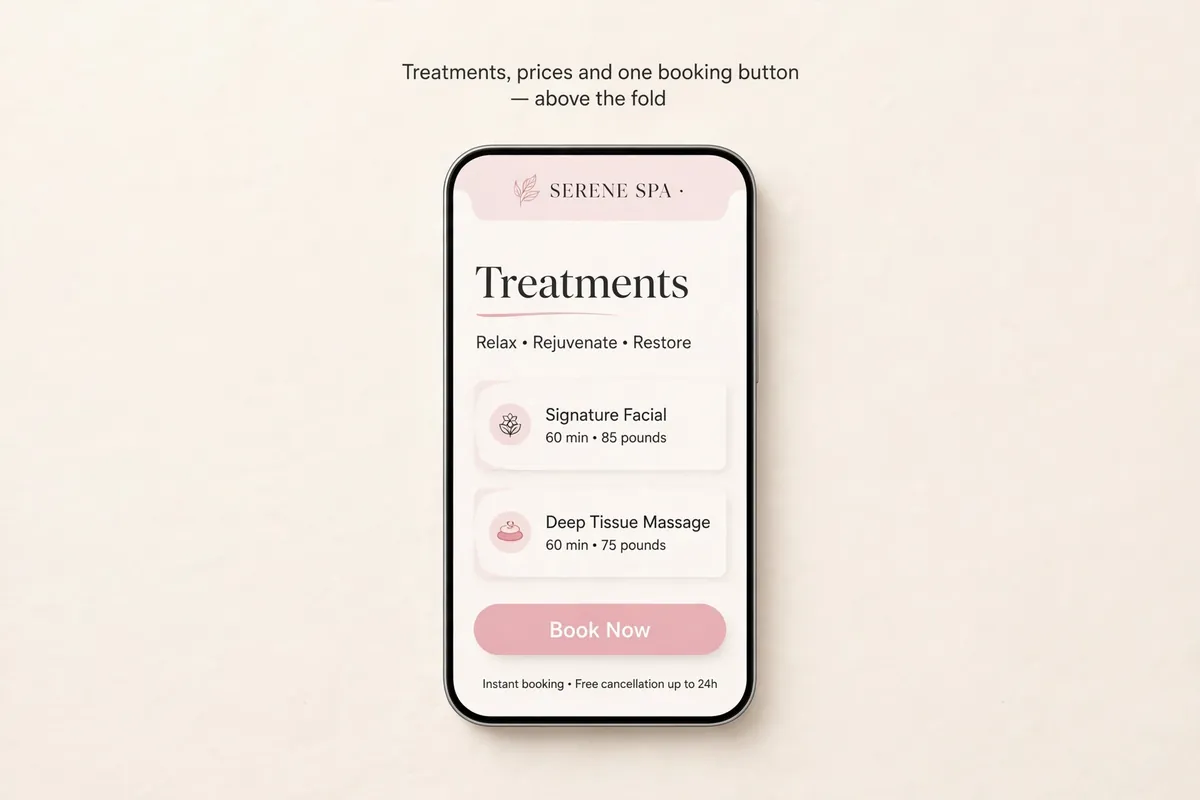
If your current site fails this test, it is costing you bookings every week, see what a website built to take bookings looks like.
Show the work the way spa guests want to see it
Salons show before-and-afters. Spas sell a feeling, so your content should too, but it still needs the practical details.
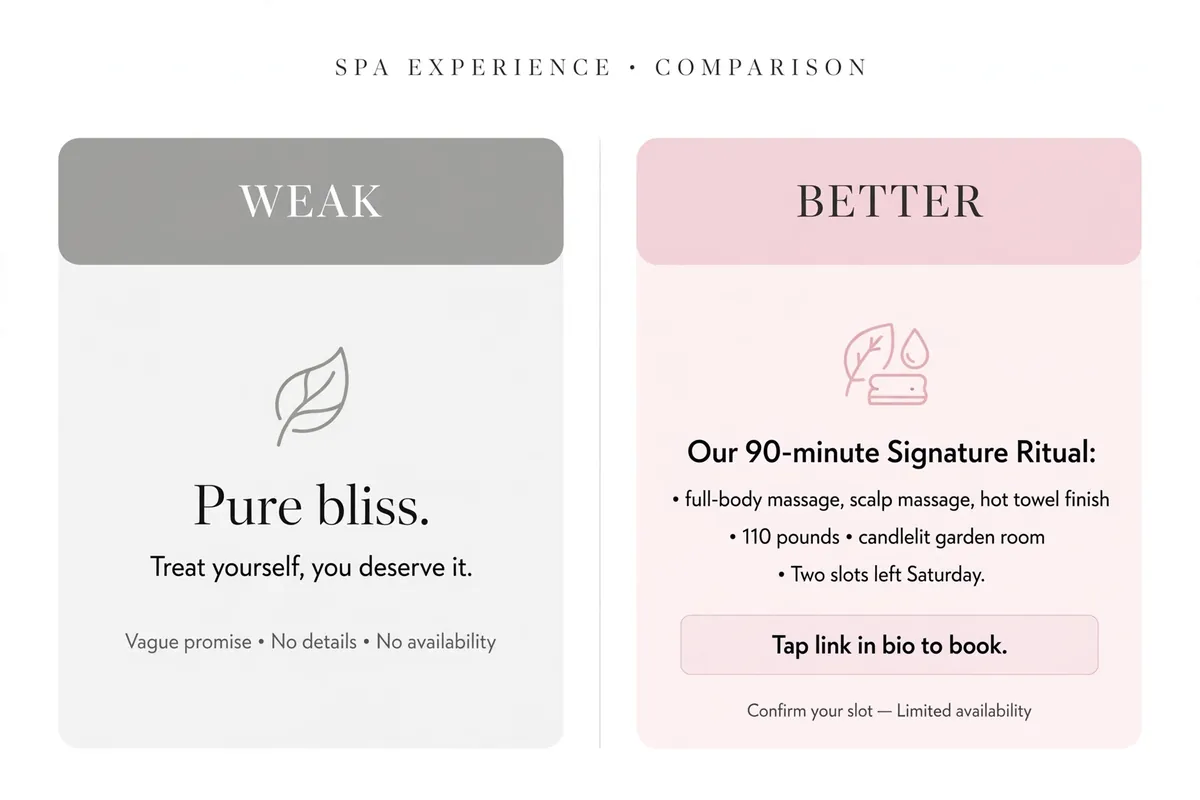
Weak Instagram caption: “Pure bliss 🕯️✨ Treat yourself, you deserve it 💕 #spaday #selfcare”
Better caption: “Our 90-minute Signature Ritual: full-body massage, scalp massage and a hot towel finish, £110, in our candlelit garden treatment room. Two slots left this Saturday. Tap the link in bio to book.”
The better version works because it names the treatment, the price, the setting and the next step. Atmosphere makes them stop scrolling; specifics make them book.
Stage 3, Book: make booking effortless
A guest decides to book, hits friction, and books your competitor instead, and you never know it happened. Remove the friction:
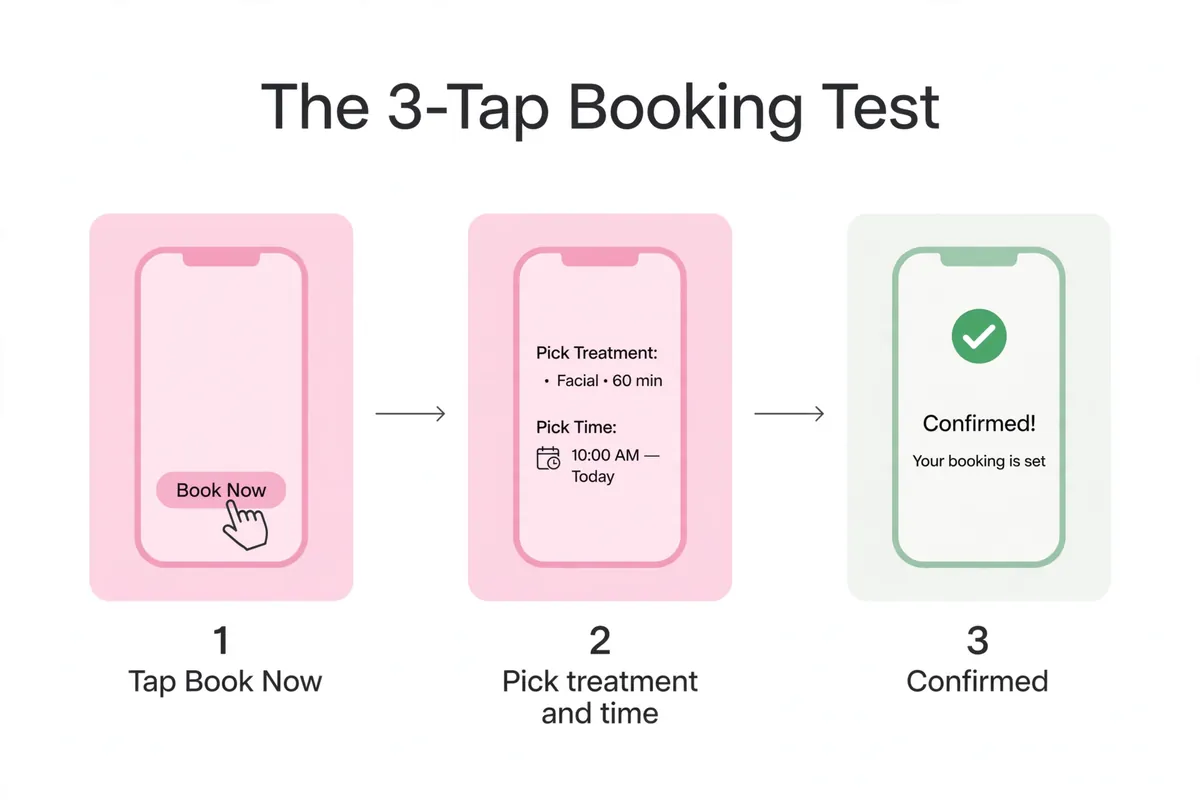
- Online booking, actually working: test it on your own phone monthly. If it takes more than three taps from “book now” to confirmed, fix it.
- Answer the phone: spa guests still call, especially gift buyers and older clients. If you cannot answer during treatments, use a proper voicemail that says when you will call back, and call back the same day.
- Hold provisional bookings: for spa days and group bookings, offer a 48-hour courtesy hold. It turns “let me check with my friend” into a booking instead of a lost enquiry.
- Confirm and remind: a confirmation text at booking and a reminder 24 hours before cuts no-shows dramatically.
Gift vouchers: your highest-margin marketing
For most UK spas, December gift vouchers are the single biggest marketing event of the year. Treat them like a product launch, not an afterthought:
- Make them buyable in under a minute on your website, a guest should never have to call or visit to buy a voucher.
- Sell experiences, not amounts: “Twilight Spa Evening for Two, £120” outsells “£120 gift voucher” because the buyer can picture it.
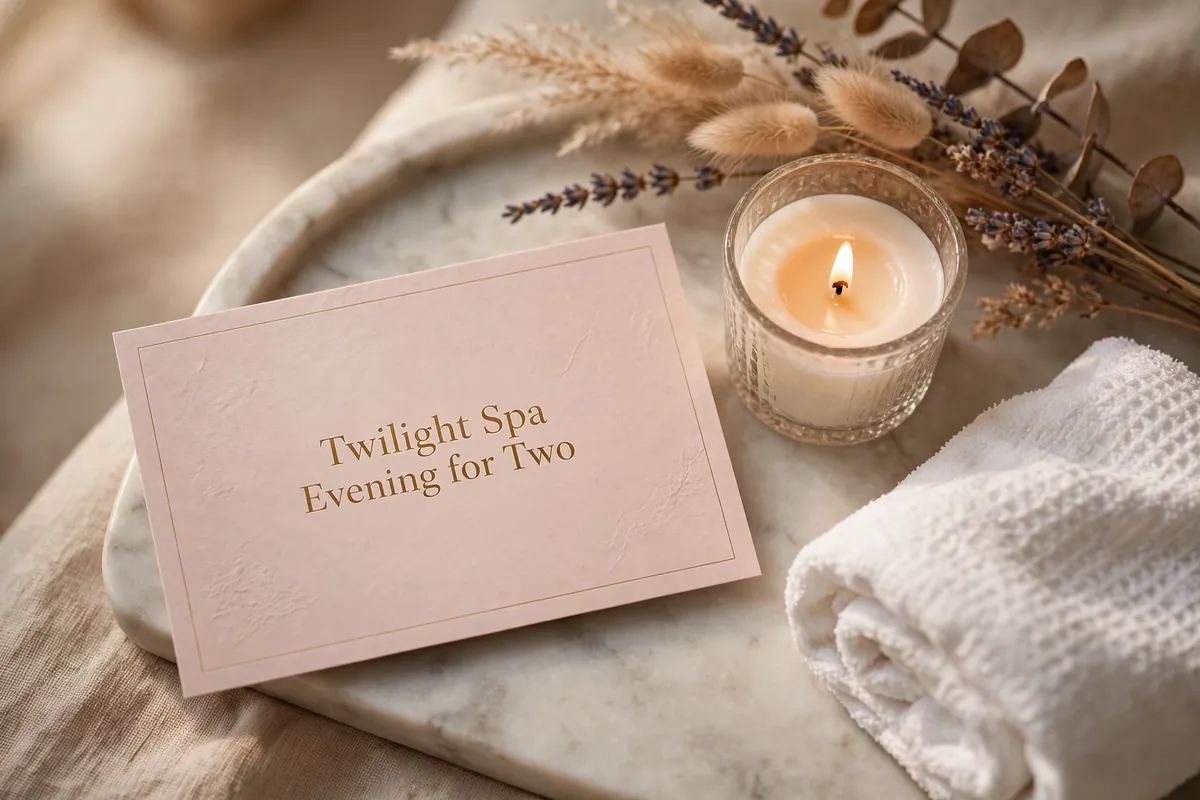
- Word the terms clearly: state the expiry date, whether it covers weekends, and how to book with it before purchase. Under UK consumer law, voucher terms must be transparent, and a disappointed gift recipient is a lost client twice over.
Example (illustrative, not a real client result): a spa sells 60 “Spa Evening for Two” vouchers at £120 in December, £7,200 banked before Christmas. Redemption costs roughly £40 in therapist time and product per couple. The vouchers fund January’s quiet weeks, and every voucher guest is a potential rebooker and reviewer. Run your own numbers; the principle holds at any price point.
📞 Turn more browsers into bookings
Your guest journey has six stages, and most spas are leaking guests at two or three of them. Book a free 30-minute strategy call and we will find your biggest leak together.
Free, 30 minutes, no obligation. We reply within one working day.
Stage 4, Visit: the experience is the marketing
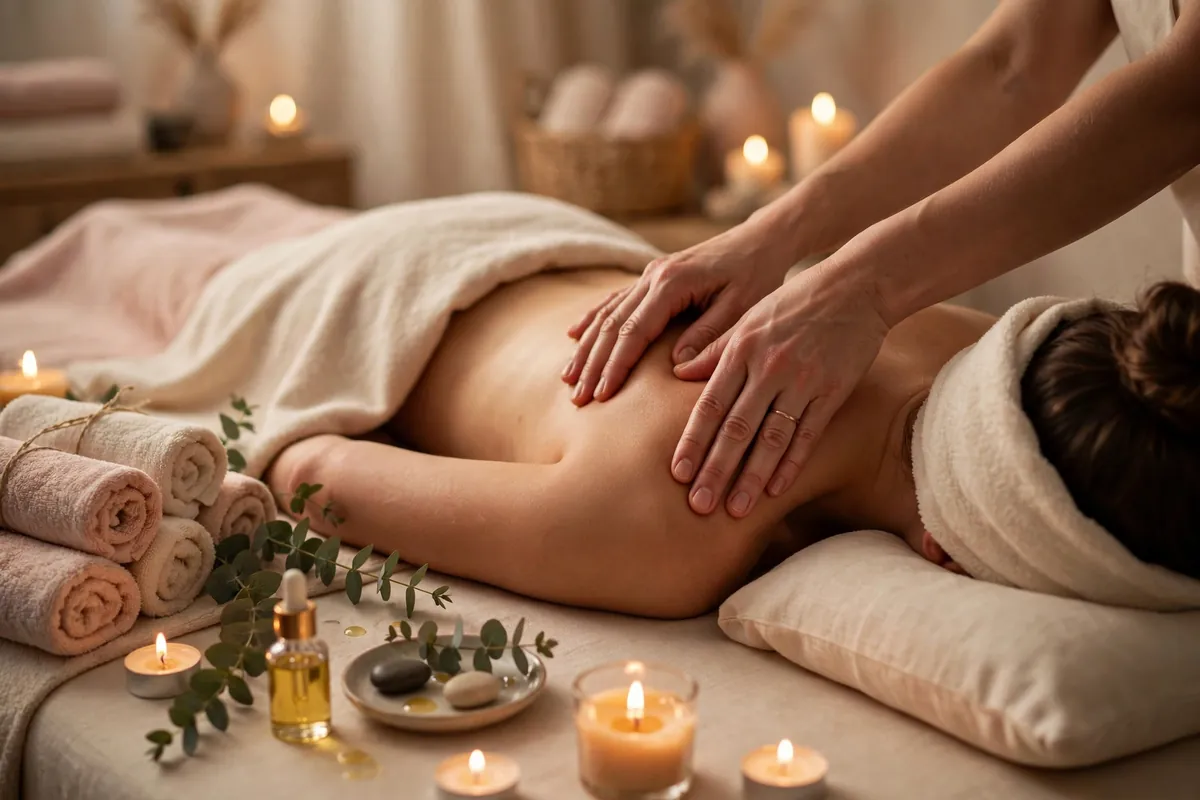
A spa appointment is the only marketing slot where you have the client’s undivided attention for 60 to 90 minutes. Waste it and you have paid to acquire a one-time visitor. Use it and you have bought a rebooker, a retail customer and a reviewer.
The consultation that sells without selling
Two questions at the start of every appointment change everything:
- “What would you like to feel like when you leave today?”
- “Is there anything about your skin/body/stress levels we should know?”
The first question sells the *outcome*; the second opens the door to an honest add-on recommendation. “Given what you’ve told me about your shoulders, the hot stones add-on would really help, it’s £20 extra, shall I include it?” That is service, not a sales pitch.
Spa scent marketing: your cheapest signature
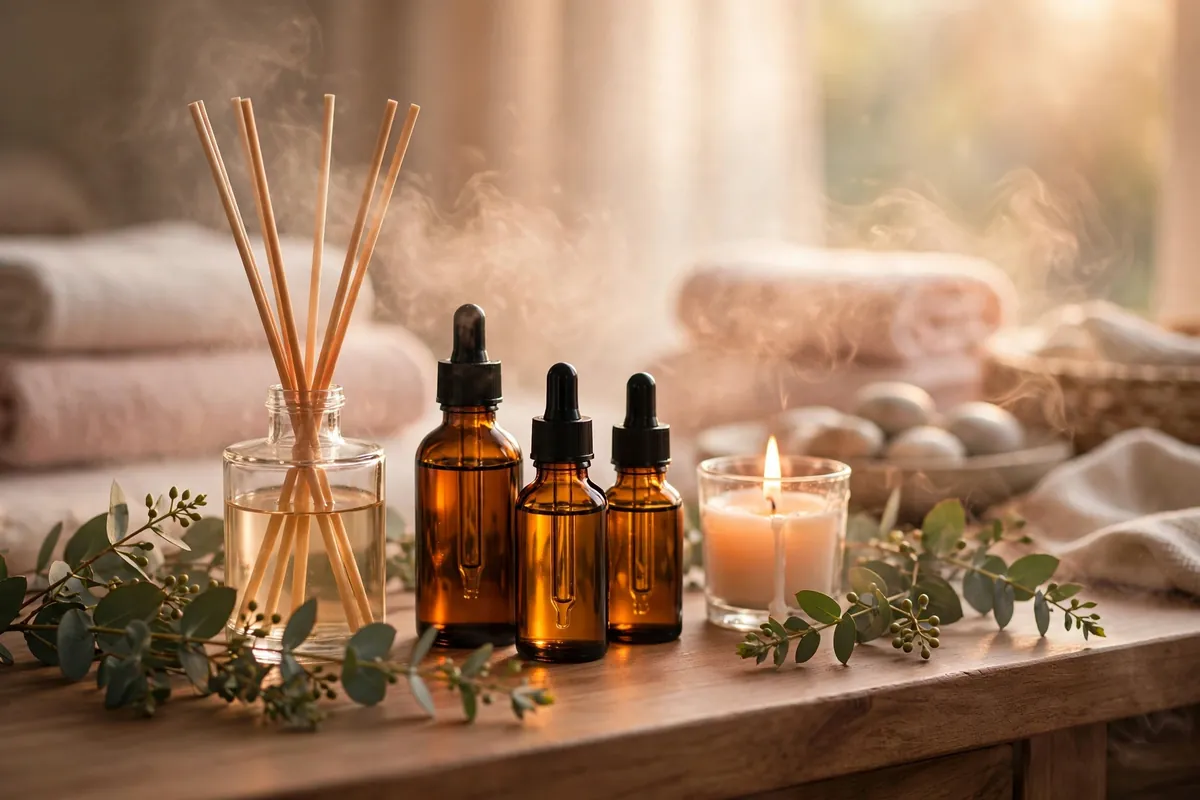
Spa scent marketing is simply this: choose one signature scent for your spa and use it everywhere, reception diffuser, treatment rooms, the oil you retail. Scent is the sense most tied to memory, and a guest who smells “your” scent months later remembers the feeling of your spa.
Do it properly:
- Pick one scent and commit. Changing it every month builds no association.
- Diffuse it at reception so the experience starts at the door, not the treatment room.
- Retail the same oil or candle so guests can buy the memory. “This is the blend we use in your treatment, you can take it home for £28” is the easiest retail sentence in the business.
Spa sales and marketing at the till: retail that does not feel pushy
Spa sales and marketing done well does not mean hard selling, it means recommending what you genuinely used. The rule: only recommend products you applied during the treatment, and say so.
“The balm I used on your shoulders is this one, a pea-sized amount does both shoulders. It’s £24 and lasts about three months.”
One recommendation per visit. No display-table ambush. Track which therapist sells what, praise the best, and coach the rest, retail is a skill, and skills can be taught.
The rebooking script (copy and paste)
At the end of every appointment, before the client stands up:
“Your muscles will love a follow-up in about 4 weeks, shall I book you in for [day]? We get busy around then, and I’d like you to have [therapist name] again.”
Train every therapist to do this. It takes 20 seconds and it is the single most effective retention habit in the industry.
Stage 5, Rebook and refer: the stages that pay for everything
Acquiring a new spa guest is the most expensive thing you do. Everything in this stage exists to make sure you only pay for it once.
Memberships and packages: sell the habit, not the visit
One-off treatments make lumpy revenue. Memberships smooth it out and lock in loyalty.
- Keep it simple: one membership, one price. “The Monthly Reset, one 60-minute treatment a month, £79, plus 10% off everything else.”
- Price it to be used: the treatment should cost slightly less than buying singly, but the membership should feel like a commitment to self-care, not a discount scheme.
- Packages for the commitment-shy: “Course of 6 facials, £420 (save £60)” suits guests who will not subscribe but will prepay.
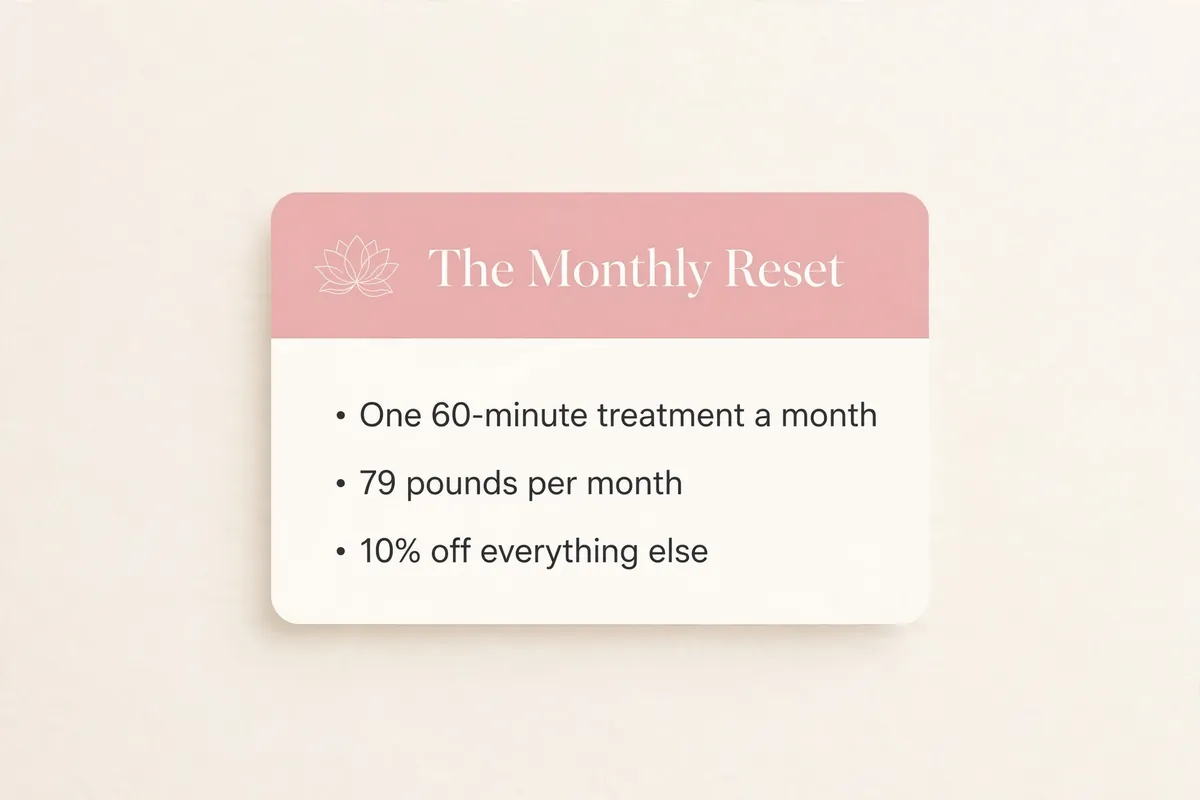
Example (illustrative, not a real client result): 40 members at £79/month is £3,160 of predictable monthly revenue before a single walk-in books. If each member visits 10 times a year instead of 3, the spa trades a small margin per treatment for a full diary, fuller quiet weekdays, and monthly retail sales. Run your own numbers before you set the price.
Win back the guests who drifted away
You have a list of guests who have not booked in 4+ months. They already trust you, they just forgot. Send this (only to guests who agreed to marketing messages, see the legal note below):
Hi [name], it’s [your name] from [spa]. We haven’t seen you in a while and we’d love to have you back. Here’s £15 off any treatment booked before [date]: [booking link]. Reply STOP to opt out.
Send to 30 lapsed guests. Even a handful of replies fills quiet weekdays for the cost of a few texts.
Legal note: under PECR, the UK’s electronic marketing rules, you need consent (or the “soft opt-in” for existing customers) before sending marketing texts or emails, and every message must offer an opt-out. The ICO’s direct marketing guidance explains it plainly. This is general information, not legal advice.
Turn reviews into a machine
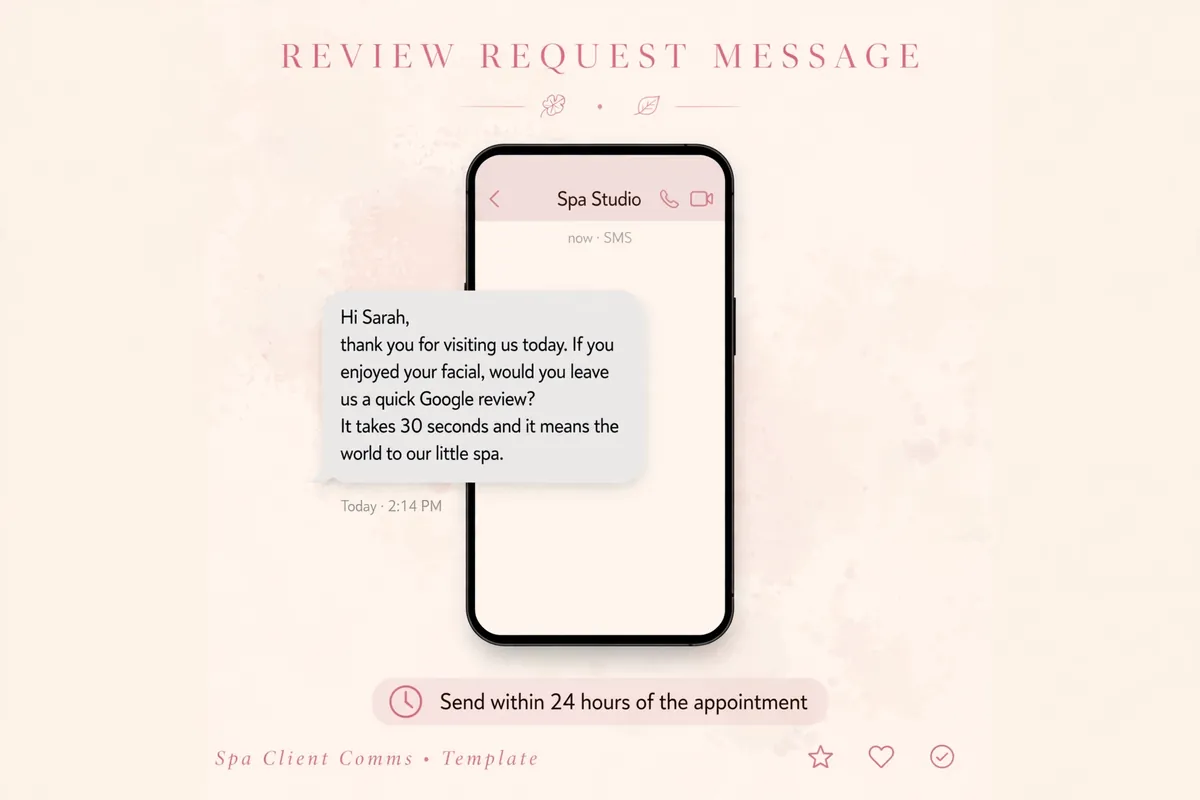
Reviews are free advertising that never sleeps. Do not hope for them, systemise them. Send this by WhatsApp or SMS within 24 hours of the appointment:
Hi [name], thank you for visiting us today. If you enjoyed your [treatment], would you leave us a quick Google review? It takes 30 seconds and it means the world to our little spa: [your review link]
Aim for 2 to 3 new reviews a week, steady and believable. Reply to every review, especially the unhappy ones: a calm, professional reply to a complaint convinces more future guests than ten five-star reviews.
Referrals and partnerships
- A referral reward that runs itself: “Refer a friend and you both get £15 off your next visit.” Pin the terms to your Instagram highlights and print a card for reception.
- Hotel and Airbnb partnerships: offer nearby hotels, B&Bs and Airbnb hosts a 10% code for their guests. One partnership can fill quiet weekday slots for months.
- Local businesses: bridal shops, gyms, physiotherapists, wedding planners, one partnership a quarter, done properly, beats ten half-hearted ones.
Marketing a spa by type: day, health, luxury and float
The six stages apply to every spa, but the emphasis shifts by type:
Day spas
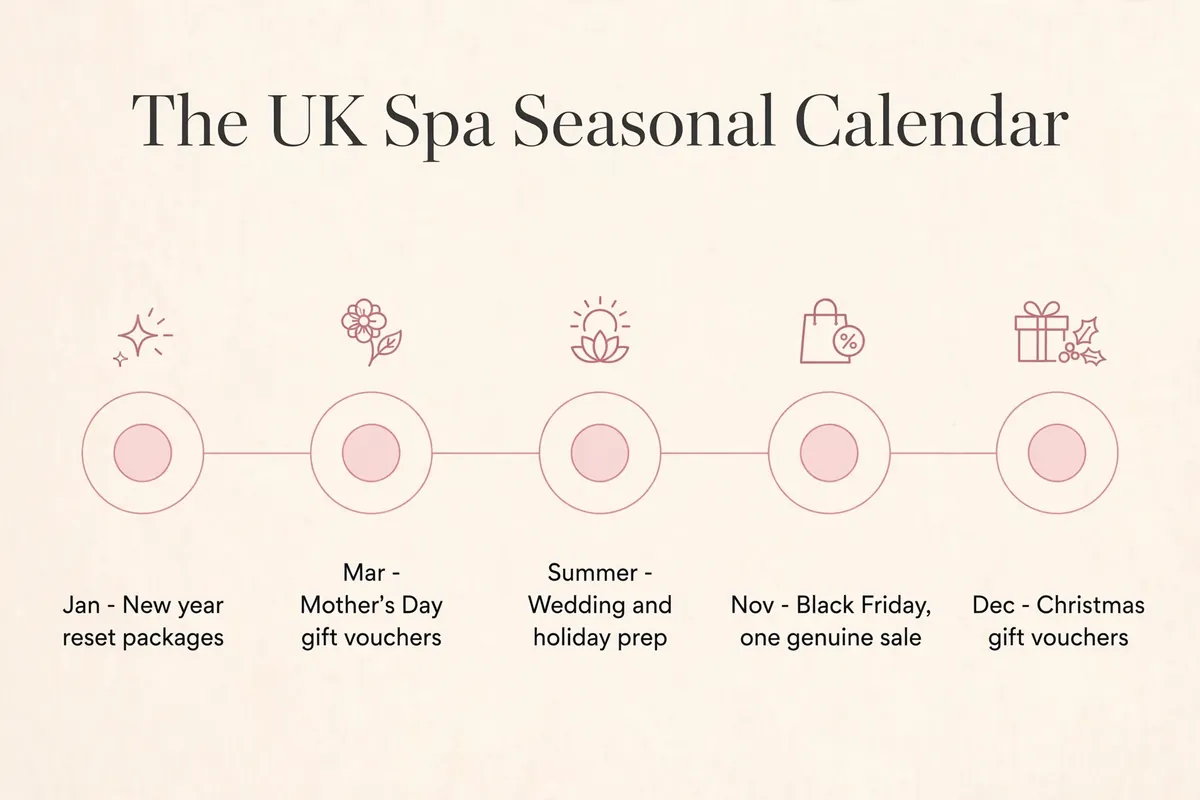
Your guests are local and occasion-driven: birthdays, hen parties, “I need a break” Saturdays. Lean into gift vouchers, group packages (“Spa Day for Four”), and the UK seasonal calendar, Mother’s Day, Valentine’s, Christmas. Your Google Business Profile and atmosphere-led Instagram do the heavy lifting.
Health spa marketing
Health spa marketing sells outcomes, not indulgence: better sleep, less pain, real recovery. Content should educate, “what a sports massage actually does for desk shoulders”, and your proof is expertise: therapist qualifications, treatment explanations, consistent programmes. Memberships and courses of treatment fit naturally, and corporate wellness packages (a local firm’s team day) are an underused revenue stream.
Luxury spa marketing
Luxury spa marketing has one rule: never look cheap. No “50% off” banners, no shouting. Invest in photography that looks like a magazine, calm assured copy, and partnerships with hotels and concierge services. Discounts, if ever, are private: a quiet “we’d love to see you again” note to a lapsed high-value guest, never a public sale.
Marketing for float spas
Marketing for float spas has an education problem: most people have never floated and slightly fear the pod. First-timer offers (“First Float £35”) lower the barrier, and Google reviews saying “I was nervous but…” are worth their weight in gold.
What spa marketing costs: an honest breakdown
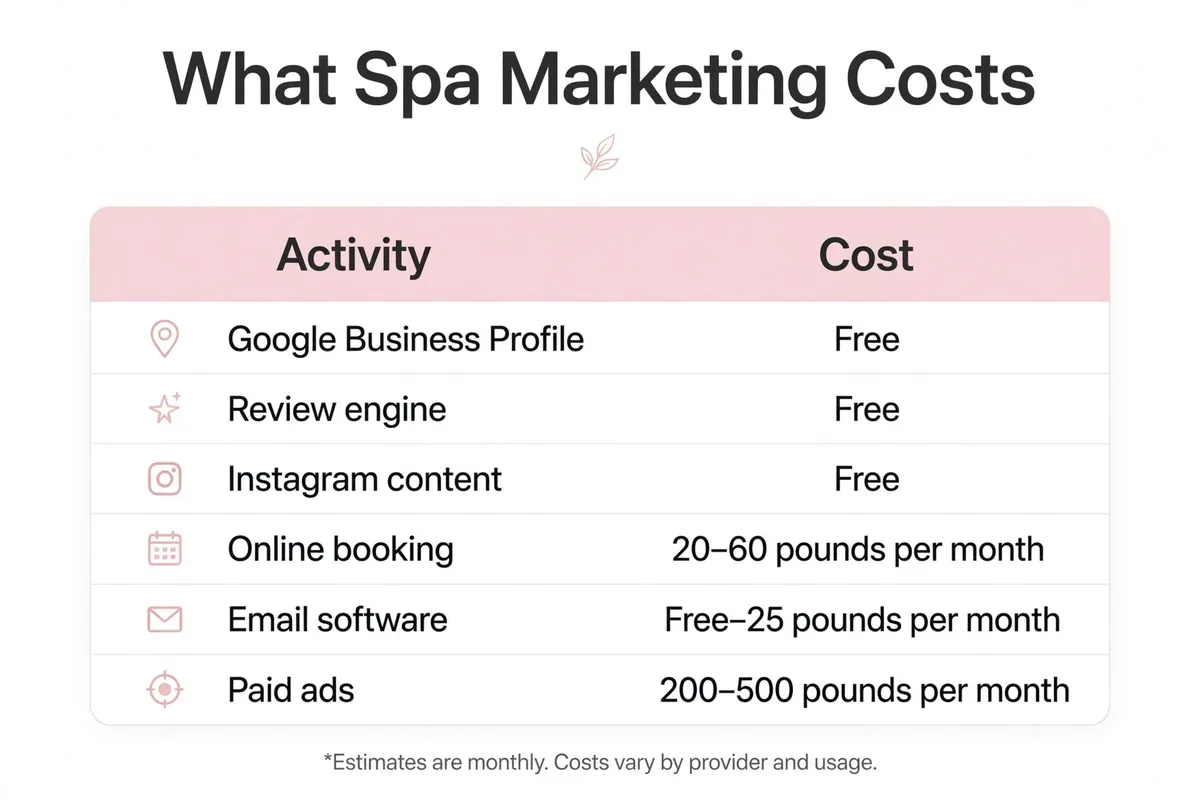
| Activity | Cost | Time to set up | Ongoing time |
|---|---|---|---|
| Google Business Profile | Free | 45 min | 10 min/week |
| Review engine | Free | 30 min | 5 min/day |
| Instagram/TikTok content | Free | 20 min/post | 2 to 3 hrs/week |
| Website that converts | £500 to £3,000 build | 2 to 4 weeks | 1 hr/month |
| Online booking system | £20 to £60/month | 1 to 2 hrs | 15 min/week |
| Gift voucher campaign (Christmas) | Design + ad cost | 1 day | Seasonal |
| Email/SMS software | Free to £25/month | 2 hrs | 1 hr/month |
| Membership launch | Free (your time) | 1 day | 30 min/week |
| Paid ads (Meta/Google) | £200 to £500/month to start | 1 day | 2 hrs/week |
| Signature scent + diffuser | £50 to £150 | 1 hr | Refills only |
| Help from a studio like ours | Quoted per project | , | , |
Most of spa marketing costs time, not money. Spend money only on what you can measure, a tracked ad with a booking link, or help from people who do this daily. Never spend what you cannot afford to lose while you are still learning what works.
Five mistakes that cost spas bookings
- Hiding your prices. “Prices on request” does not signal luxury, it signals effort. Guests compare three spas in a minute; the one without prices loses.
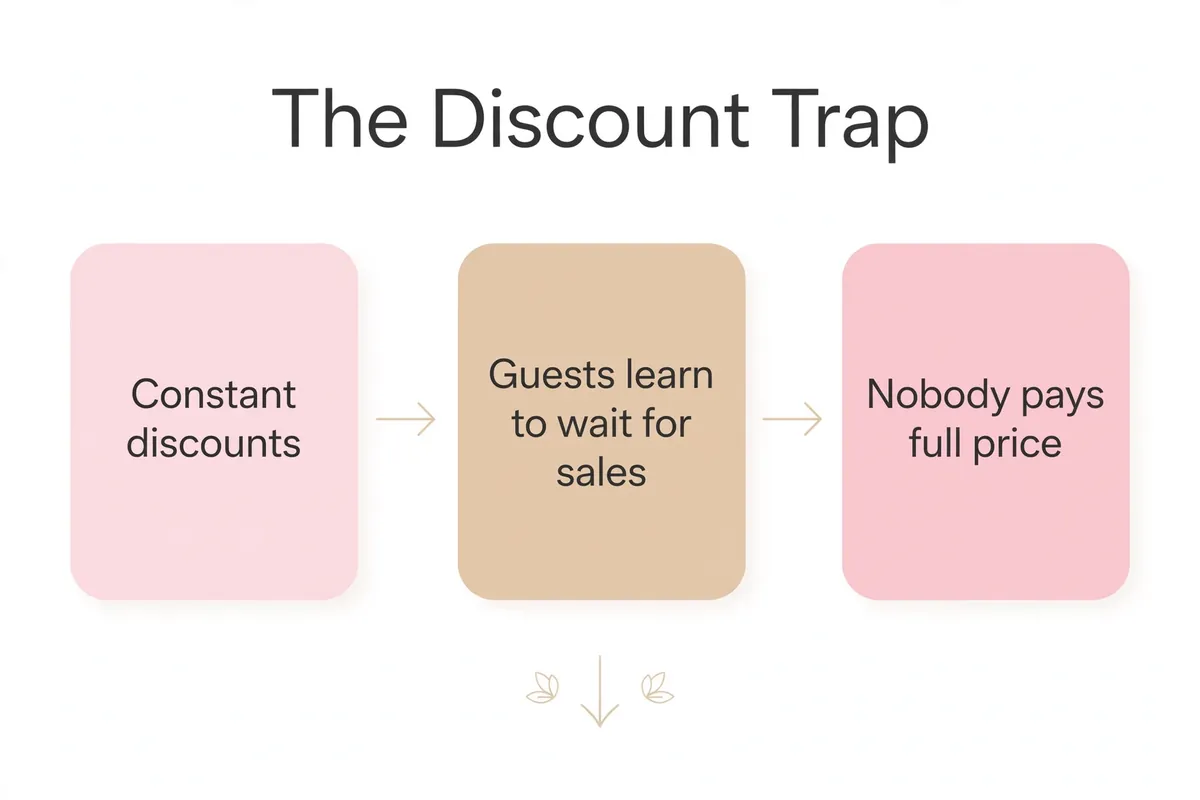
- Discounting so often that nobody pays full price. If there is always an offer on, guests learn to wait. Under UK advertising rules, discount claims must be genuine and provable, the ASA has banned brands for “was/now” prices they could not substantiate (Pinsent Masons summary of ASA rulings). Discount with a reason and a deadline, or bundle instead.
- Ignoring Google while obsessing over Instagram. Instagram builds desire; Google captures it. A guest who sees your Reel then searches your name needs to find a finished, review-rich profile, not a blank one.
- Texting a bought list. Bought lists almost never carry the specific consent PECR requires. One complaint to the ICO costs more than any campaign could ever earn. Build your own list from real guests.
- Letting guests leave without a next appointment. The rebooking script takes 20 seconds. Every guest who walks out unbooked is a guest you will pay to re-acquire.
Frequently asked questions
How do I attract more clients to my spa?
Start where spa guests already look: a complete Google Business Profile with prices, real photos and recent reviews. Add Instagram content that shows your space and names prices, a website that wins the 30-second comparison, and online booking with no friction. These four beat any single advertising campaign. (48 words)
What is the best marketing for a spa in the UK?
The combination of local search (Google Business Profile plus reviews), atmosphere-led Instagram content, a price-transparent website, gift vouchers at Christmas, and retention systems, memberships, rebooking at the chair, and legal email/SMS. Paid ads help once these foundations exist; running ads to a half-finished Google profile wastes money. (47 words)
How do I start marketing for my spa?
Pick the stage of the guest journey that hurts most using the decision table in this guide, and fix one stage this month. Most spas should start with their Google Business Profile (45 minutes), then their website’s prices and booking button. Do not try all six stages at once. (49 words)
How much should a spa spend on marketing?
Start with the free activities in this guide, most of spa marketing costs time, not money. When you spend, spend on what you can measure: a tracked ad with a booking link, or professional help. Never spend what you cannot afford to lose while you are still learning what works. (50 words)
Do spas need a website if they are on Fresha or Treatwell?
Yes. Booking platforms rent you visibility; your website is the one place you control the story, the prices and the booking, with no commission. Guests also check your website to decide whether you are the right spa before they book anywhere. A simple, fast, price-transparent site pays for itself. (49 words)
The bottom line
Spa marketing is not one big campaign, it is six stages, each feeding the next. Get discovered on Google, win the 30-second comparison, make booking effortless, make the visit unforgettable, rebook before they leave, and turn happy guests into reviewers and referrers. Fix the stage that hurts most first, and work through the rest in order.
Marketing your spa this way turns guesswork into a system, and systems fill diaries. If you want help building yours, from your Google presence to content that actually books, book a free 30-minute strategy call.
Free, 30 minutes, no obligation. We reply within one working day.
Last updated: October 2026