If your treatment rooms sit empty on a Tuesday while Saturdays sell out weeks ahead, you don’t have a demand problem, you have a plan problem. Most spa owners market in bursts: a panicked discount here, a flurry of Instagram posts there, then silence. These spa marketing strategies give you the opposite: a complete marketing strategy for your spa business that you can actually follow, a step-by-step spa marketing plan with a copy-paste template, a 90-day rollout, seasonal campaign ideas and honest costs. Written for day spas, hotel spas and destination spas across the UK.
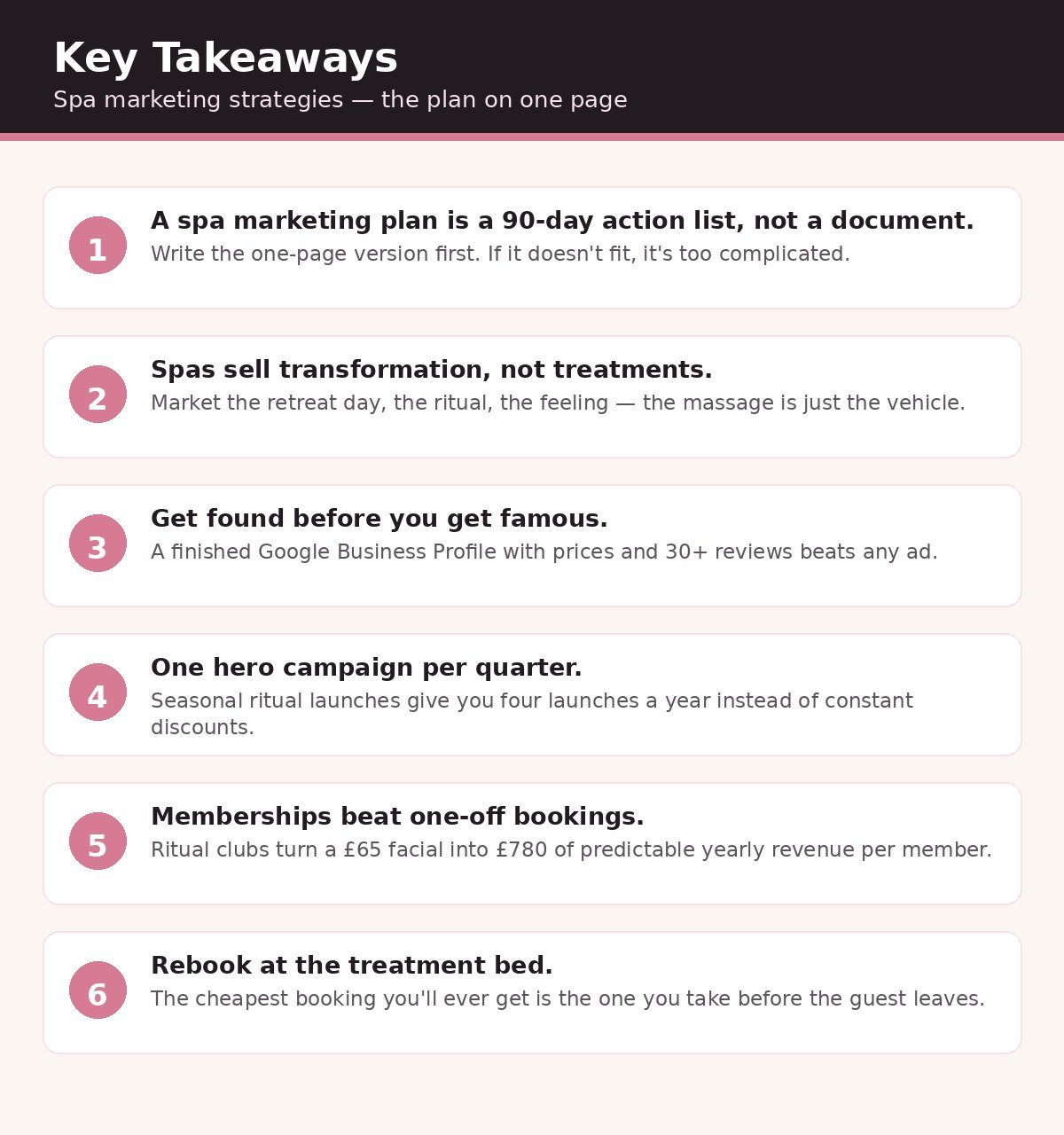
TL;DR, the plan on one page
- The plan: a 7-section, one-page-per-section spa marketing plan, snapshot, guest personas, positioning, offers, channels, quarterly campaigns, numbers.
- Get found first: a finished Google Business Profile plus a review engine beats any ad for local spa searches.
- Sell the feeling: market retreat days, rituals and transformations, and put your therapists’ names on them.
- Promote without discounting: one hero campaign per quarter (seasonal ritual launches) instead of constant sales.
- Keep them: ritual membership clubs and hotel partnerships turn one-off guests into repeat revenue.
Want a second pair of eyes on your spa marketing plan before you start? Book a free 30-minute strategy call, we’ll tell you which three moves fit your spa best.
Why spas need their own playbook. Spas are not salons with candles. The buying psychology is different. Salon clients buy maintenance, a cut every six weeks. Spa guests buy escape, occasion and transformation: a birthday retreat day, a pre-wedding glow ritual, a recovery package after a brutal quarter at work. Your marketing has to sell the feeling, not the treatment list.
The market is big and crowded. The Global Wellness Institute counts close to 3,800 spas in the UK worth £2.4 billion (Spa Business), and the UK Spa Association’s 2025 State of the Industry survey of 108 operators found hitting budget targets is the top challenge. The good news: Professional Beauty’s Value of Beauty report recorded 9% growth in UK consumer spending on beauty services in 2024 (Professional Beauty). The demand is there, the spas with a plan are the ones taking it.
Your spa marketing plan template: the 7 sections
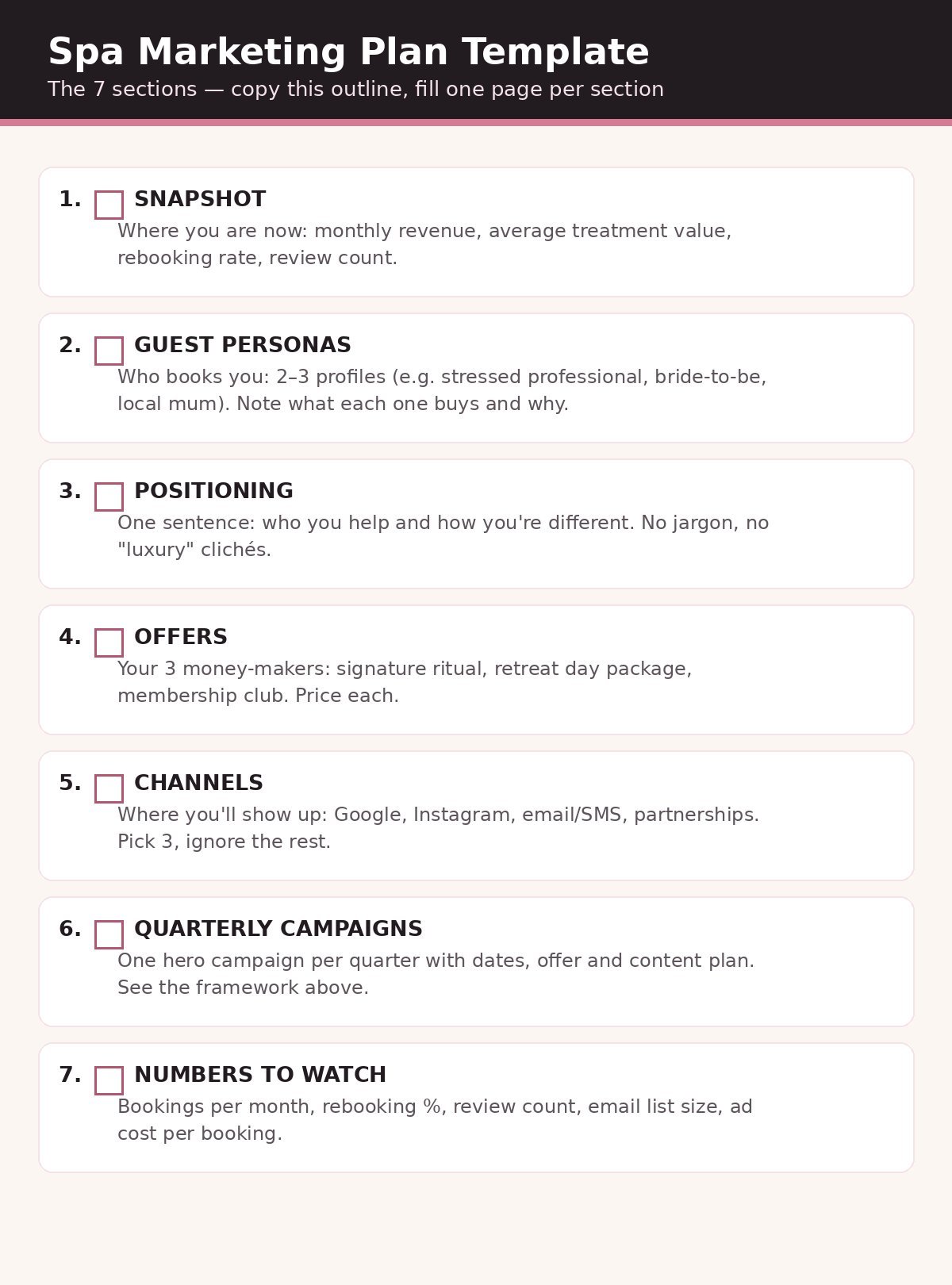
A spa marketing plan is not a 20-page document nobody reads. It’s a working plan, one page per section, that you pin above your desk. Copy this outline. It works as your spa marketing plan template and your spa marketing plan sample in one:
1. Snapshot, Where you are now: monthly revenue, average treatment value, rebooking rate, Google review count. 2. Guest personas, Two or three profiles of who books you (the stressed professional, the bride-to-be, the local mum treating herself). Note what each one buys and why. 3. Positioning, One sentence on who you help and how you’re different. No jargon, no "luxury haven" clichés. 4. Offers, Your three money-makers: a signature ritual, a retreat day package, a membership club. Price each. 5. Channels, Where you’ll show up: Google, Instagram, email/SMS, partnerships. Pick three and ignore the rest. 6. Quarterly campaigns, One hero campaign per quarter, each with dates, an offer and a content plan. 7. Numbers to watch, Bookings per month, rebooking percentage, review count, email list size, cost per booking.
Now let’s fill it in, step by step.
Step 1: Know your numbers before you spend a penny
A marketing plan for a spa business starts with honesty about where you are. Pull four numbers this week: monthly revenue, average treatment value, what percentage of guests rebook, and how many Google reviews you have. Everything in this plan moves one of those four numbers. If a tactic doesn’t, skip it.
Then pick your starting point:
| Your situation | Start with these three |
|---|---|
| Day spa, quiet midweek | Retreat day packages · one hotel partnership · finished Google profile |
| Hotel spa, low local awareness | Local SEO · seasonal ritual launch · corporate gifting |
| New spa, small budget | Google profile · review engine · therapist-led Instagram |
| Established but discount-dependent | Ritual club · quarterly campaigns · win-back emails |
And here’s what each move honestly costs:
| Tactic | Cost | Time |
|---|---|---|
| Google Business Profile setup | Free | 1 hour, then 10 min/week |
| Review request system | Free | 30 minutes to set up |
| Instagram, 3 posts a week | Free | 2 to 3 hours/week |
| Email/SMS software | £15 to £30/month | 2 hours/month |
| One Meta ad campaign | £200 to £500/month | 1 hour/week to monitor |
| Ritual membership club | Free to £50/month software | 3 hours to set up |
| Hotel partnership | Free | 2 to 3 hours to arrange |
| Seasonal ritual launch | Treatment development time | 4 to 6 hours per quarter |
Most of a spa business marketing plan costs time, not money. Spend money only on what you can measure.
Step 2: Digital spa marketing strategies, get found first
Spa searches are local and high-intent: "day spa near me", "couples massage York", "spa day with afternoon tea". Nobody books from a half-finished listing. These digital spa marketing strategies come before everything else.
Finish your Google Business Profile
This is the single highest-return hour in spa marketing. Do it this week:
- Claim and verify your profile via Google’s official Business Profile help page.
- Choose the most specific category, "Day spa", "Massage spa" or "Wellness centre", not just "Spa".
- List every treatment with prices. "60-minute deep tissue massage from £65" beats a price list hidden behind a PDF.
- Add 10+ real photos: treatment rooms, relaxation lounge, therapists at work, not stock images.
- Add your booking link and turn on messaging. Reply to every review within 48 hours.
For the full walkthrough, see our guide to local SEO for salons, the same principles apply to spas.
Build a review engine (set this up in under an hour)
Reviews are the reason a stranger picks your spa over the one down the road. Most spas just hope guests leave one. Hope is not a system. Here’s the system, and it takes under an hour to set up:
- Copy your Google review link (find it in your Business Profile dashboard).
- Save this text in your phone and your booking software:
Hi [name], we hope you’re still floating after your [treatment] today. If you have 30 seconds, a Google review would mean the world to our small team: [your review link]. Thank you for choosing us.
- Say it in person at checkout: "If you loved your treatment today, a Google review would mean everything to us, I’ll text you the link."
- Send the text within 24 hours of the appointment.
Aim for two to three new reviews a week. Steady and believable beats a sudden flood.
Make your website take bookings
Your website has one job: turn a search into a booking. That means your treatments, prices, location and a booking button above the fold on mobile, loading fast. If your site reads like a brochure and books like a maze, it is costing you guests every week. This is what a spa website built to take bookings looks like, and if review management feels like a second job, our reputation management service exists for exactly that.
Step 3: Content that sells the experience, not the treatment
Nobody books a spa from a price list. They book from a feeling, and your content is where that feeling lives. Three rules for spa content:
Film the ritual, not the room. A 30-second Reel of the hot towel being placed, the scalp massage, steam rising off the stones, that sells. Another slow pan across an empty treatment room does not. Post three times a week: one ritual close-up, one therapist moment, one guest-facing tip ("what to expect at your first hot stone massage").
Build your therapists’ personal brands. This is the most underused spa marketing strategy there is. Name your therapists, their specialities and their signature treatments. "Book Amara’s Signature Glow Facial" will always outperform "book a facial". Give each therapist one content slot a week and let guests choose *them*. Therapists with a following bring their own demand, and stay longer.
Write captions that answer the three questions. Every viewer is thinking: what is it, what does it cost, how do I book?
Weak caption: "Relax and unwind with our spa day 💆♀️✨ #spaday #selfcare"
Better caption: "Our Winter Recovery Retreat: 3 hours, hot stone back massage, glow facial and afternoon tea, £129. January dates just opened. Tap the link in bio to book, or DM RETREAT and we’ll find you a slot."
The better version works because it names the package, the price and the next step. If creating this kind of content every week feels like a second job, our social media management takes it off your plate.
📞 Turn your quietest days into your most profitable
These strategies work, but they work faster with a plan built around your spa. Book a free 30-minute strategy call and we’ll map your next 90 days together.
Free, 30 minutes, no obligation. We reply within one working day.
Step 4: Spa marketing promotions that protect your pricing
Here is the trap most spas fall into: quiet week, panic discount, full diary, empty profit. Do it often enough and guests learn to never pay full price. These spa marketing promotions fill rooms without training anyone to wait for a sale.
Sell retreat day packages, not discounts
Bundle treatments, lunch and robe time into one named package with one price. Example (illustrative, not a client result): "The Reset Day, 9:30am to 3pm, hot stone back massage, glow facial, two-course lunch, full use of the relaxation lounge and gardens. £139." Packages feel premium; percentage discounts feel cheap. Packages also raise your average booking value in a single move, one £139 booking instead of one £65 treatment.
Launch one seasonal ritual per quarter
Instead of discounting year-round, give guests four reasons a year to book at full price. Each quarter gets one hero campaign: a named, limited-date ritual with four weeks of content behind it.
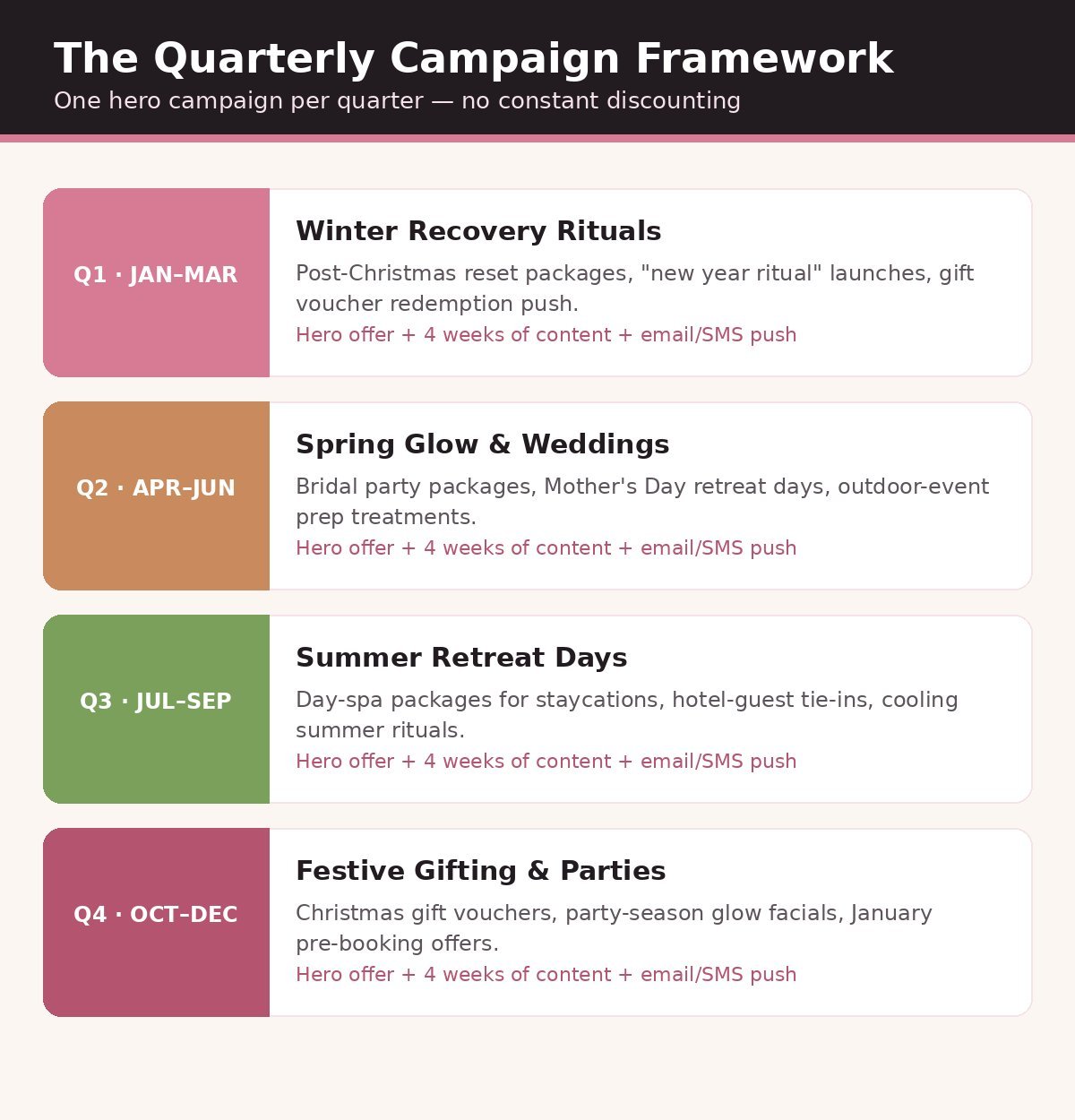
- Q1 (Jan to Mar): Winter Recovery Rituals, post-Christmas reset packages, gift voucher redemption push.
- Q2 (Apr to Jun): Spring Glow & Weddings, bridal party packages, Mother’s Day retreat days.
- Q3 (Jul to Sep): Summer Retreat Days, day-spa packages for staycations and hotel-guest tie-ins.
- Q4 (Oct to Dec): Festive Gifting, Christmas gift vouchers, party-season glow facials, January pre-booking offers.
Keep every promotion ASA-safe
Under UK advertising rules, any discount claim must be genuine and provable, the ASA has banned brands for "was/now" prices they couldn’t substantiate (Pinsent Masons summary of ASA rulings). Safe ways to run spa marketing promotions:
- A genuine first-visit offer with clear dates: "New guests: £20 off your first ritual this month."
- Bundle, don’t slash: "Two rituals and lunch, £139" instead of chopping treatment prices.
- Gift with booking: a travel candle or 10ml oil with every retreat day in February.
- Avoid "up to 50% off" unless you can prove a meaningful number of treatments are genuinely discounted that much.
Legal note on texts and emails: under PECR, the UK’s electronic marketing rules, you need consent (or the "soft opt-in" for existing customers buying similar services) before sending marketing texts or emails, and every message must offer an opt-out. The ICO’s direct marketing guidance explains it plainly. This is general information, not legal advice.
Step 5: Ritual clubs and partnerships, the retention engine
New guests are expensive. Regulars are profitable. This step is about keeping them.
Open a ritual membership club
A membership club turns a £65 facial into £780 of predictable yearly revenue per member, and members visit twelve times a year instead of twice. Example (illustrative, not a client result): a "Monthly Glow Club" at £65 a month: one 60-minute facial, 10% off retail, priority booking at Christmas. Forty members is £2,600 a month you can count on before the month starts. Keep it simple: one tier, one hero treatment, direct debit. You can always add tiers later.
Two habits feed the club. First, rebook at the treatment bed: "Your skin will want this again in about four weeks, shall I book you in for [date]?" Twenty seconds, and it’s the cheapest booking you’ll ever take. Second, win back lapsed guests with a personal text (only to guests who agreed to marketing messages): "Hi [name], it’s [your name] from [spa]. We haven’t seen you in a while, we’d love to have you back. Here’s £15 off any ritual booked before [date]: [booking link]. Reply STOP to opt out."
Partner with hotels that don’t have a spa
Hotel-spa partnerships are the highest-leverage move for an independent spa. Find hotels, B&Bs and wedding venues within 20 minutes that have no treatment rooms. Offer their guests 10% off, leave your brochures at their reception, and recommend them in your "spa break" packages. One good hotel partner can send you a steady stream of guests who’ve never heard of you and arrive ready to spend. Add corporate "team reset" half-days for local businesses and bridal packages with wedding venues, and you have three partnership channels that cost nothing to start.
Your 90-day rollout plan
Don’t try everything at once. Work in three phases, each one builds on the last.
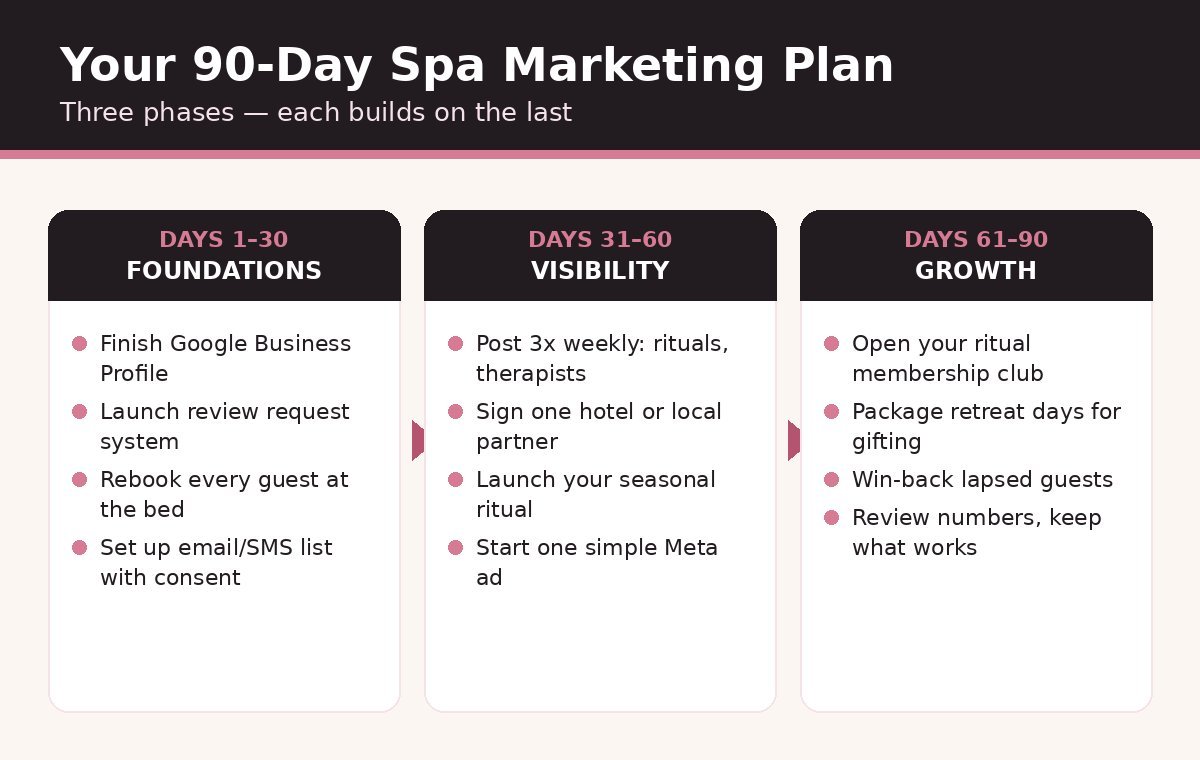
- Days 1 to 30: Foundations. Finish your Google Business Profile, launch the review engine, start rebooking at the treatment bed, set up your email/SMS list with proper consent.
- Days 31 to 60: Visibility. Post three times a week (rituals, therapists, tips), sign one hotel or local partner, launch your first seasonal ritual, start one simple Meta ad to a 10-mile radius.
- Days 61 to 90: Growth. Open your ritual membership club, package retreat days for gifting, run a win-back campaign for lapsed guests, then review your numbers and keep what worked.
By day 90 you’ll know exactly which three channels drive your bookings, that’s your plan for the next quarter.
5 mistakes that cost spas bookings
- Living on discounts. If there’s always a sale on, guests learn to wait. Promote with a reason and a deadline, a seasonal ritual launch, or bundle instead of discounting.
- "Up to 50% off" claims you can’t prove. The ASA requires documentary evidence for price claims. One complaint can get your ad banned and your name published in a ruling.
- Buying a marketing list and texting it. Bought lists almost never carry the specific consent PECR requires. Build your own list from real guests.
- Boosting Instagram posts with no booking link. If a guest can’t tap through to book, the ad is decoration. Every paid post needs a booking link and a deadline, or don’t run it.
- A beautiful Instagram and a blank Google profile. Instagram builds desire; Google captures it. A guest who sees your Reel then searches your name needs to find prices, photos and recent reviews, not an empty listing.
Frequently asked questions
What should a spa marketing plan include?
Seven sections: a snapshot of your current numbers, two to three guest personas, a one-sentence positioning, your three money-making offers, three marketing channels, one hero campaign per quarter, and five numbers to watch monthly. Keep it to one page per section so you actually use it. (46 words)
How much should a spa spend on marketing?
Start with the free moves in this guide, a finished Google profile, review engine, rebooking habit and organic content cost nothing but time. When you spend, spend on what you can measure: one tracked Meta ad (£200 to £500/month) or email software (£15 to £30/month). Never spend what you can’t afford to lose while learning. (51 words)
How can I market my spa with no budget?
Finish your Google Business Profile with prices and photos, ask every happy guest for a review, rebook at the treatment bed, post three ritual Reels a week, and approach one nearby hotel for a partnership. All five are free and together they cover being found, being trusted and being rebooked. (50 words)
Is Instagram or Google more important for spas?
Google, by a small margin, spa searches are local and high-intent ("day spa near me"), and the booking decision happens on your Google profile. Instagram builds the desire that sends people to Google. Do Google first, then add Instagram; never the other way round. (44 words)
How do I fill my spa in quiet months like January?
Launch a seasonal ritual instead of a sale: a "Winter Recovery Retreat" with limited January dates, pushed to your email list and past gift-voucher buyers. Pair it with a win-back text to guests who haven’t visited in three months. Quiet months reward planning, not panic discounting. (46 words)
The bottom line. The best spa marketing strategies aren’t complicated. Be easy to find on Google, show the experience, not the price list, on social, ask happy guests for reviews, rebook before they leave, and give people four full-price reasons a year to come back. Do those things consistently and the quiet Tuesdays start filling.
If you want help doing it properly, your plan, your content and your Google presence handled for you, book a free 30-minute strategy call.
Free, 30 minutes, no obligation. We reply within one working day.
Last updated: October 2026