If your diary has quiet gaps and no-shows keep creeping up, salon text message marketing might be the cheapest fix you haven’t tried. A text lands in your client’s pocket, no algorithm, for a few pence. But UK marketing texts come with real rules: PECR consent, an opt-out in every message, and fines that grew sharply in 2025. This guide covers the UK rules in plain English, a five-step setup and 11 copy-paste SMS templates, each with its character count.
TL;DR, the essentials
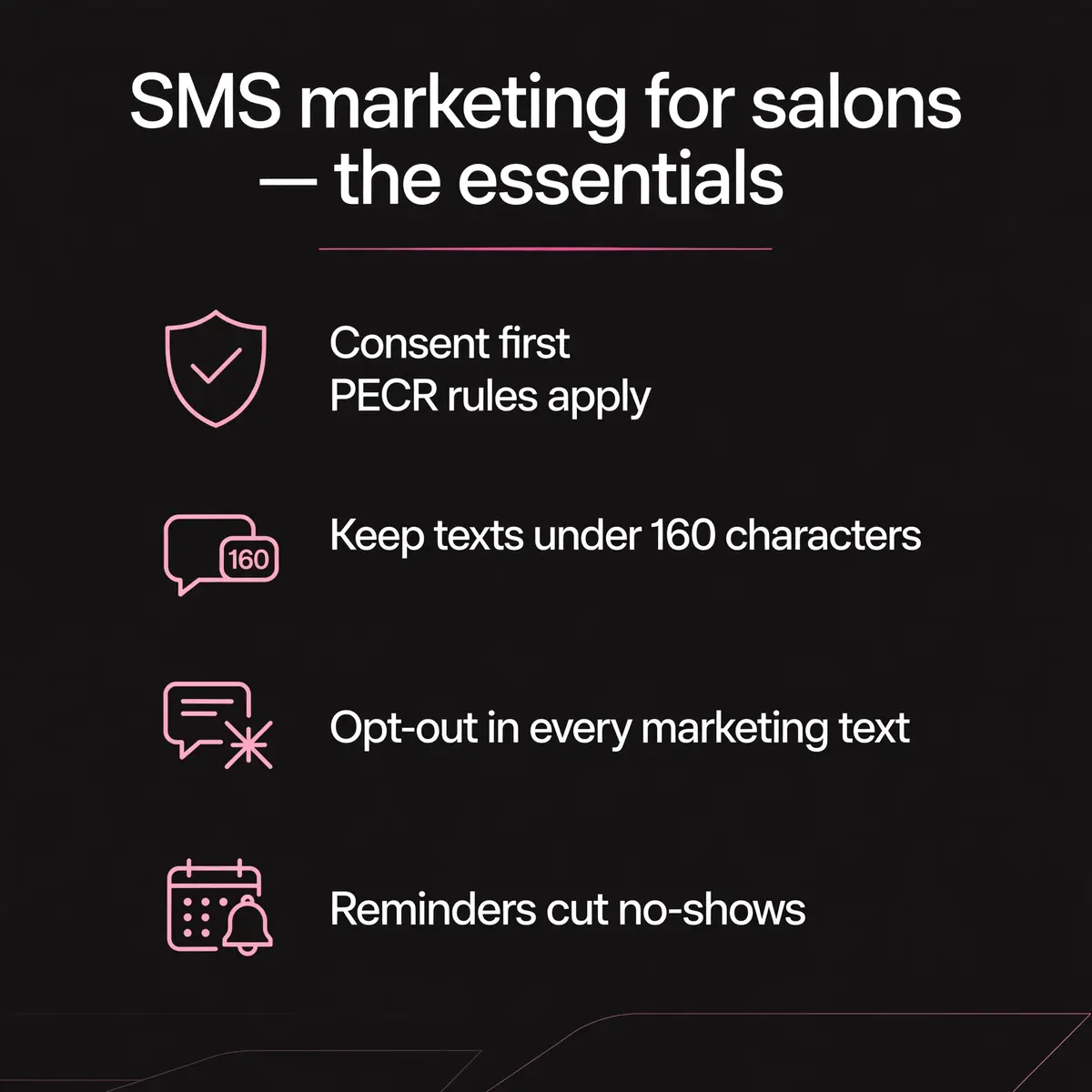
- Two jobs: service texts (reminders, confirmations) cut no-shows; marketing texts (offers, win-backs) fill gaps.
- The law: PECR requires consent for marketing texts, or the "soft opt-in" for existing customers, plus an opt-out in every message.
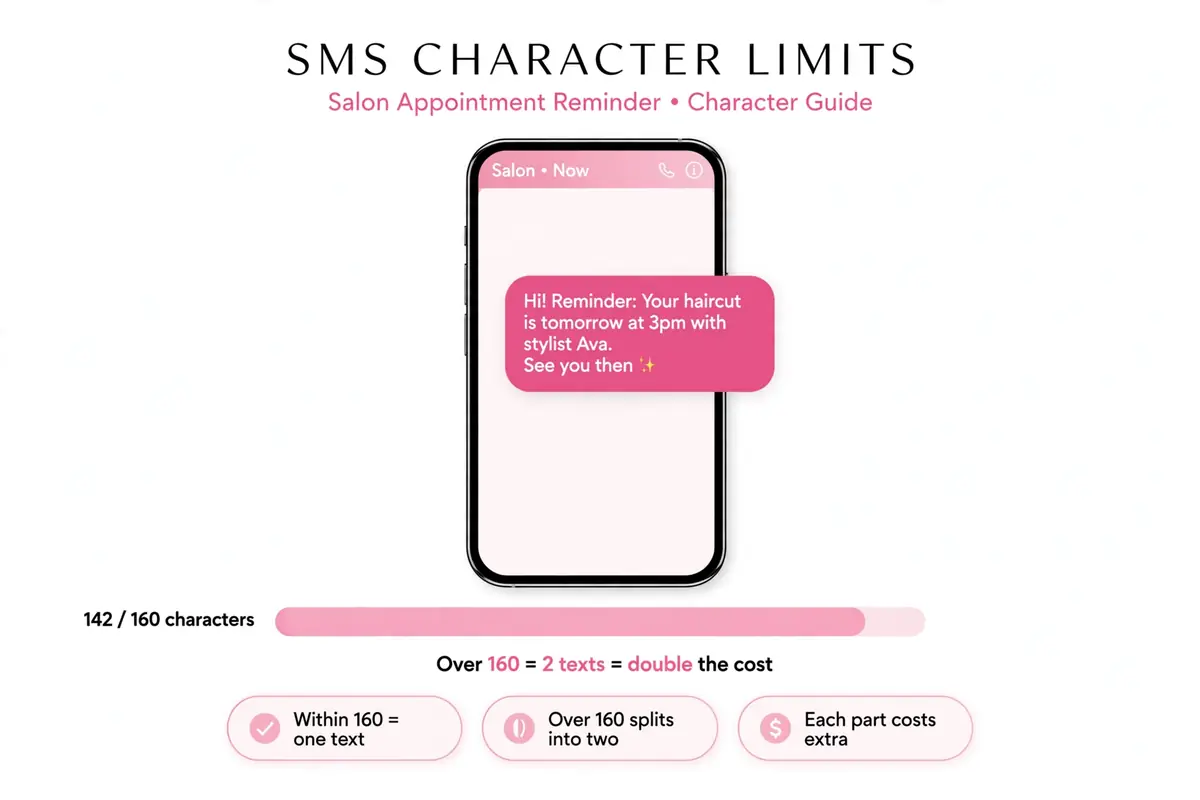
- The cost rule: 160 characters per text. Go over and you pay for two.
Setting up salon text marketing? Book a free 30-minute strategy call, we’ll review your consent and list setup before you send a thing.
Why salon text message marketing works
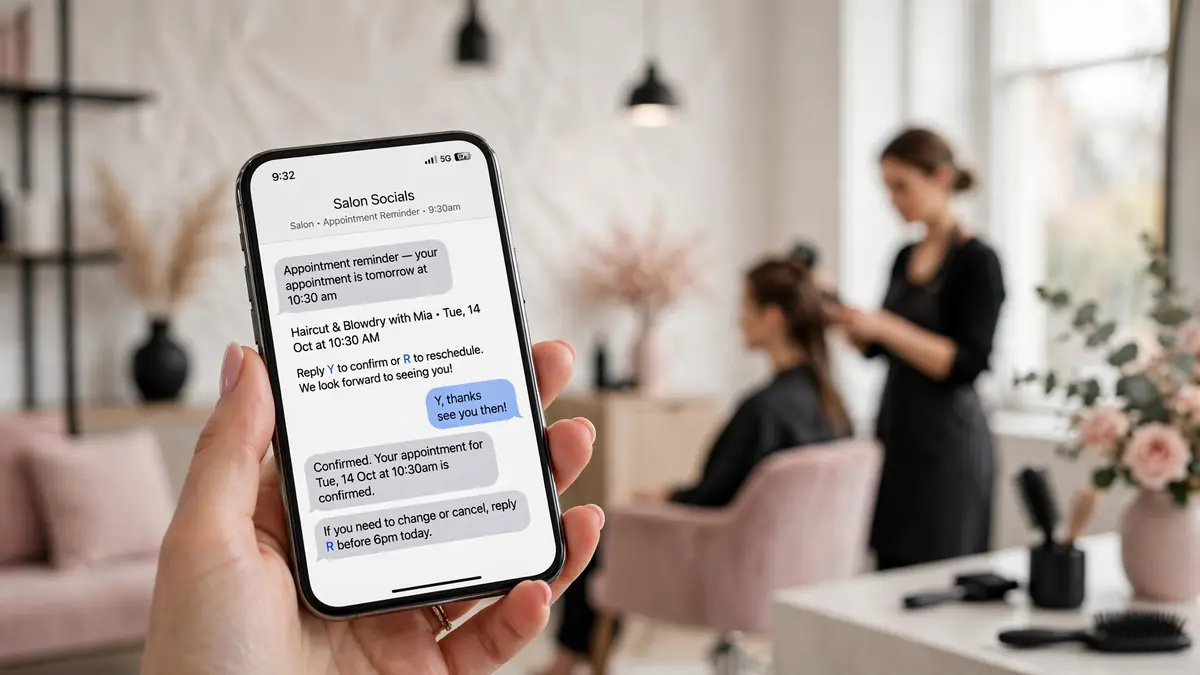
Two jobs, and the law treats them differently. Service texts (reminders, confirmations, slot alerts) cut no-shows, most booking systems send them automatically. Marketing texts (offers, win-backs, birthday treats) drum up business; these are the ones PECR cares about. Your list is small and warm; "Reply YES" beats any booking form. It pairs with social: Instagram creates desire, a text captures the booking, see our social media management for salons.
The UK rules: PECR and GDPR in plain English
Most salon SMS guides skip this section. Don’t. The UK’s Privacy and Electronic Communications Regulations (PECR) govern marketing texts and the ICO enforces them. What follows is general information, not legal advice, the ICO’s direct marketing guidance is the authoritative source.
The core rule: you need prior consent before sending marketing texts to individuals (Regulation 22 of PECR). There are exactly two lawful routes:
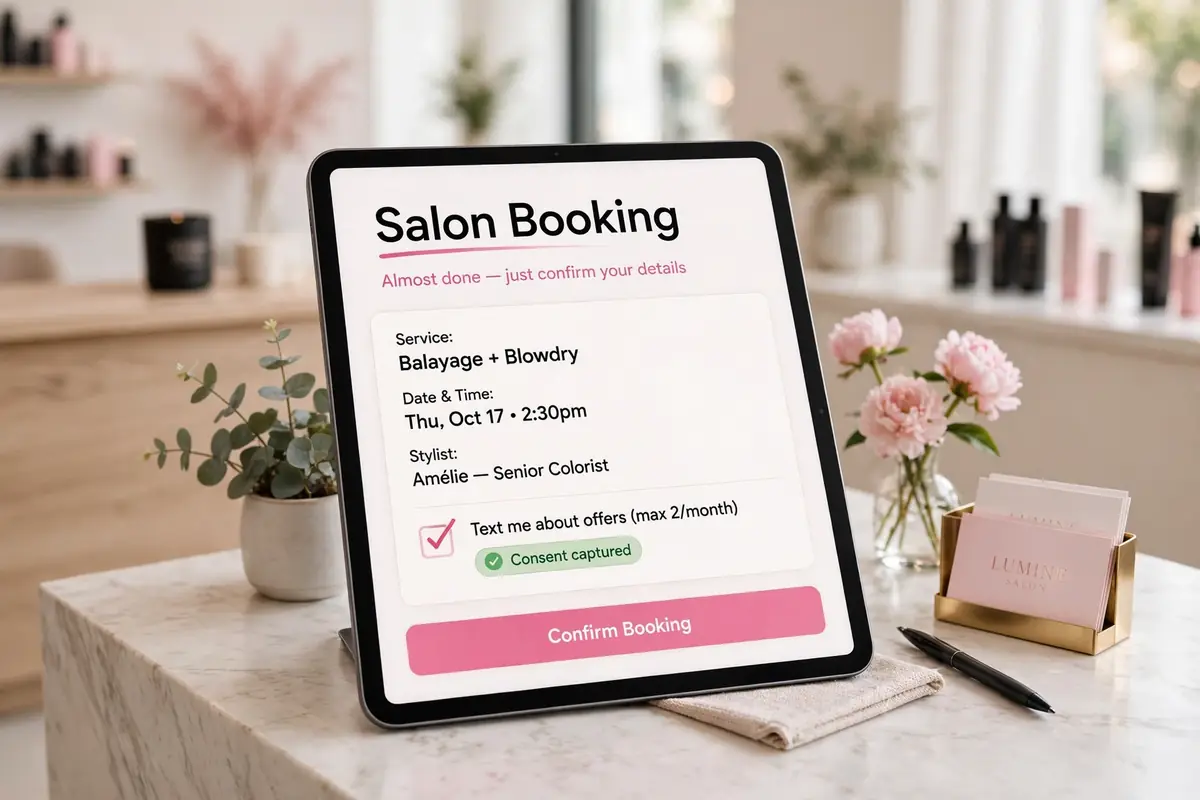
1. Fresh consent. The client actively agrees to marketing texts. Consent must be freely given, specific, informed and unambiguous: a separate, unticked tick-box at booking (never pre-ticked or buried in terms), saying what they’ll receive and how to opt out. Record every consent, when, how, exact wording, and keep a suppression list of opt-outs.
2. The soft opt-in (existing customers). You can text marketing messages without fresh consent only if all four of these are true at once:
- You got their number during a sale (or negotiations for a sale) of your services;
- You’re marketing your own similar services (salon treatments to a salon client, yes; a partner’s unrelated product, no);
- You gave them a clear, free chance to opt out when you collected their number;
- Every message you send gives them a simple way to opt out.
Miss any one of the four and the soft opt-in doesn’t apply, get fresh consent instead.
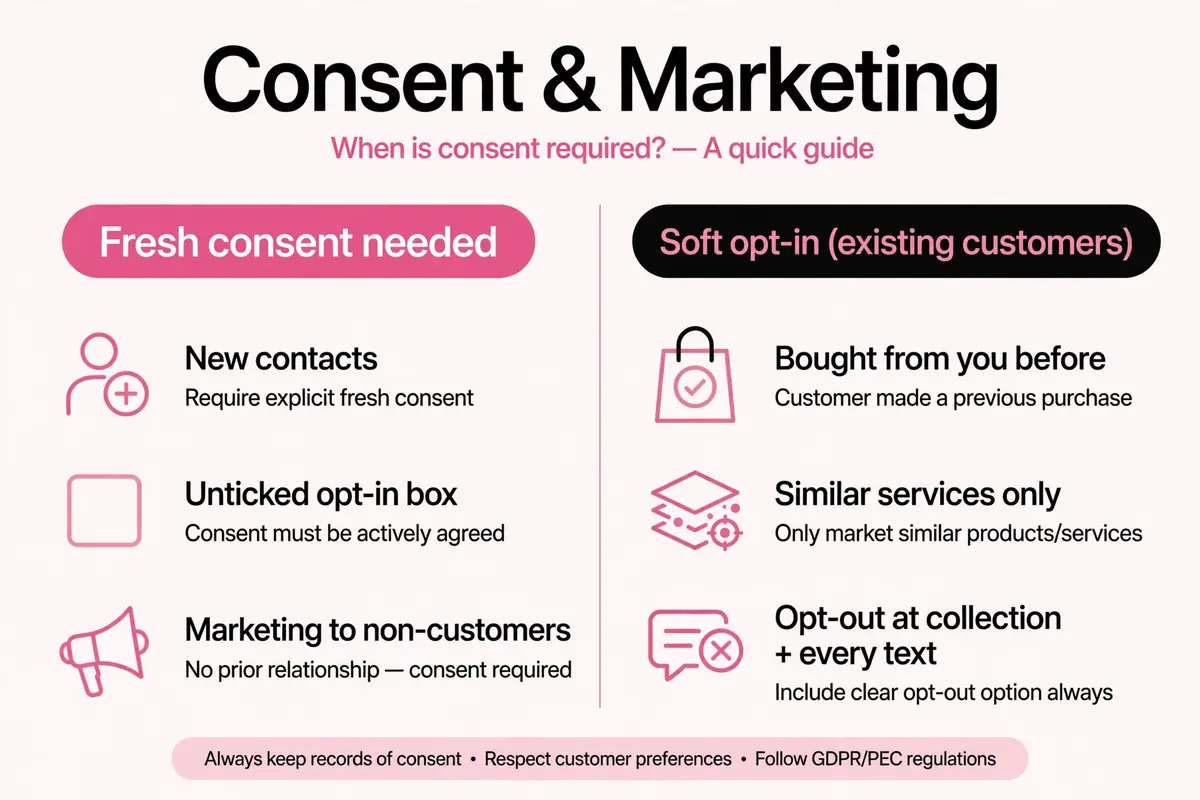
Every marketing text must identify your salon and offer a simple opt-out ("Reply STOP to opt out"). Honour opt-outs immediately, good platforms process STOP replies automatically.
Three things that catch salons out:
- Bought lists are a non-starter. Consent given to someone else almost never counts, build your own list from real clients.
- Reminders are not marketing. Confirming a booked appointment is a service message, no marketing consent needed. Sneak an offer in and it becomes marketing.
- The fines got serious. The Data (Use and Access) Act 2025 raised the ICO’s maximum PECR penalty from £500,000 to up to £17.5 million or 4% of global turnover (Griffin House Consultancy summary). The biggest penalties target the worst offenders, but the rules apply to everyone.
The 160-character rule (and why your sender ID matters)
A standard text holds 160 characters, one "segment", and it’s what you pay for. Hit 161 and it sends as two: the client sees one text, you pay double. Every template below shows its count. Emoji can shrink a segment to 70 characters, and long links eat 20+, use a short link.
Then there’s the sender ID, the name or number your text appears to come from. Two options: your salon name as text (up to 11 characters), professional but one-way; or a real mobile number, clients can reply "YES" to confirm.
Many salons choose a real number precisely because replies drive confirmations. One heads-up: under Ofcom’s strengthened anti-scam rules, providers must now verify sender IDs against the business behind them (Telecoms.com summary), expect to provide business details at signup.
How to set up text message marketing for a salon: 5 steps
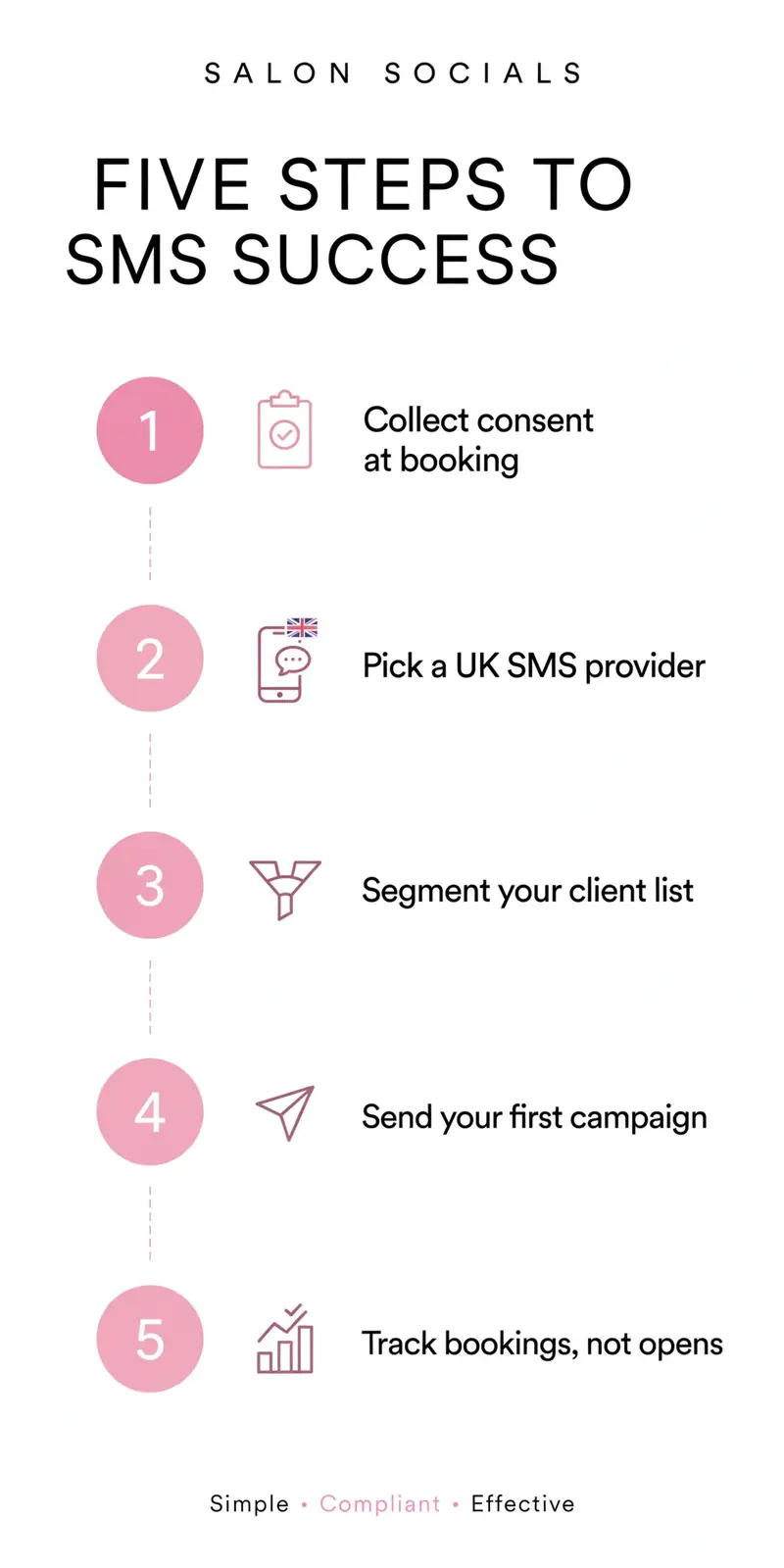
1. Collect consent at booking. Add one unticked tick-box to your booking form: "☐ Text me about offers (max 2/month). Reply STOP to opt out anytime." Record it, most salon software stores marketing preferences per client.
2. Pick a UK SMS provider. You want pay-as-you-go pricing, automatic STOP handling, and two-way replies for confirmations. The basic tier of any established UK provider covers a salon.
3. Segment your list. Active, lapsed (3+ months), waitlist, birthday month. Don’t blast everyone, a win-back sent to last week’s happy client looks sloppy.
4. Send your first campaign. Start with reminders, then one win-back text to lapsed clients. Measure both.
5. Track bookings, not opens. Ignore "open rates". Count bookings with a unique link per campaign, or ask clients to mention the text.
11 copy-paste salon SMS templates (with character counts)
Replace the bracketed bits. Counts are for the template as written, re-check with real names and links. These salon text message marketing examples form a complete sms marketing for salon template library, your salon text message marketing template pack: every item marked marketing needs consent or a valid soft opt-in, and the opt-out line is already built in.
Appointment reminders (service messages)
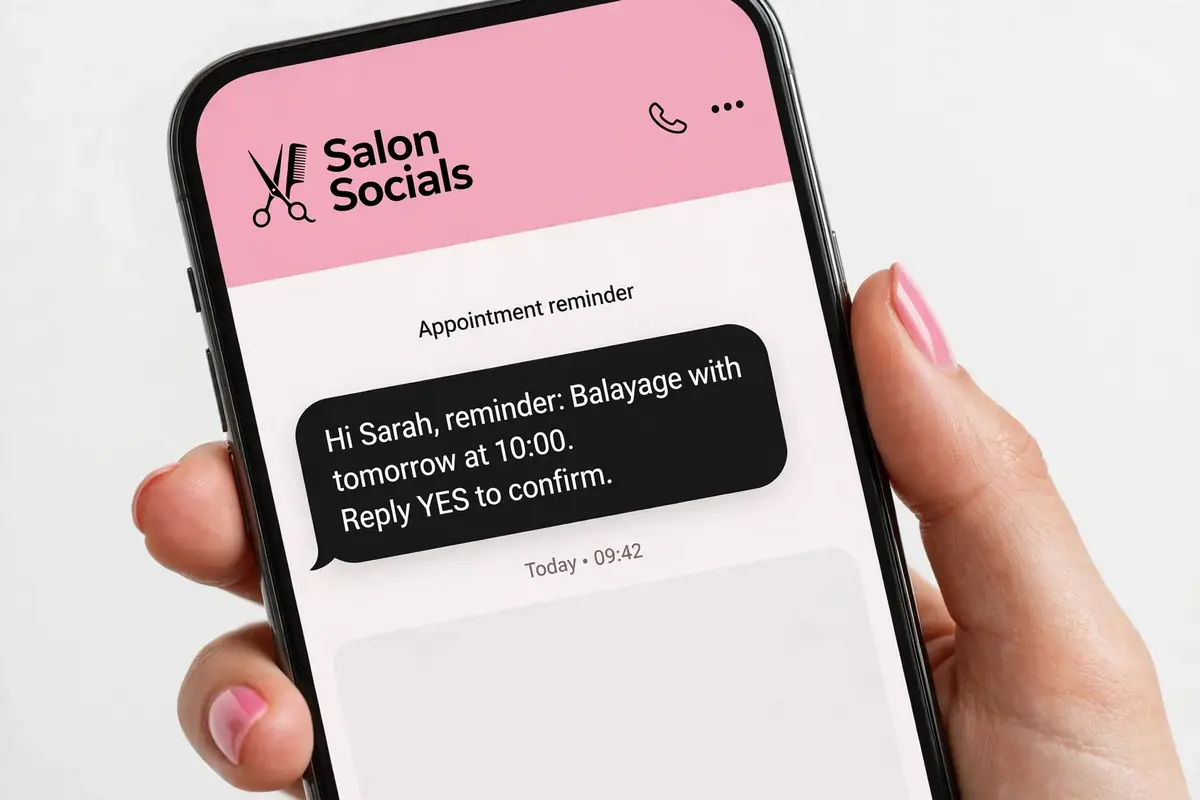
1. The 48-hour reminder, 129 characters, most booking systems send this automatically; switch it on first.
Hi [Name], reminder: [Service] with [Stylist] on [Day] at [Time] at [Salon]. Reply YES to confirm, or call [number] to rearrange.
2. The day-before nudge, 125 characters, add the address for first-time clients.
Hi [Name], see you tomorrow at [Time] for [Service] with [Stylist]. [Salon], [address]. Running late? Reply or call [number].
3. The waitlist gap-fill, 121 characters, waitlist only; a slot alert to a willing list is a service message.
Hi [Name], a [Service] slot opened today at [Time] with [Stylist]. Want it? Reply YES, first come, first served. [Salon]
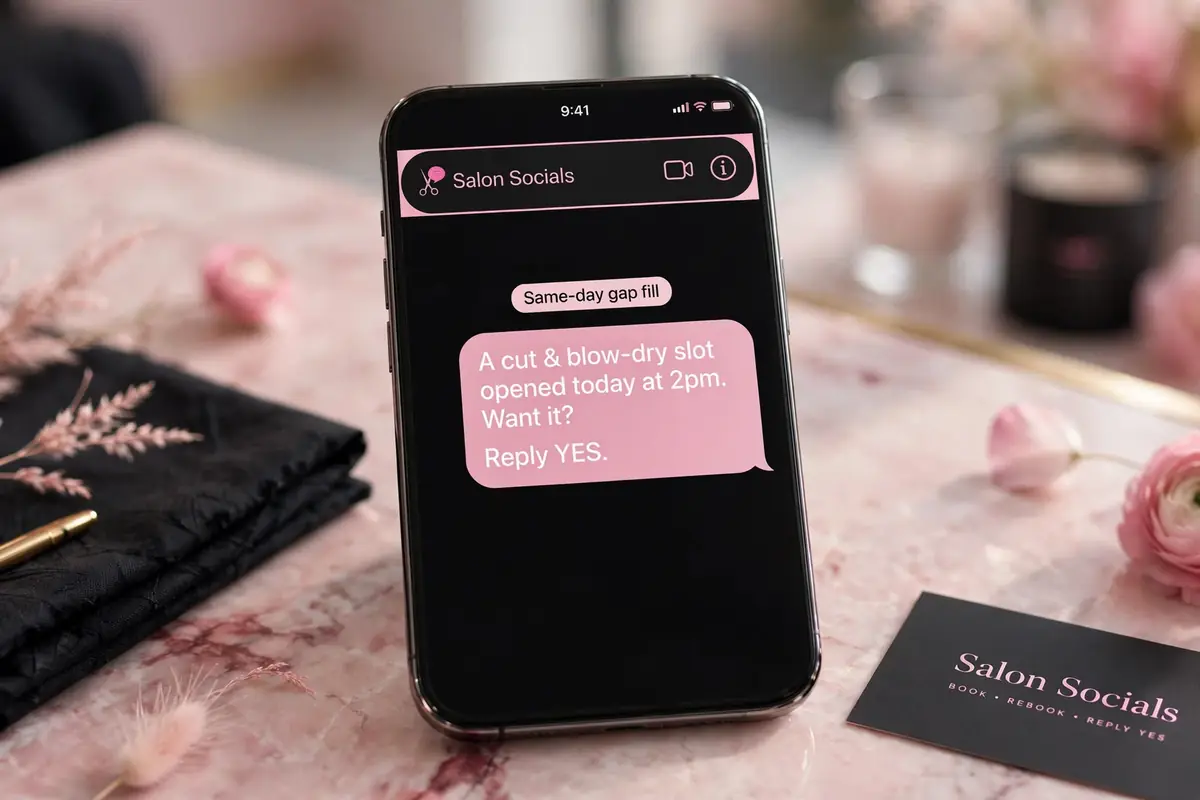
The gap-fill text: a same-day slot alert to a willing waitlist, no offer inside, so no consent needed.
Rebooking and reviews
4. The rebook nudge, 121 characters · marketing, time it to the service: 4 weeks for roots, 6 for cuts.
Hi [Name], it’s been [X] weeks since your [Service] at [Salon], time for a refresh? Book: [link]. Reply STOP to opt out.
5. The review request, 123 characters, keep it a pure thank-you; add an offer and it becomes marketing.
Hi [Name], thanks for visiting [Salon] today! Loved it? A quick Google review would mean a lot: [link]. Thanks, [Stylist] x
Reviews compound, see our reputation management for salons.
Offers and promotions (marketing messages)
6. The quiet-afternoon offer, 121 characters · marketing, same-day and expiring; never a standing discount.
Quiet afternoon at [Salon]! Book any [Service] today before 4pm and get 20% off: [link]. Ends 4pm. Reply STOP to opt out.
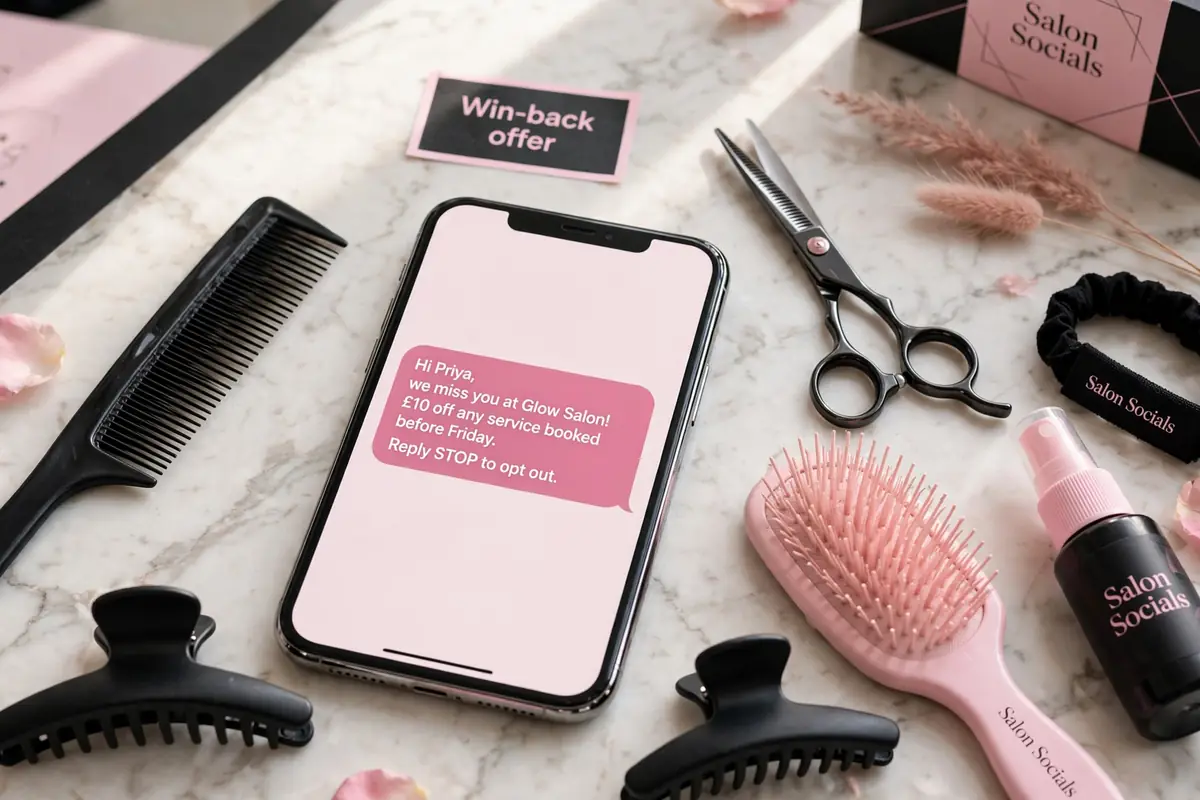
7. The win-back, 107 characters · marketing, for clients gone 3+ months; twenty cost under a pound.
Hi [Name], we miss you at [Salon]! £10 off any service booked before [date]: [link]. Reply STOP to opt out.
8. The new-service announcement, 102 characters · marketing, “First 10” creates the reason to book now.
New at [Salon]: [Service] from £[price]! First 10 bookings get 15% off: [link]. Reply STOP to opt out.
Special occasions
9. The birthday treat, 117 characters · marketing, collect birthday + consent at booking; then it runs itself.
Happy birthday, [Name]! £10 off any treatment at [Salon] this month, our gift to you: [link]. Reply STOP to opt out.
10. The Christmas push, 107 characters · marketing, send mid-October, not December.
Party season books out fast! Secure your Christmas [Service] at [Salon] now: [link]. Reply STOP to opt out.
Growing your list
11. The welcome and consent capture, 133 characters, a reply of OFFERS is clean, documented consent.
Hi [Name], welcome to [Salon]! You’re booked for [Service] on [Day] at [Time]. Reply OFFERS for occasional offer texts (max 2/month).
📱 Want these tailored to your salon?
Templates get you started; a proper setup gets you bookings. Book a free 30-minute call and we’ll map your first campaign together.
Free, 30 minutes, no obligation. We reply within one working day.
4 mistakes that cost salons money
- Texting a bought or scraped list. No valid consent means a PECR breach from message one, and bought numbers never book anyway.
- Hiding a promotion inside a reminder. The moment a service text carries an offer, it becomes a marketing text and needs consent plus an opt-out.
- Forgetting the opt-out. Every marketing text must offer a way out. Honour STOP replies immediately, your provider should automate this.
- Texting at 2am. UK law sets no quiet hours, but overnight offers earn complaints and opt-outs. Stick to roughly 9am to 8pm.
What does salon SMS marketing cost?
| What | Typical cost | Notes |
|---|---|---|
| Text messages | A few pence each | Pay-as-you-go; one segment = 160 characters |
| SMS platform | Free to £20/month | Basic tiers cover a salon’s volume |
| Your time | About 1 hour to set up | The templates above do the writing |
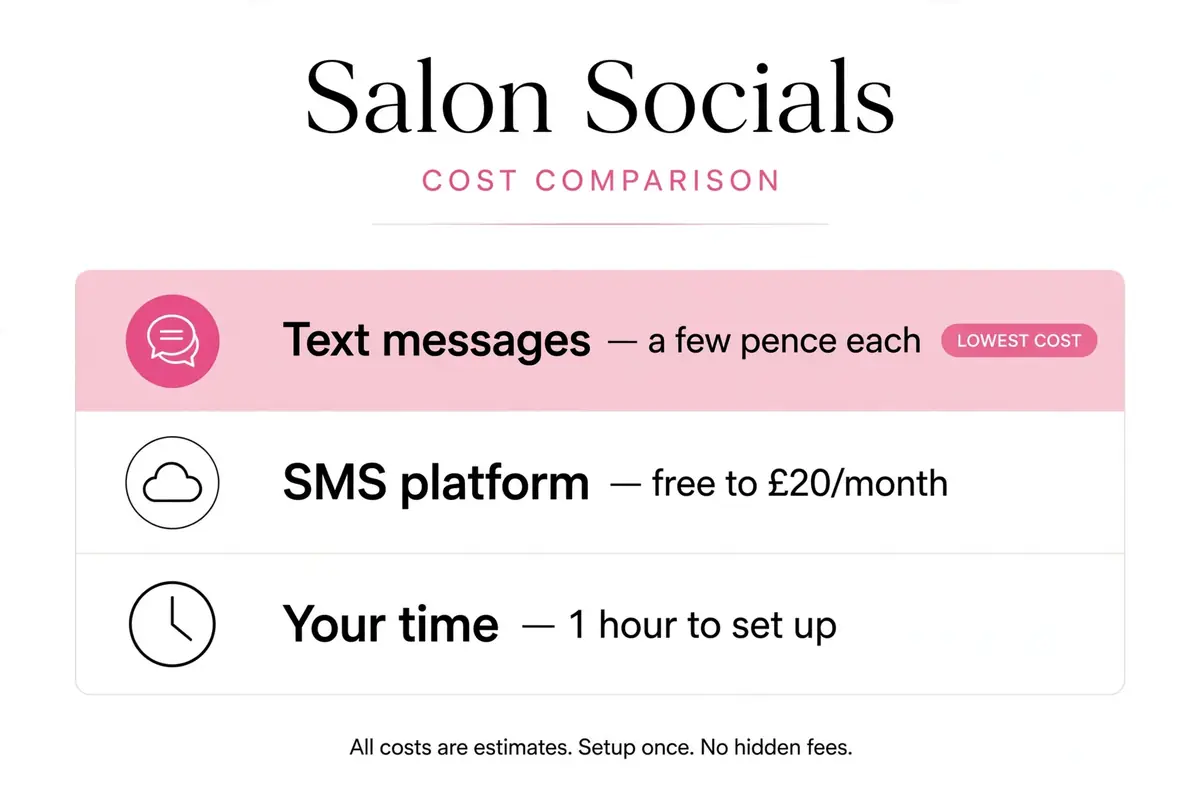
Worked example (illustrative, not a client result): as an sms marketing for salon example, texting 200 lapsed clients costs roughly £6 to £10. If 6 rebook at £45 average, that’s £270 of revenue. Run your own numbers first.
Every link in your texts should land on a page that books in seconds, if yours doesn’t, see what a website built to take bookings looks like.
Frequently asked questions
Is SMS marketing legal for salons in the UK?
Yes, with the right permission. Under PECR you need the client’s consent before sending marketing texts, or you can rely on the "soft opt-in" for existing customers, as long as you offered an opt-out at collection and in every message. Every marketing text must identify your salon and offer an opt-out. This is general information, not legal advice. (58 words)
How do I get consent to text my salon clients?
Ask at booking with a separate, unticked tick-box: "Text me about offers (max 2/month). Reply STOP to opt out anytime." Never pre-tick it or bury it in your terms. Record when and how each client consented, and keep a suppression list of opt-outs. For existing customers you can alternatively rely on the soft opt-in if all four conditions are met. (60 words)
How long can a marketing text be?
One SMS segment is 160 characters, that’s what you pay for per send. Go over 160 and the message sends as two segments, doubling your cost. Emoji and special characters can shrink a segment to 70 characters, so write plainly and check the count (including your link) before scheduling. (49 words)
How much does SMS marketing cost a small salon?
Very little. Texts cost a few pence each on pay-as-you-go, platforms run free to around £20 a month at salon volumes, and setup takes about an hour. Texting 200 lapsed clients typically costs under £10, if even a handful rebook, the campaign pays for itself many times over. (48 words)
Can I send marketing texts from my salon’s mobile number?
Yes, and it’s often the better choice: clients can reply to confirm, rearrange or ask questions, which an alphanumeric sender ID (your salon name as text) can’t do. Under Ofcom’s strengthened rules your provider will verify your sender ID against your business at signup, so have your business details ready. (50 words)
Text marketing won’t replace Instagram or Google, many clients will still Google you after your text (see our local SEO for salons guide). But for reminders, rebookings and quiet-day offers, nothing beats a message in your client’s pocket. Get consent right, keep texts short, start with reminders.
If you’d like help setting it up properly, consent wording, segments and your first campaign mapped out, book a free 30-minute strategy call.
Free, 30 minutes, no obligation. We reply within one working day. Prefer to write first? Contact us here.
Last updated: October 2026