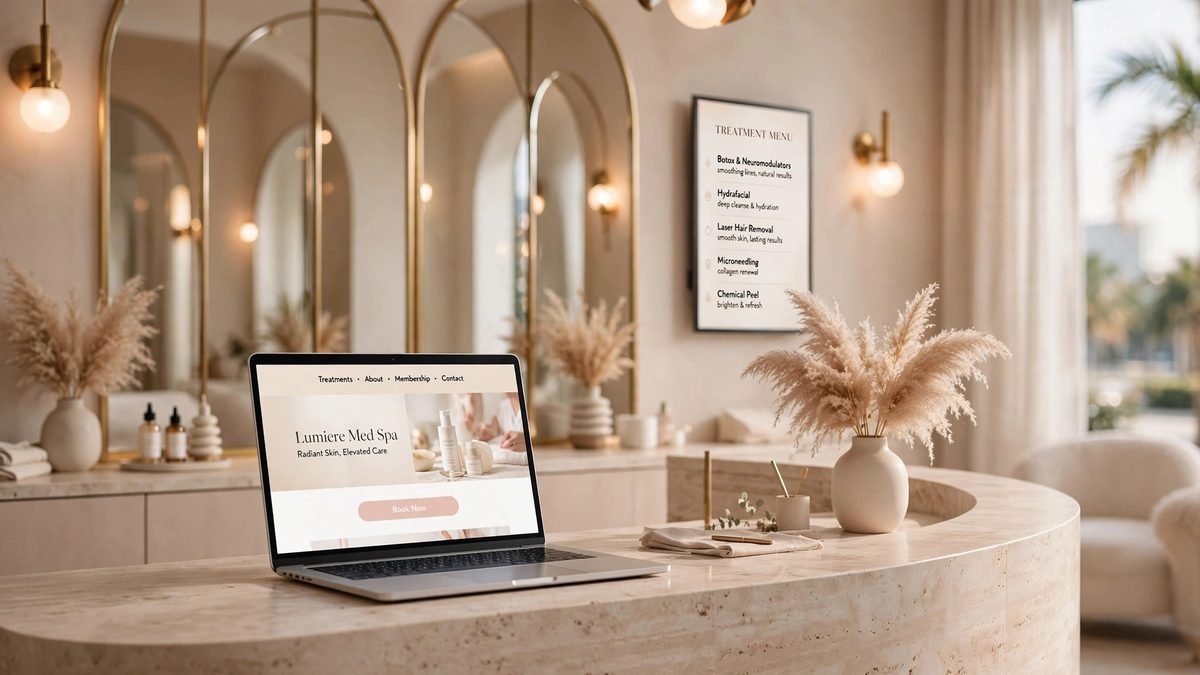
If you’re researching med spa web design in Tampa, you’re probably planning a new website or a redesign, and you want one that books consultations, not just looks pretty. Most med spa websites fail at exactly that: beautiful hero images, a booking button buried three clicks deep, no prices, and a contact form from 2015. This guide shows what a booking-first med spa website needs, homepage layout, treatment pages, booking flow, trust signals, honest costs, and red flags for any med spa web design company, whether you’re in Tampa, Austin, or Los Angeles.
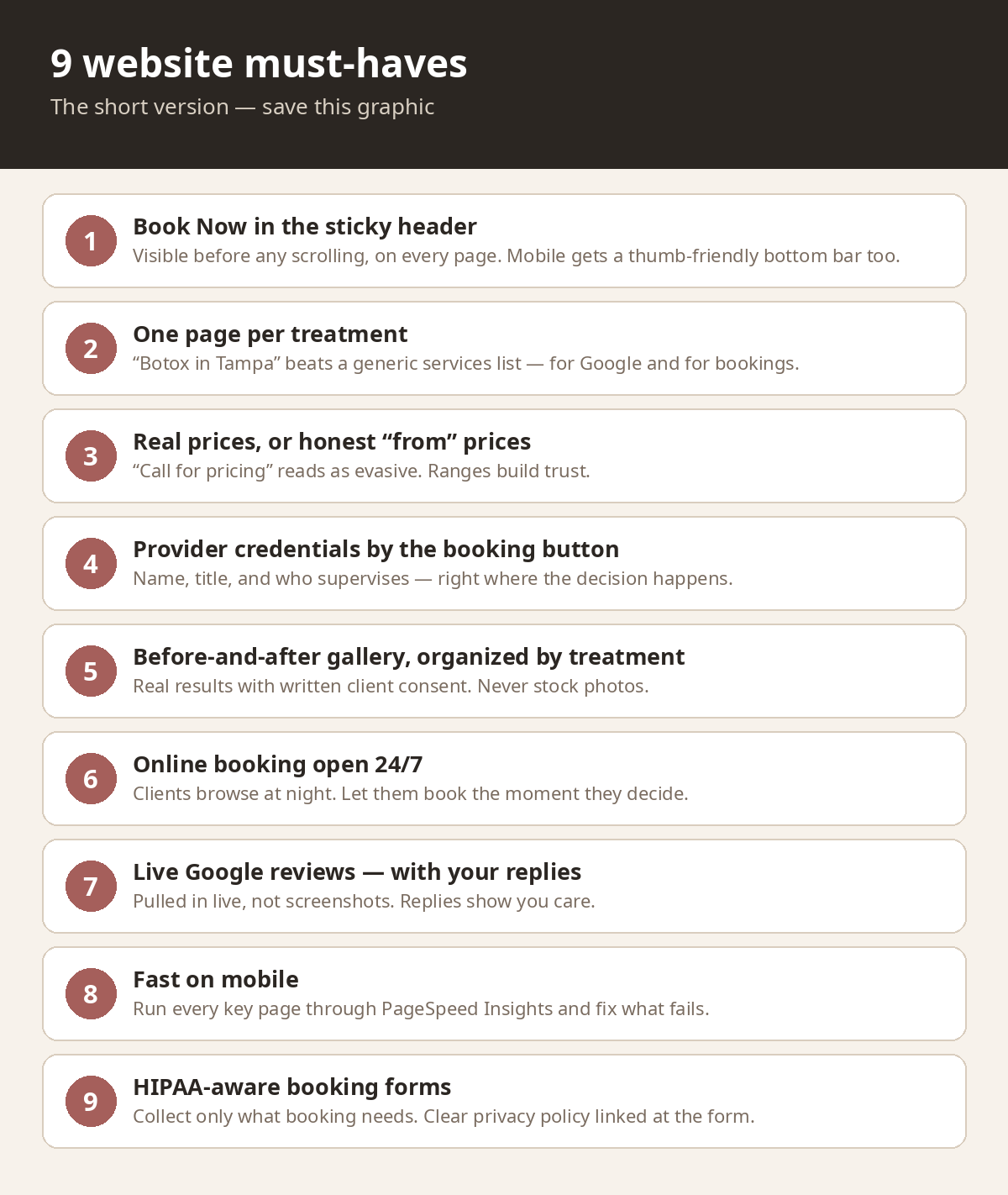
TL;DR, the 9 must-haves at a glance
- Homepage: sticky Book Now button, one headline naming the outcome + your city, a trust bar, and treatments with "from" prices.
- Treatment pages: one page per treatment ("Botox in Tampa"), pricing, provider, FAQs, and a booking CTA on each.
- Booking: online scheduling open 24/7, bookable without scrolling on mobile, 3-field forms, availability shown first.
- Trust: real before-and-afters with client consent, live Google reviews with your replies, provider credentials by every booking button.
- Technical: fast on mobile, Google Business Profile set to "Medical spa," HIPAA-aware booking forms.
How does your current site stack up? Book a free 30-minute website review, we’ll walk through your homepage and booking flow and name the three fixes that matter most.
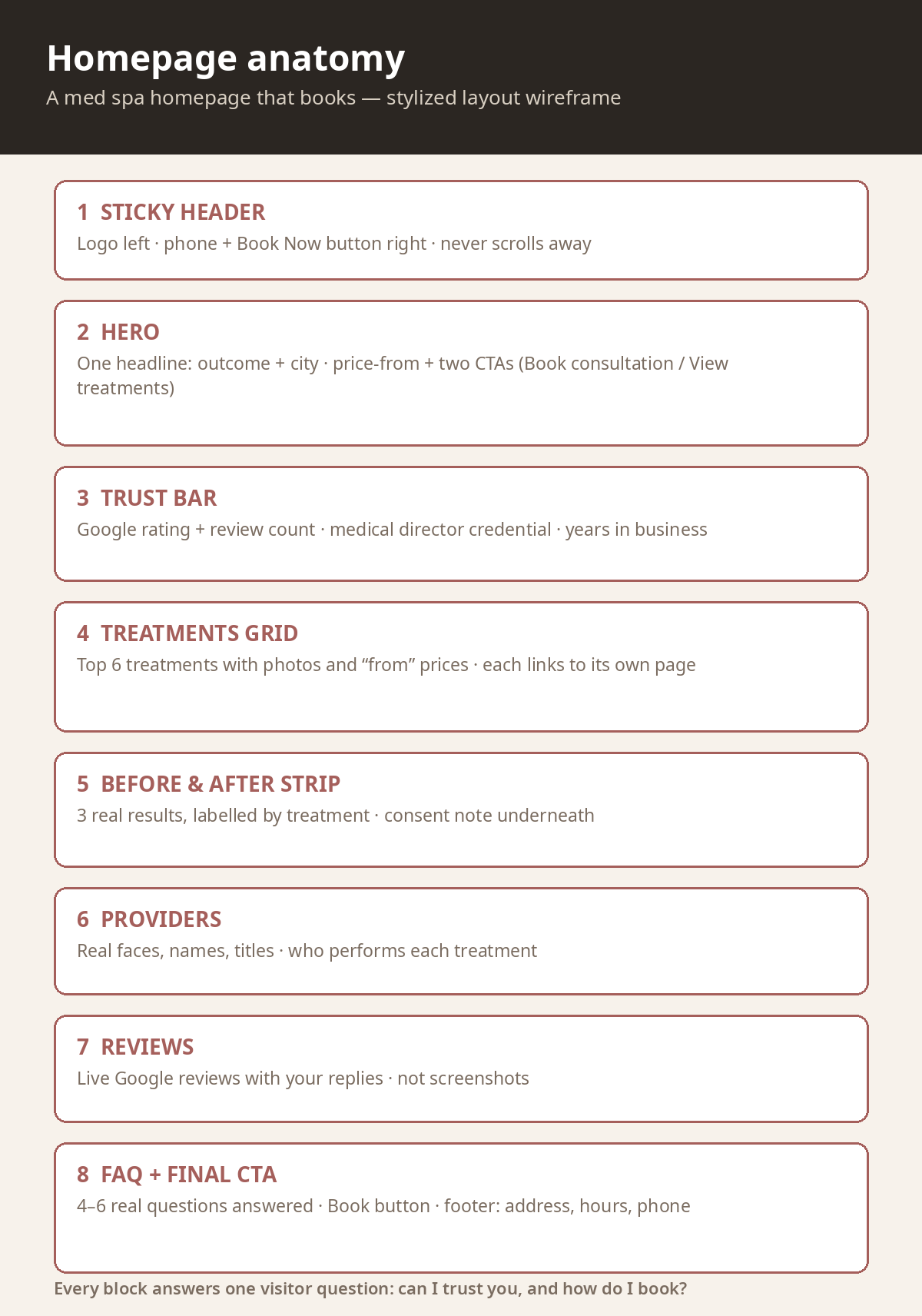
The anatomy of a homepage that books
A med spa homepage has one job: turn a curious visitor into a booked consultation. Every block should answer one of two questions, "can I trust you?" or "how do I book?" Here’s the layout, top to bottom:
Three things most med spa homepages get wrong:
- The headline talks about the clinic, not the client. "Welcome to Radiance Aesthetics" tells the visitor nothing. "Botox, fillers & laser in Tampa, natural results, medical oversight" tells them everything. Name the outcome and the city.
- The booking button appears once, at the bottom. Sticky header on desktop, sticky bottom bar on mobile, always visible, on every page. By the time a visitor decides, they shouldn’t have to hunt.
- The trust signals live on the About page. Your Google rating, your medical director’s credential, and your review count belong next to the booking button, not three clicks away.
Your treatment pages are your real sales team
The biggest structural mistake in medical spa web design is one long "Services" page listing everything. Nobody searching "laser hair removal Austin" wants your services list, they want a page about laser hair removal in Austin. Build one dedicated page per treatment: Botox, dermal fillers, laser hair removal, microneedling, chemical peels, HydraFacial, and so on.
Each treatment page should follow the same anatomy:
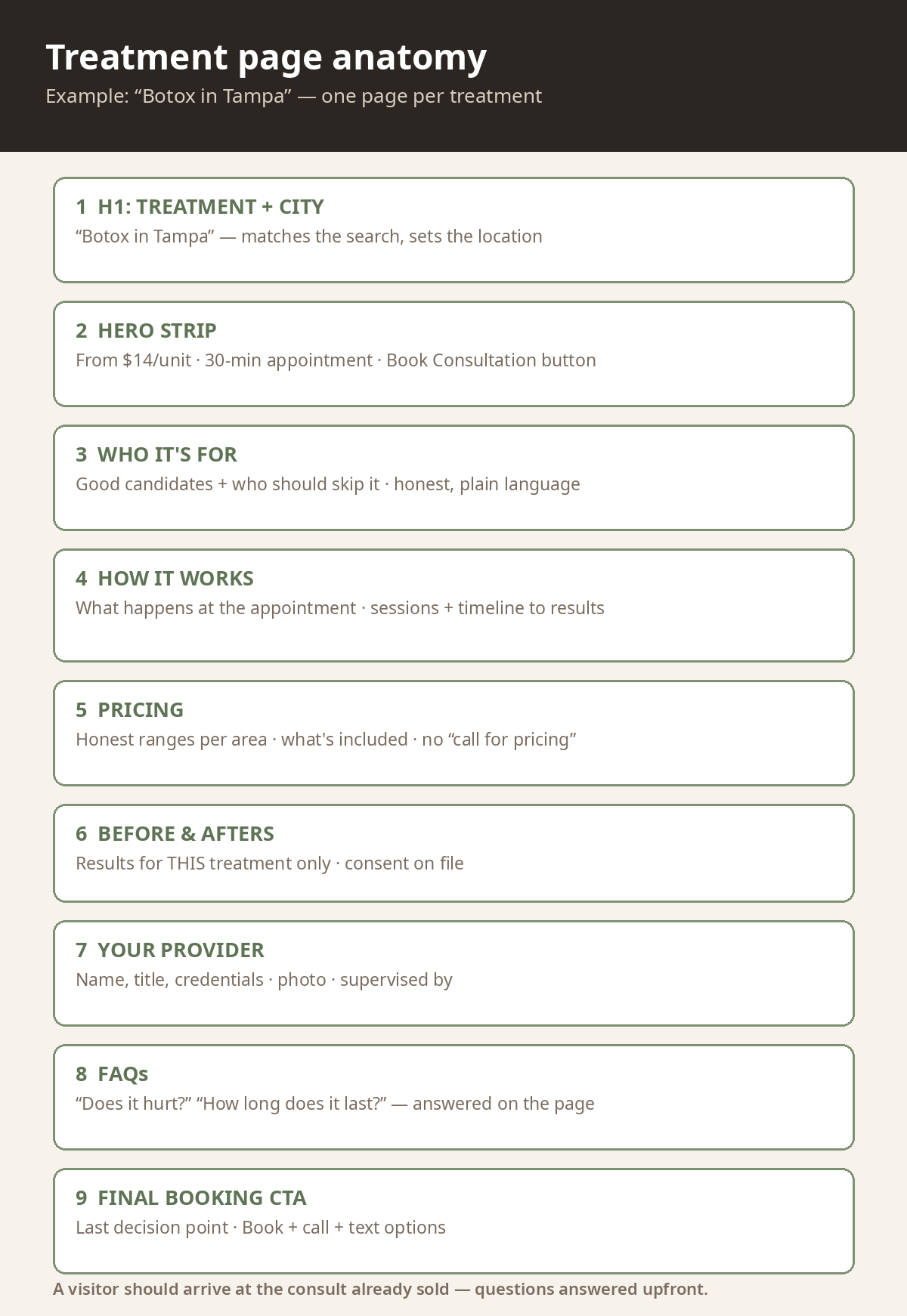
A visitor should arrive at the consultation already sold. That means the page answers the questions they’d otherwise ask on the phone, does it hurt, how long does it last, how many sessions, what does it cost, before they ever pick up the phone. These pages are also your best local SEO asset: a page written for "Botox in Tampa" can rank for exactly that high-intent search. Our local SEO for med spas builds on this same structure.
Example (illustrative, not a client result): a "Lip Filler in Los Angeles" page might open with "From $650/syringe · 45-minute appointment," name the injector and their credentials, show three real before-and-afters for lip filler only, answer six FAQs, and close with a booking button.
The booking experience: remove every point of friction
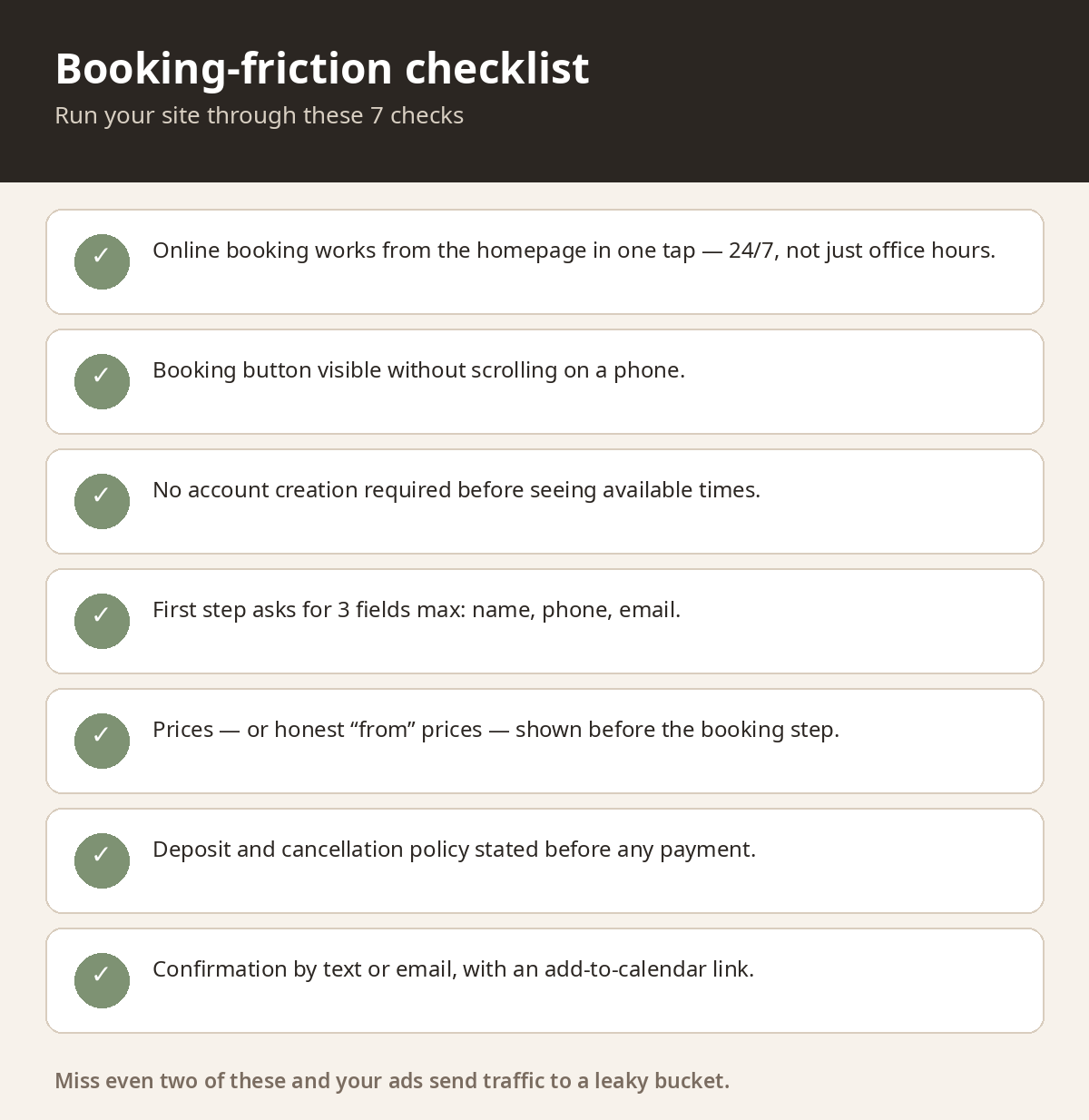
Most med spa websites don’t have a traffic problem, they have a friction problem. The visitor is ready; the site makes it hard. Run yours through these checks:
And this is what the flow should feel like on a phone:
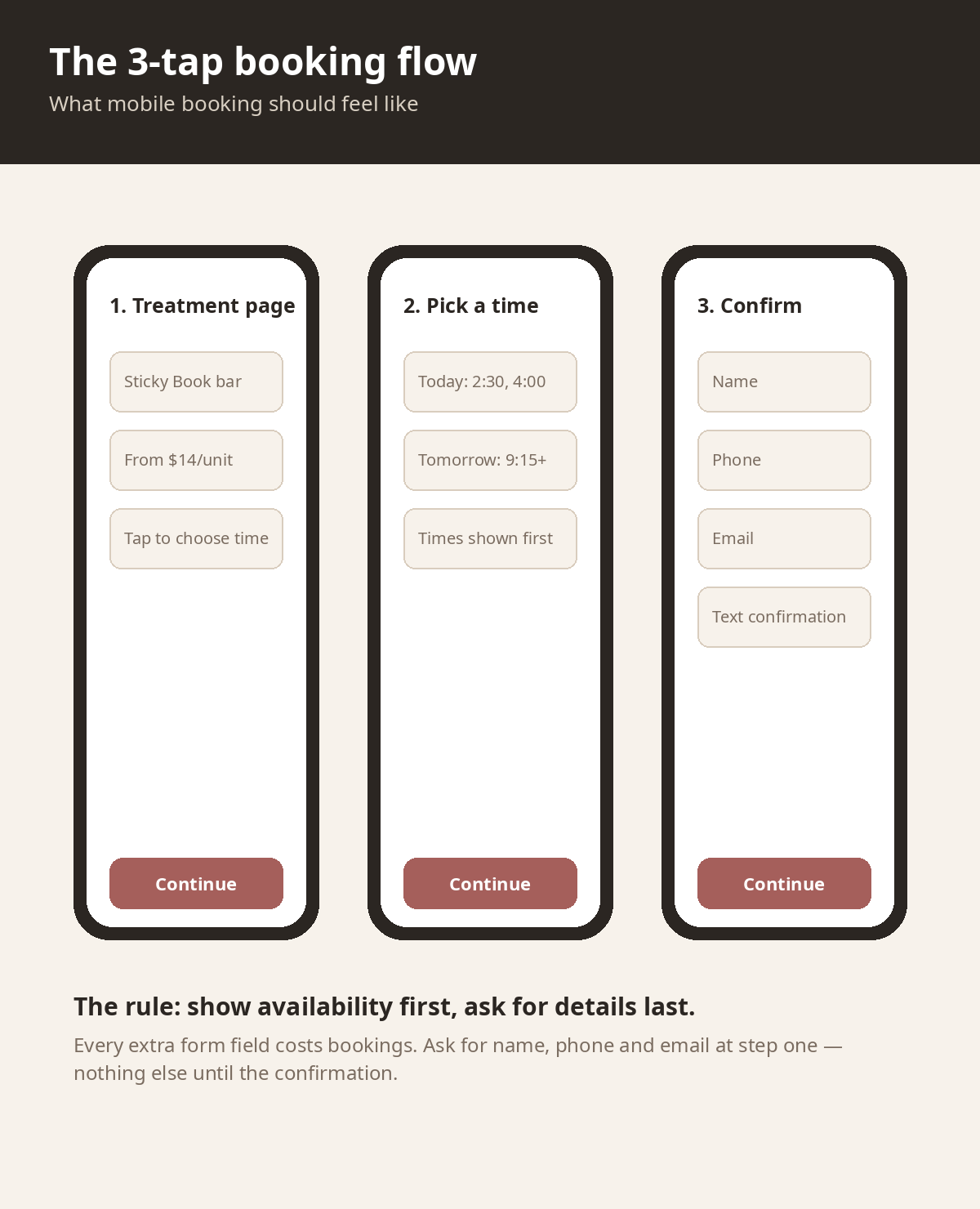
Two friction points deserve special attention:
- The account wall. If visitors must create an account before seeing available times, many will leave. Show availability first; collect details at the end.
- The form that interrogates. Every extra field costs bookings. Name, phone, email, that’s enough to confirm an appointment. Medical history and consent forms can wait until after the booking is secured (and if those collect health details, use HIPAA-aware tools, more below).
📋 Get a free website review
Send us your URL before the call and we’ll bring a marked-up list of your site’s booking blockers.
Free, 30 minutes, no obligation. We reply within one working day.
Trust signals a med spa site can’t skip
Med spa treatments are intimate, expensive, and sometimes medical. Visitors ask one question: "Is this place safe and legitimate?" Your site has to answer it before they read a word.

The four trust signals that matter most:
- Provider credentials, placed by the booking button. Name the injector on the treatment page: name, title, qualifications, supervising physician. "Performed by Sarah Mitchell, APRN, under Dr. James Lee" converts. An anonymous "our team" page doesn’t.
- Before-and-after galleries with written consent. Organize results by treatment, Botox results on the Botox page. Real client photos, documented consent, consistent lighting, no heavy filters. Overly edited results destroy trust.
- Live Google reviews, with your replies. Pull your Google reviews onto the site live, not as screenshots. And reply to them, especially the critical ones, a thoughtful reply to a 3-star review says more about you than ten 5-star reviews. If reviews feel like a second job, our reputation management for clinics exists for exactly that.
- Transparent pricing. "Call for pricing" reads as evasive, visitors assume the worst. You don’t need exact prices for everything; honest ranges ("Botox from $14/unit," "lip filler $650 to $850/syringe") build more trust than silence. Keep results flowing on Instagram too, our social media management handles that channel while your site does the booking.
Speed and mobile: the technical non-negotiables
None of the above matters if the site is slow. Test every key page, homepage and your top three treatment pages, in Google’s PageSpeed Insights (opens in a new tab), on the mobile tab. Oversized before-and-after images are the usual culprit on med spa sites: compress them and use modern formats.
Two more technical items owners forget:
- Your Google Business Profile category. Set the primary category to "Medical spa", not "Spa," not "Beauty salon." It’s a two-minute change via Google’s Business Profile help center (opens in a new tab) and it determines which searches you can appear for. See also our local SEO for salons guide.
- HIPAA-aware booking. Forms collecting only name, phone, and email are low-risk. Intake forms or treatment histories need tools that support HIPAA-aware handling, usually with a signed business associate agreement per vendor. HHS publishes HIPAA guidance for professionals (opens in a new tab). This is general information, not legal advice, when in doubt, ask your attorney, not your web designer.
What med spa web design costs in 2026
Which route fits you?
10 questions to ask any med spa web design company
Ask these before you sign:
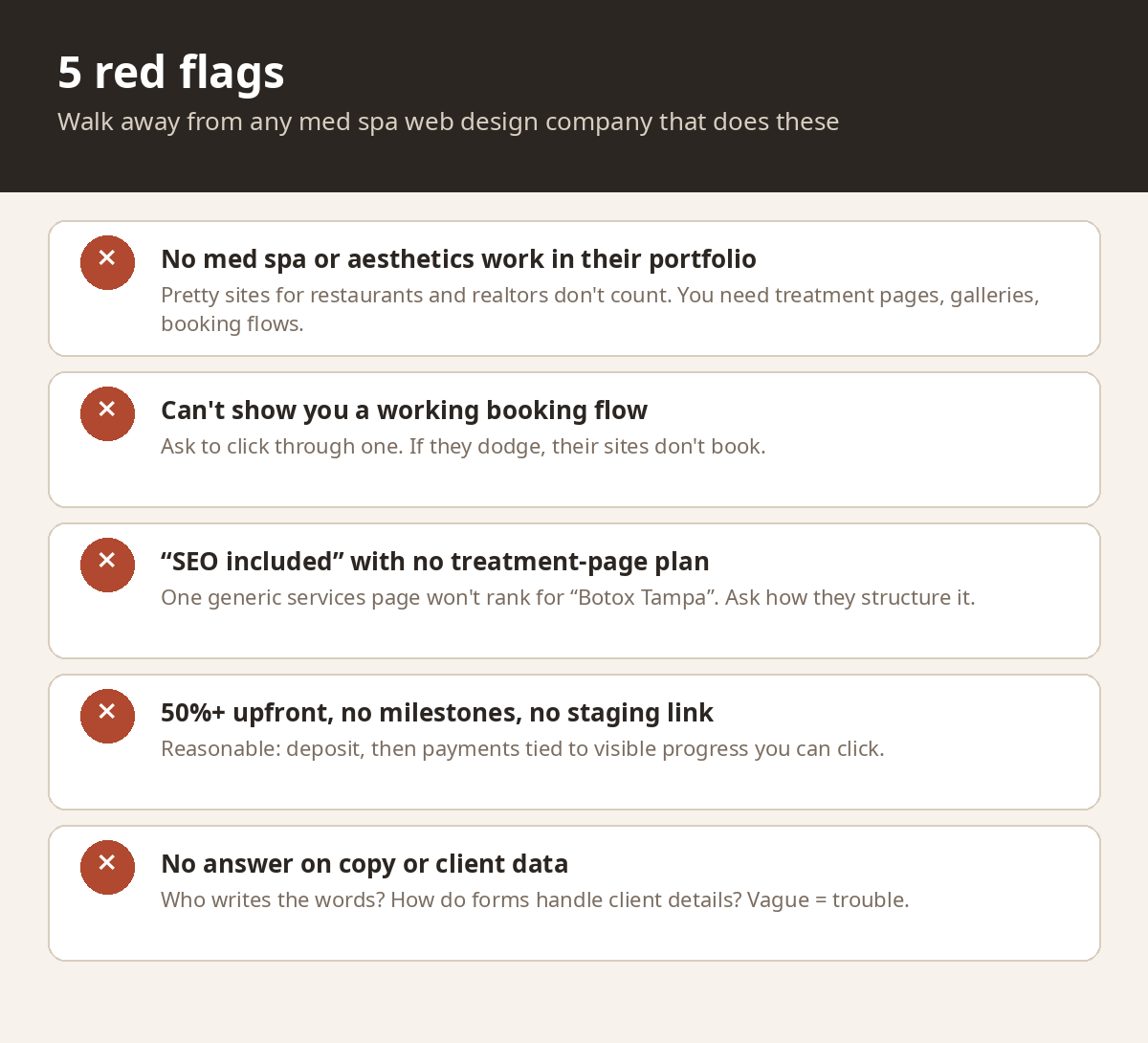
- Can you show me a med spa or aesthetics site you built, and click through its booking flow with me?
- How do you structure treatment pages, one page per treatment, or a single services list?
- Who writes the copy? (If the answer is "you do," budget for a copywriter or expect thin pages.)
- How do you handle before-and-after galleries for speed and mobile?
- Which booking platform do you integrate with, and does it stay inside my site’s branding?
- How do your forms handle client data, and what do you recommend for HIPAA-aware intake?
- What’s your process for Google Business Profile and local SEO setup?
- What does the payment schedule look like, deposit, milestones, final payment on launch?
- Will I get a staging link to review before anything goes live?
- What happens after launch, who updates the site, and what does that cost per month?
5 mistakes that cost med spas bookings
- The treatment menu is a PDF. Search engines can’t read it, phones render it badly, and no treatment inside it can rank on its own. Put every service on the site as text, with its own description and price.
- No prices anywhere. "Call for pricing" doesn’t create mystique, it creates bounce. Ranges are fine. Silence isn’t.
- Stock photos instead of real results. Visitors spot stock instantly, and in aesthetics it reads as "we have nothing to show." Real photos, real consent, consistent lighting.
- The booking tool looks like a different business. Different colors, different logo, different tone at the moment of commitment kills trust. Brand your booking pages and confirmation emails to match your site.
- Google Business Profile ignored. Instagram builds desire; Google captures it. A visitor who finds you on social then searches your name needs a complete, review-rich profile with the "Medical spa" category, not a blank listing.
Tampa, Austin, Los Angeles, or anywhere
You don’t need a web designer in your zip code. You need one who understands med spas: treatment-page structure, booking flows, before-and-after galleries, HIPAA-aware forms. A specialist working remotely will outperform a generalist across the street, use the 10 questions above, and hire the better process, not the closer office.
That’s how we work: Salon Socials designs websites for med spas and beauty businesses for clinics worldwide, delivering fully online, strategy, copy, design, booking integration, and local SEO setup in one build.
Frequently asked questions
How much does med spa web design cost in Tampa?
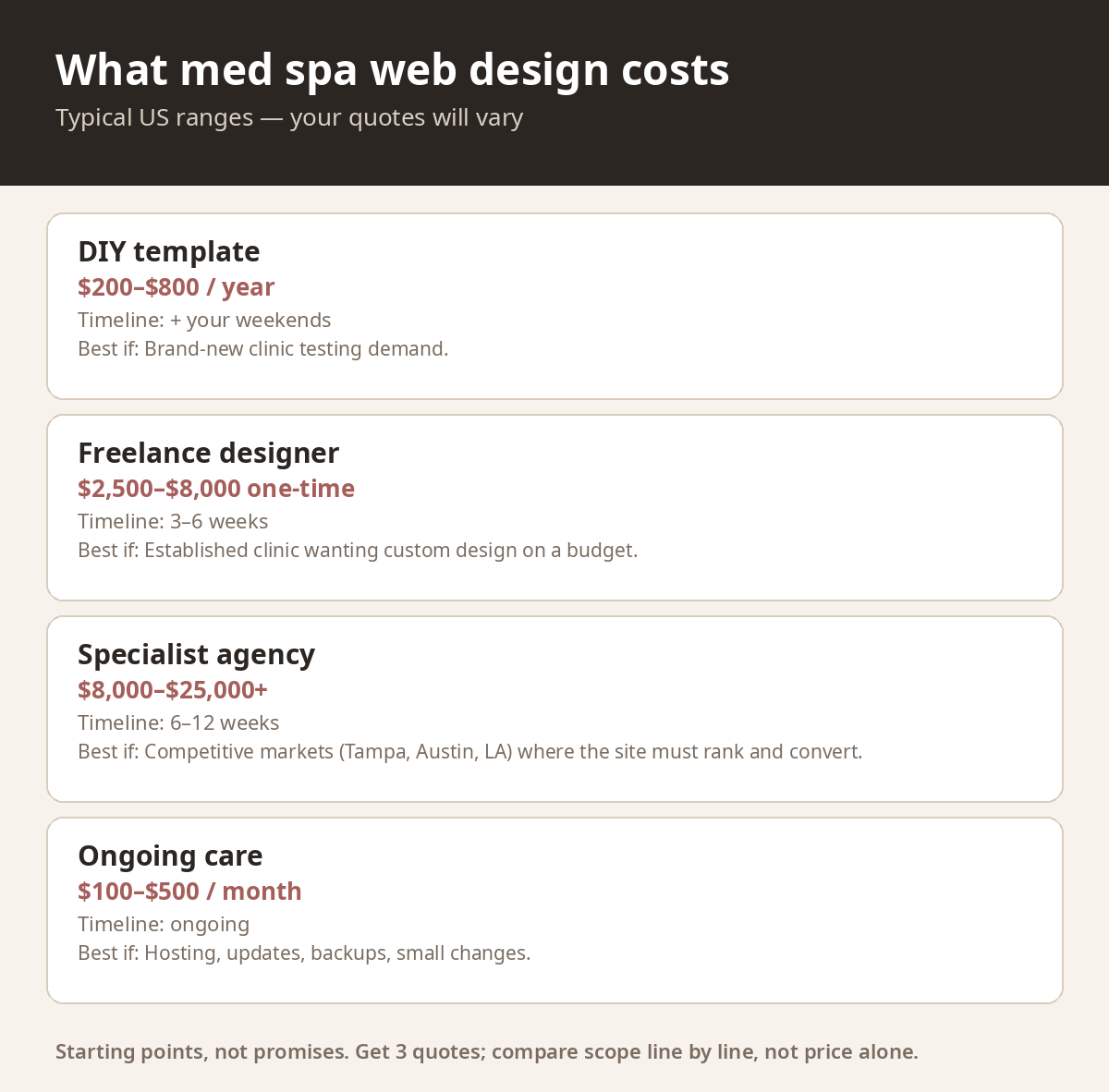
Typical ranges: $200 to $800 per year for a DIY template, $2,500 to $8,000 one-time for a freelance designer, and $8,000 to $25,000+ for a specialist agency, plus $100 to $500 per month for hosting, updates, and maintenance. Tampa pricing sits in line with other major US metros. Get three quotes and compare scope line by line, not price alone. (52 words)
Should I use a template or hire a web designer for my med spa?
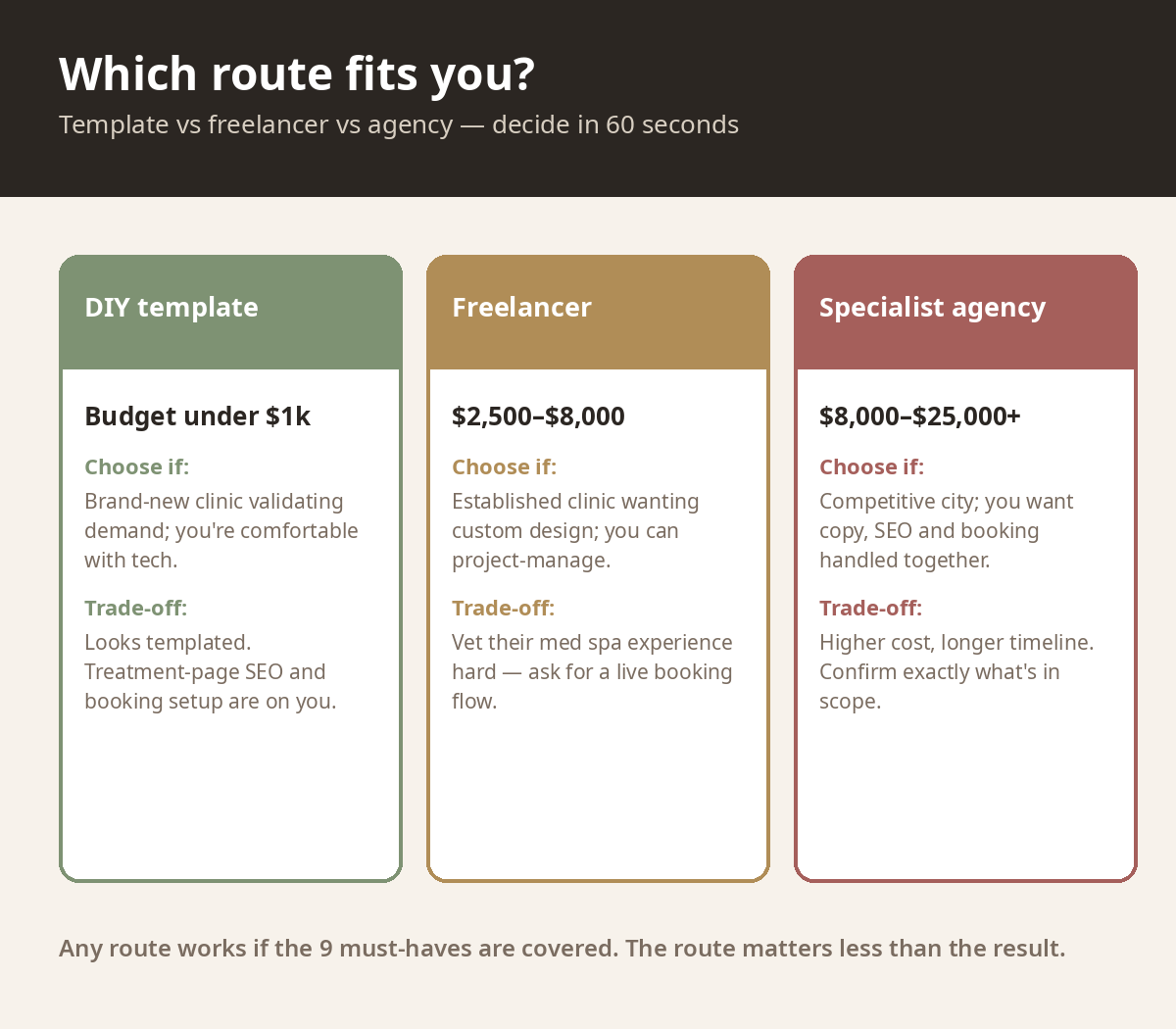
A template works if you’re brand-new and validating demand, but templates rarely deliver treatment-level pages, proper booking flows, or local SEO structure. Hire a designer or agency once you have steady revenue and compete in a busy market like Tampa, Austin, or Los Angeles. Either way, demand the 9 must-haves in this guide. (53 words)
Do med spa websites need to be HIPAA compliant?
HIPAA governs how you handle protected health information, not the mere existence of your website. If forms only collect name, phone, and email for booking, risk is low, but intake forms collecting health details need HIPAA-aware tools and usually a signed BAA with each vendor. See HHS’s HIPAA guidance for professionals. This is general information, not legal advice. (58 words)
How long does it take to build a med spa website?
A template can be live in a weekend. A freelancer typically needs 3 to 6 weeks; a specialist agency 6 to 12 weeks including copywriting, treatment pages, booking integration, and QA. Add 2 to 4 weeks if you need brand photography or a before-and-after gallery built from scratch. Rushing usually means the booking flow gets skipped. (50 words)
Can my website take bookings without online scheduling software?
Yes, a simple "request a consultation" form with name, phone, and email works, as long as someone replies within one business day. But 24/7 online scheduling with live availability books more consultations, especially from evening browsers. At minimum, never make "call during office hours" the only way to book. (49 words)
The bottom line:
A med spa website that books isn’t the prettiest one, it’s the one that makes booking effortless and trust instant. Sticky Book Now button. One page per treatment with honest prices. Provider credentials where the decision happens. Real before-and-afters. Reviews you reply to. Fast on mobile. Nail those, and your site becomes a consultation-booking machine instead of an expensive brochure. (60 words)
[Book My Free Strategy Call →](https://calendly.com/hello-salonsocials/30min)
Free, 30 minutes, no obligation. We reply within one working day.
Last updated: October 2026