If you run an aesthetics clinic and you’re searching for a med spa marketing plan, you’re probably asking two questions at once: how do I get more consultations, and how do I do it without breaking the UK’s strict advertising rules? Most med spa marketing plans online are written for the US, where clinics advertise injectables freely. In the UK you can’t, and copying American tactics can get your ads pulled or your clinic named in an ASA ruling. This guide gives you a compliance-first medical spa marketing plan built for UK aesthetics clinics: a consultation-led funnel, ASA-safe content, and a copy-paste monthly calendar you can run from Monday.
TL;DR, the plan in 30 seconds
- Sell consultations, not treatments. Every part of this med spa marketing strategy points at one goal: a booked consultation.
- Know the UK rules first. Never advertise Botox or other prescription-only treatments publicly, don’t target under-18s, and never use discount urgency on procedures.
- Run a monthly rhythm: Google profile, reviews, education content, consultation offers, one email, one ad review, every week.
- The template below turns all of this into a copy-paste monthly calendar.
- Track consultations booked, not likes.
Want a second pair of eyes on your clinic’s marketing before you start? Book a free 30-minute strategy call, we’ll tell you which parts of this plan to run first.

Why a med spa marketing plan works differently here
A med spa marketing plan for a UK aesthetics clinic is a different animal from the American versions you’ll find on Google. Three reasons:
- You sell consultations, not treatments. Nobody should book an injectable from an Instagram ad. Your marketing’s job is to get the right person into a consultation, where a qualified practitioner assesses suitability. Every channel, Google, Instagram, ads, email, should end at a consultation booking.
- Trust is the product. Aesthetics clients hand you their face. They choose on practitioner credibility, clinic atmosphere, reviews and how safe the process feels, not on who shouts loudest about discounts.
- The rules are strict and enforced. The ASA has banned clinic ads for trivialising procedures with Black Friday-style urgency and 0%-risk claims. Get the compliance layer wrong and the rest of the plan is a liability.
That is why this plan is compliance-first: the rules shape every step below, instead of being an afterthought.

The UK rules of med spa marketing: what the ASA says
Before you spend a pound, understand the rules. This is general information, not legal advice, the ASA runs a free Copy Advice service if you’re unsure about a specific ad.
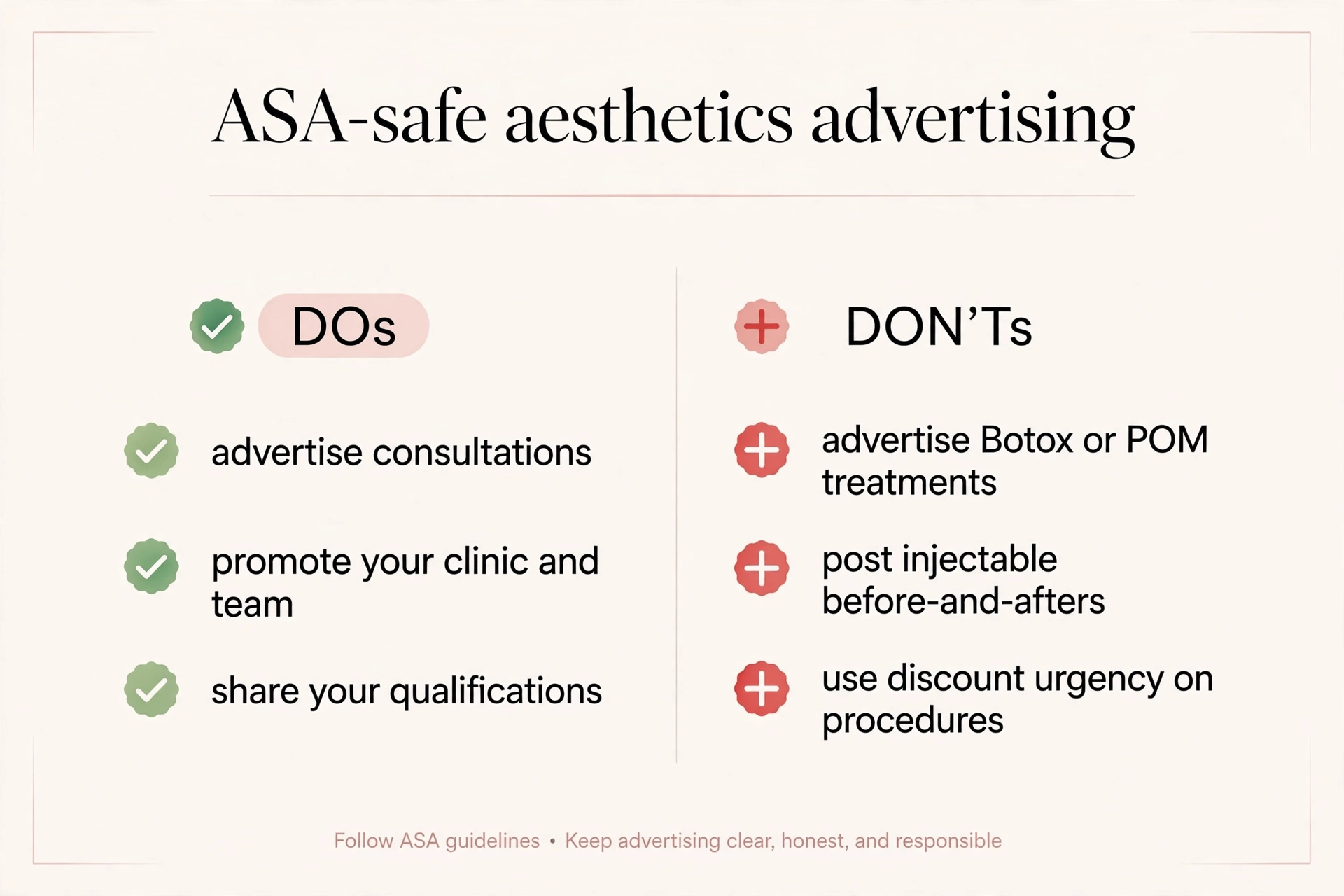
- Never advertise Botox (or any prescription-only medicine) to the public. Botox is a prescription-only medicine (POM) in the UK, and MHRA/CAP rules prohibit advertising POMs to the general public. That means no mention on your website, social media, leaflets or ads, including indirect references like "wrinkle-relaxing treatments" or hashtags. Before-and-after photos of Botox count as visual claims and break the rules too. You can advertise consultations for wrinkles, that is the compliant workaround, and it’s exactly why this plan is consultation-led. (See the ASA’s Bitesize guide on advertising Botox.)
- Don’t direct cosmetic-intervention ads at under-18s. Since 25 May 2022, CAP Code rule 12.25 prohibits marketing for cosmetic interventions from being targeted at under-18s through media selection or context. (See the ASA’s announcement of the targeting rules.)
- Don’t trivialise procedures. The ASA has upheld rulings against aesthetics clinics whose ads made cosmetic procedures sound casual, "HUGEEE SAVINGS!" urgency, "0% infection rate" claims and Black Friday-style pressure were ruled socially irresponsible because they detracted from the seriousness of the decision. (See the ASA’s ruling against a clinic’s Black Friday ad.) Keep your tone serious, honest and measured.
- Discounts must be genuine and provable. Any price claim has to be substantiated. Never run "was/now" offers you can’t evidence.
- Testimonials are fine, with conditions. They must be genuine, used with permission, and must not reference POMs or make claims you can’t prove.
Step 1: Foundation, be easy to find and easy to trust
Do this before spending on ads. A clinic that runs ads to a half-finished Google profile is paying to disappoint people.
Google Business Profile (about 2 hours, one-off). Claim and verify your profile. Pick the most specific category available (many UK clinics use "Skin care clinic" or "Beauty salon", check what your competitors use). List every treatment with a starting price. Add 10+ real photos of your clinic, your treatment rooms and your team, not stock images. Turn on messaging. For the full walkthrough, see our guide to local SEO for salons.
Your website (the consultation machine). Your site has one job: turn searches into consultation bookings. That means services, prices, practitioner qualifications and a "Book a consultation" button above the fold on mobile, loading fast. If your current site doesn’t do that, see what a website built to take bookings looks like. Treatment pages should inform without naming POMs, describe concerns ("lines and wrinkles") and the consultation process, not the medicine.
Practitioner credibility. Your qualifications, training and experience are your strongest marketing assets, and fully ASA-safe. Put names, faces and credentials on the website, the Google profile and Instagram. Clients choose practitioners, not logos.
Reviews from day one. Ask every happy client for a Google review within 24 hours, in person and by text. Reply to every review within 48 hours. Aim for 2 to 3 new reviews a week, steady and believable beats a sudden flood.
Step 2: Build your consultation-led funnel
Most med spa marketing strategies fail because they try to sell the treatment. Yours sells the consultation. The funnel is three stages:
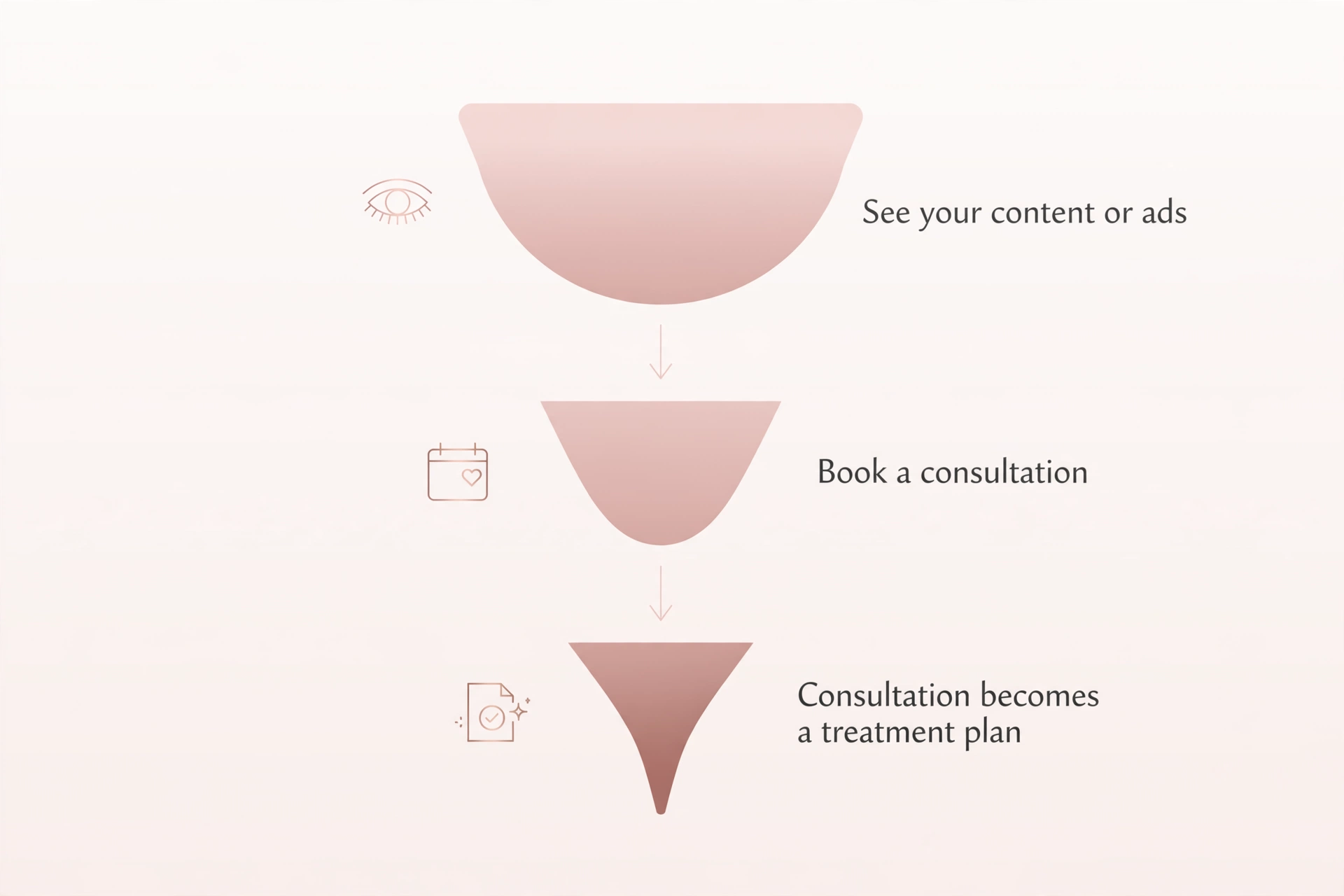
- They see you. A Google search, an Instagram Reel, a Meta ad, all ASA-safe, all pointing one place.
- They book a consultation. Your landing page or booking link offers one clear action: book a consultation (free or paid, either works, but be transparent about which). No treatment menu to get lost in.
- The consultation becomes a treatment plan. Suitability is assessed properly, in person, by a qualified practitioner. This is also where your conversion happens, so the consultation experience itself is part of the marketing plan.
Example (illustrative, not a client result): if you want 10 consultations a month and your ads deliver them at £25 each, your monthly ad budget is £250. Work backwards from the consultations you want, not forwards from a budget you picked at random. Track cost per consultation as your single most important number, not clicks, not likes.
Consultation offers that stay compliant: "Free 15-minute skin health consultation", "New client consultation with treatment plan", "Meet your practitioner" open evenings. Avoid outcome promises ("look 10 years younger") and urgency discounting on procedures.
Step 3: Content and social media the ASA-safe way
Your content has five pillars. These are the medical spa marketing plan ideas you’ll rotate through every month, none of them touch the red lines.

- Educate. Answer questions clients already ask: "What happens at a skin consultation?", "How should I prepare for my first appointment?", "What’s the difference between a facial and a clinical treatment?" One question, one short Reel, filmed on your phone.
- Behind the scenes. Your clinic, your treatment rooms, your hygiene routine, how you sterilise equipment. This is trust content, it answers "is this place safe?" without saying a word about treatments.
- Practitioner expertise. Your training, your qualifications, why you chose aesthetics, what a consultation with you looks like. People book people.
- Client experience stories. Talk about the *experience*, feeling listened to, the calm of the clinic, the thoroughness of the consultation. Never promise outcomes, never show injectable before-and-afters.
- Consultations and FAQs. Promote the consultation itself: what happens, how long it takes, that there’s no pressure to book treatment. End most posts with the same CTA, book a consultation.
Post 2 to 3 times a week. And check every caption against the compliance rules before it goes live.
Risky caption: "BOTOX THURSDAY 💉 £99 per area, DM to book, limited slots!!!"
Compliant caption: "Curious about options for frown lines? We offer relaxed, no-pressure consultations where a qualified practitioner talks you through what’s suitable for you, including risks and aftercare. Tap the link in bio to book. Consultations available in [your town]."
The second works because it sells the consultation, names no POM, makes no outcome promise and creates no false urgency. If producing this kind of content weekly feels like a second job, our social media management for clinics is built for exactly that.

Step 4: Paid ads and email that stay compliant
Ads. Two channels matter for clinics: Google Search (captures high intent, "aesthetics clinic [town]", "skin consultation near me") and Meta (builds awareness and retargets people who visited your consultation page). Three rules:
- Send every ad to a dedicated consultation landing page with one CTA, never your homepage.
- Never name POMs, never use before-and-after injectable images, never promise outcomes. Expect ad platforms to reject health-related creative; build your campaigns around the consultation offer so rejections don’t stall you.
- Track cost per consultation, weekly. Pause what doesn’t convert within 30 days; put more behind what does.
Our social media ads for clinics run on exactly this consultation-first model.

Email and SMS. Your past-client list is your cheapest marketing asset. Collect emails and mobile numbers at every booking, with clear consent. Under PECR, the UK’s electronic marketing rules, you need consent (or the "soft opt-in" for existing customers) before sending marketing texts or emails, and every message must offer an opt-out. The ICO’s direct marketing guidance explains it plainly. This is general information, not legal advice.
One useful email a month is enough: new practitioner availability, seasonal skin advice, consultation slots. Never buy a list, bought lists almost never carry the specific consent PECR requires.
Your copy-paste med spa marketing plan template: the monthly calendar
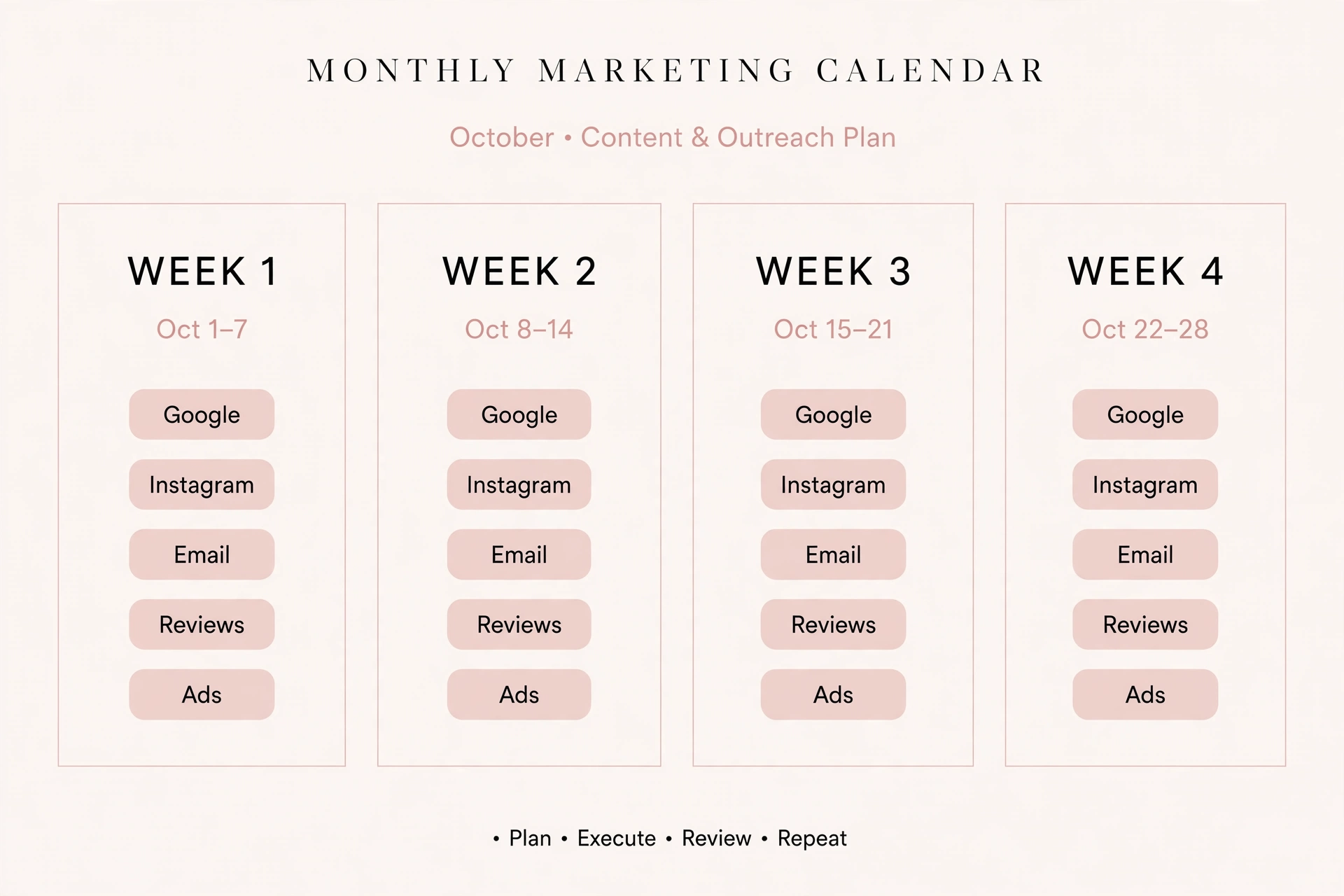
Here is the whole plan as a monthly calendar. If you’re developing a marketing plan for a medical spa from scratch, start here: copy the tables into your own document and run them every month.
The weekly rhythm (repeats every week):
| Day | Task | Time |
|---|---|---|
| Monday | Publish a Google Business Profile update; text last week’s happy clients your review request | 20 min |
| Tuesday | Film and post one education Reel (pillar 1) | 30 min |
| Wednesday | Reply to all reviews; update one website FAQ | 15 min |
| Thursday | Post practitioner/team content + Stories with consultation CTA (pillars 2 to 3) | 20 min |
| Friday | Review ads: pause losers, keep winners; check consultation bookings for next week | 20 min |
The monthly layer (first Monday of the month, about 2 hours):
| Task | Detail |
|---|---|
| Plan the month | 4 weekly themes (see below); batch-film 4 Reels in one session |
| Compliance check | Review all live ads and scheduled posts against the ASA rules above |
| Email newsletter | One useful email to your PECR-consented list |
| Numbers review | Consultations booked, cost per consultation, reviews gained, ad spend |
The 4-week theme rotation:
| Week | Theme | Focus |
|---|---|---|
| 1 | Consultations | Push the consultation offer everywhere; practitioner intro content |
| 2 | Education | Answer client questions; behind-the-scenes trust content |
| 3 | Social proof | Reviews, client experience stories, team highlights (ASA-safe) |
| 4 | Review and plan | Check the numbers; plan next month; one seasonal tie-in |
Seasonal tie-ins that work for clinics: January skin-health resets, spring wedding prep, summer "consultation before your holiday", autumn treatment-planning season, Christmas gift vouchers for consultations.
📞 Want this plan built around your clinic?
Templates are a starting point, the fastest results come from a plan shaped around your treatments, your town and your diary. Book a free 30-minute strategy call and we’ll map your next 90 days together.
Free, 30 minutes, no obligation. We reply within one working day.
What it costs and how long it takes
An honest breakdown. Every marketing plan for medical spa business owners has to answer one question: can the owner afford to run it? Figures below are typical ranges to help you budget, not quotes, and your costs will vary.
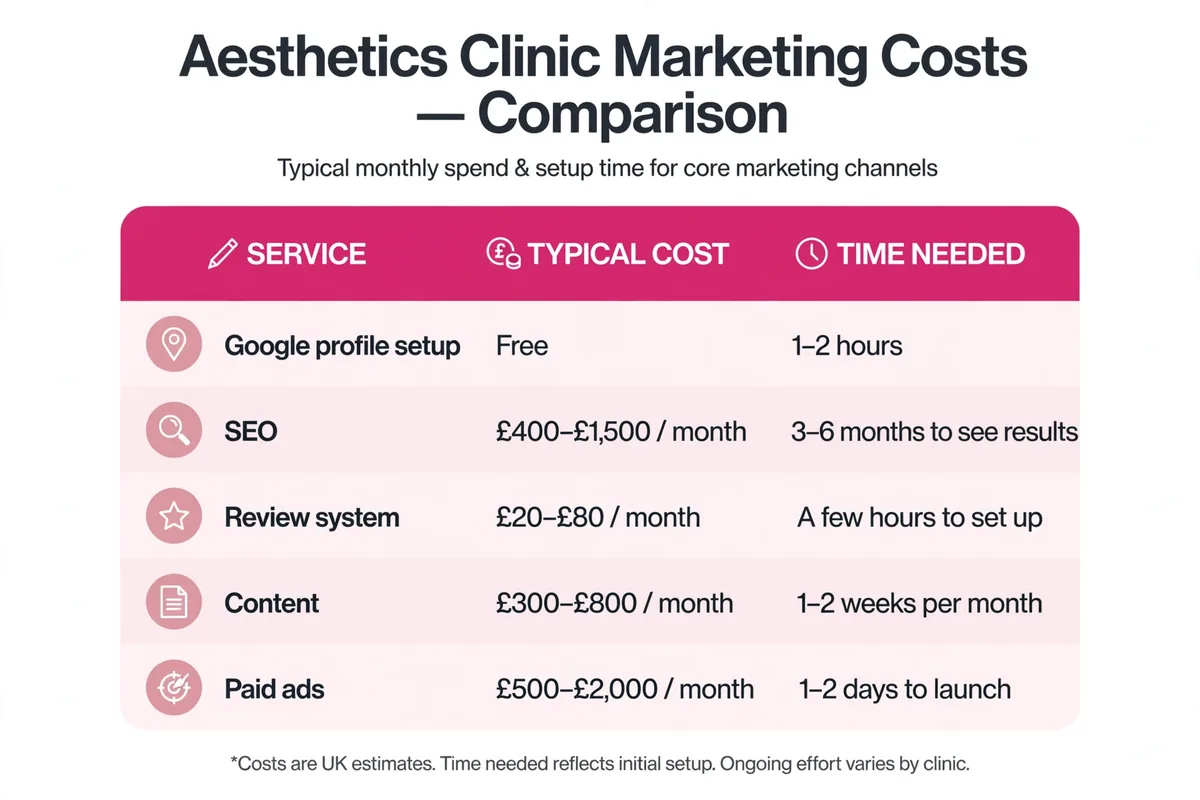
| Channel | Typical cost | Your time per month |
|---|---|---|
| Google Business Profile | Free | 2 to 3 hrs |
| Social media content | Free (your phone) | 6 to 8 hrs |
| Email/SMS software | £15 to £40/month | 2 hrs |
| Google/Meta ads | £300 to £1,000+ ad spend | 3 to 5 hrs |
| Reviews system | Free | 1 to 2 hrs |
| Website upkeep | £0 to £100/month hosting | 1 to 2 hrs |
The free channels (Google, reviews, organic social) can fill a new clinic’s consultation diary on their own. Add paid ads when the foundation is solid and you can track cost per consultation, running ads before that is paying to learn lessons you could learn free. If the whole thing feels like too much alongside treating clients, that’s the point where clinics usually get help: our local SEO for clinics covers the Google and reviews engine.
What to expect: paid ads can bring consultation requests within days; SEO, content and reviews compound over 3 to 6 months into a durable, lower-cost pipeline. Run both, quick wins now, lasting growth underneath.
6 mistakes aesthetics clinics make (and what they cost)

- Advertising Botox by name anywhere public. It’s a POM, the ASA prohibits it, and competitors do report each other. Market the consultation instead.
- Black Friday-style urgency on procedures. "Book now or miss out" on a cosmetic procedure trivialises a serious decision. The ASA has banned clinics for exactly this.
- Running ads to a homepage. Every ad needs a dedicated page with one job: book a consultation. A homepage gives visitors ten ways to leave.
- Buying an email list. Bought lists don’t carry the consent PECR requires. Build your own from real clients.
- Boosting posts with no tracking. If you can’t say what one consultation cost you, you can’t say the ad worked. Set a budget, a deadline and a booking link, or don’t run it.
Frequently asked questions
How do I create a marketing plan for a medical spa?
Start with the UK compliance rules, then build a consultation-led funnel: an optimised Google Business Profile, a website that books consultations, ASA-safe content on rotation, compliant paid ads, a review system and PECR-consented email. Write it as a monthly calendar with weekly tasks, and track cost per consultation as your main number. (52 words)
What should a med spa marketing plan include?
A medical spa marketing plan needs six things: a findable, trustworthy foundation (Google profile, website, reviews); a consultation booking funnel; ASA-safe content pillars; compliant paid ads; retention and reactivation email; and monthly measurement. For UK clinics, add a compliance check of every ad and post against ASA/CAP rules before anything goes live. (52 words)
Can I advertise Botox on Instagram in the UK?
No. Botox is a prescription-only medicine, and UK rules prohibit advertising POMs to the general public, including on Instagram, your website and leaflets. That covers indirect references and before-and-after photos too. What you can advertise is consultations: "book a consultation to discuss options for lines and wrinkles" is the compliant route. (51 words)
How much should an aesthetics clinic spend on marketing?
Start with the free channels, Google Business Profile, reviews and organic social cost nothing but time. When you add paid ads, work backwards from the consultations you want: an illustrative example is 10 consultations a month at £25 each, meaning £250 ad spend. Add £15 to £40 a month for email software. Scale spend only once you can track cost per consultation. (60 words)
How long does a med spa marketing plan take to work?
Paid ads can generate consultation requests within days of launch. SEO, content and reviews take longer, typically three to six months to compound into a steady, lower-cost pipeline. Most clinics run both: ads for immediate consultations now, and the free channels building underneath. Review your numbers monthly and put more behind whatever books consultations cheapest. (55 words)
The bottom line
A med spa marketing plan that works in the UK is simpler than the American playbooks make it look: know the ASA rules, sell the consultation instead of the treatment, be easy to find on Google, show your practitioners and your clinic with pride, and run the monthly calendar above without fail. Do that consistently, and the consultation diary fills itself.
If you’d like this plan shaped around your clinic, your treatments, your town, your diary, book a free 30-minute strategy call.
Free, 30 minutes, no obligation. We reply within one working day.
Last updated: October 2026