If you run an aesthetics clinic in the UK and you are comparing medical spa marketing software, you have probably spotted the problem: nearly every comparison is written for the US market, with dollar pricing and no mention of UK advertising rules. This guide fixes that. It compares the med spa marketing software UK clinics actually use, from all-in-one clinic platforms to email specialists and booking marketplaces, with honest pricing notes, UK legal guardrails, and a decision framework matched to your clinic’s size.
Key takeaways
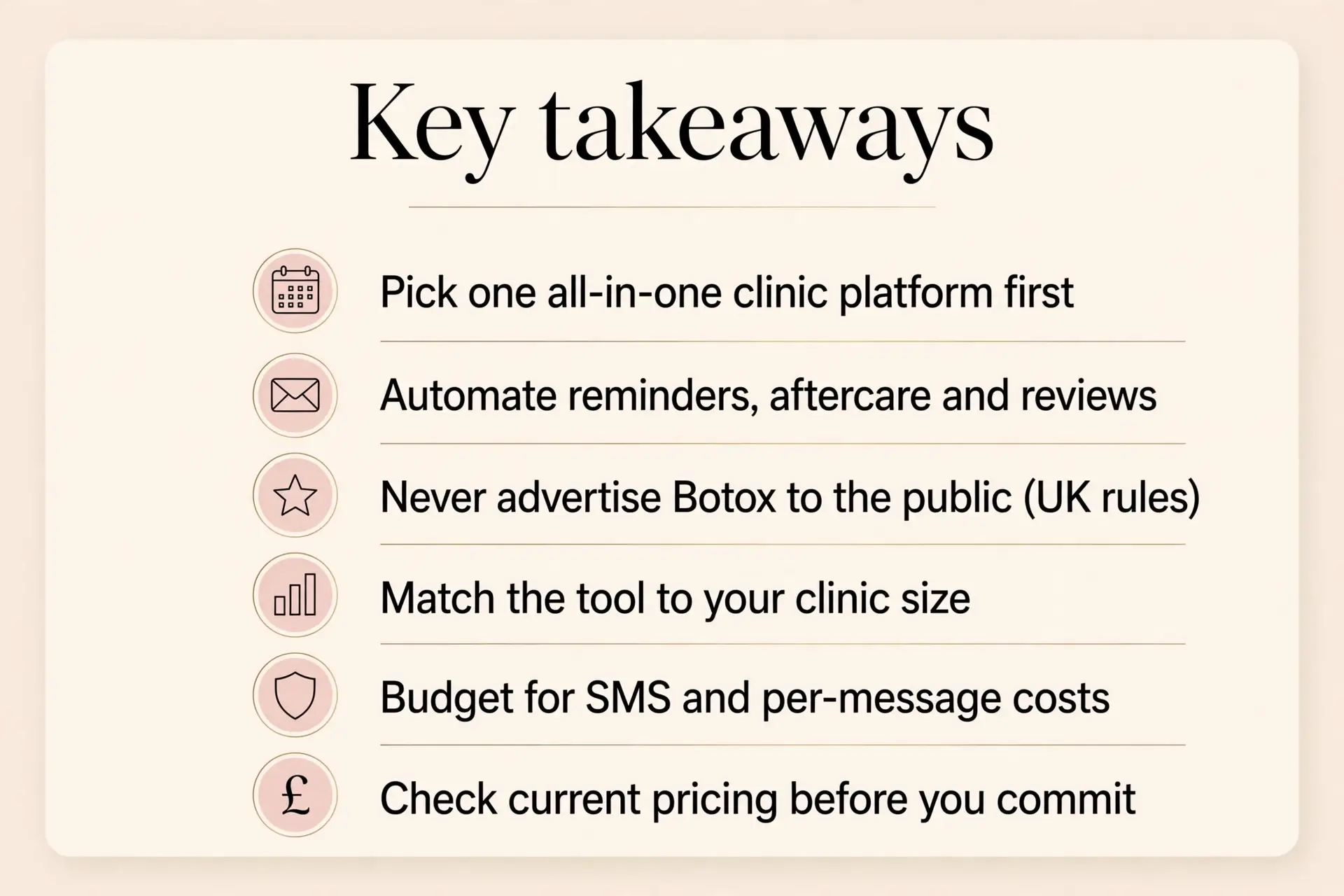
- Pick one all-in-one clinic platform first (booking, records and marketing in one place beats three disconnected tools).
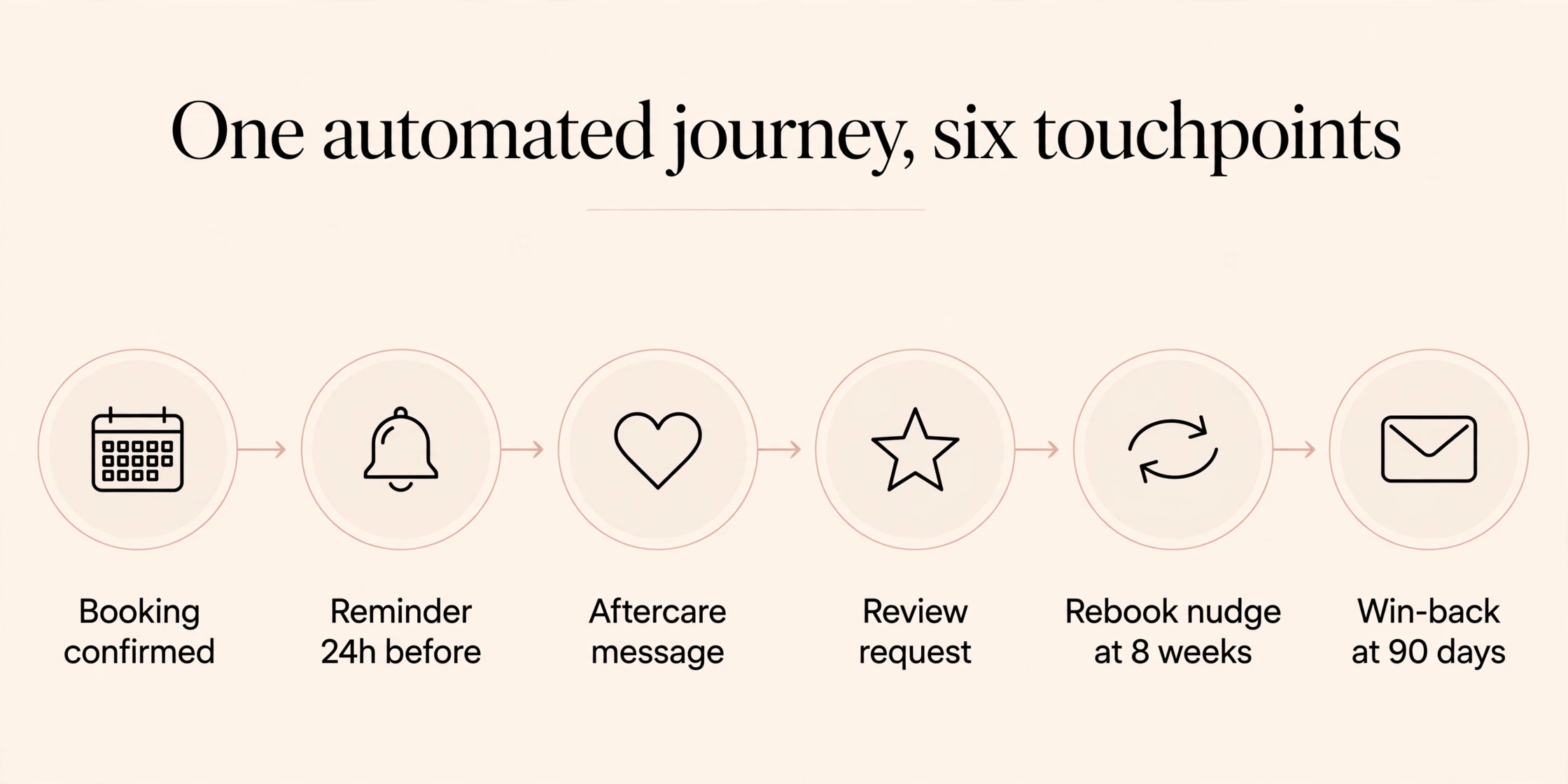
- Automate reminders, aftercare messages, review requests and rebooking nudges, that is where the bookings come from.
- UK rules shape everything: you cannot advertise Botox (or other prescription-only treatments) to the public.
- Match the tool to your clinic size, a solo practitioner and a three-site group need different software.
- Budget for SMS and per-message costs, and always check current pricing before you commit.
Choosing between tools? Book a free 30-minute call, we will help you pick the right setup for your clinic, no sales pitch.
What counts as "medical spa marketing software"?
The phrase covers four different kinds of tool, and most clinics need one from the first category plus maybe one other. Knowing the categories stops you buying three tools that do the same job.
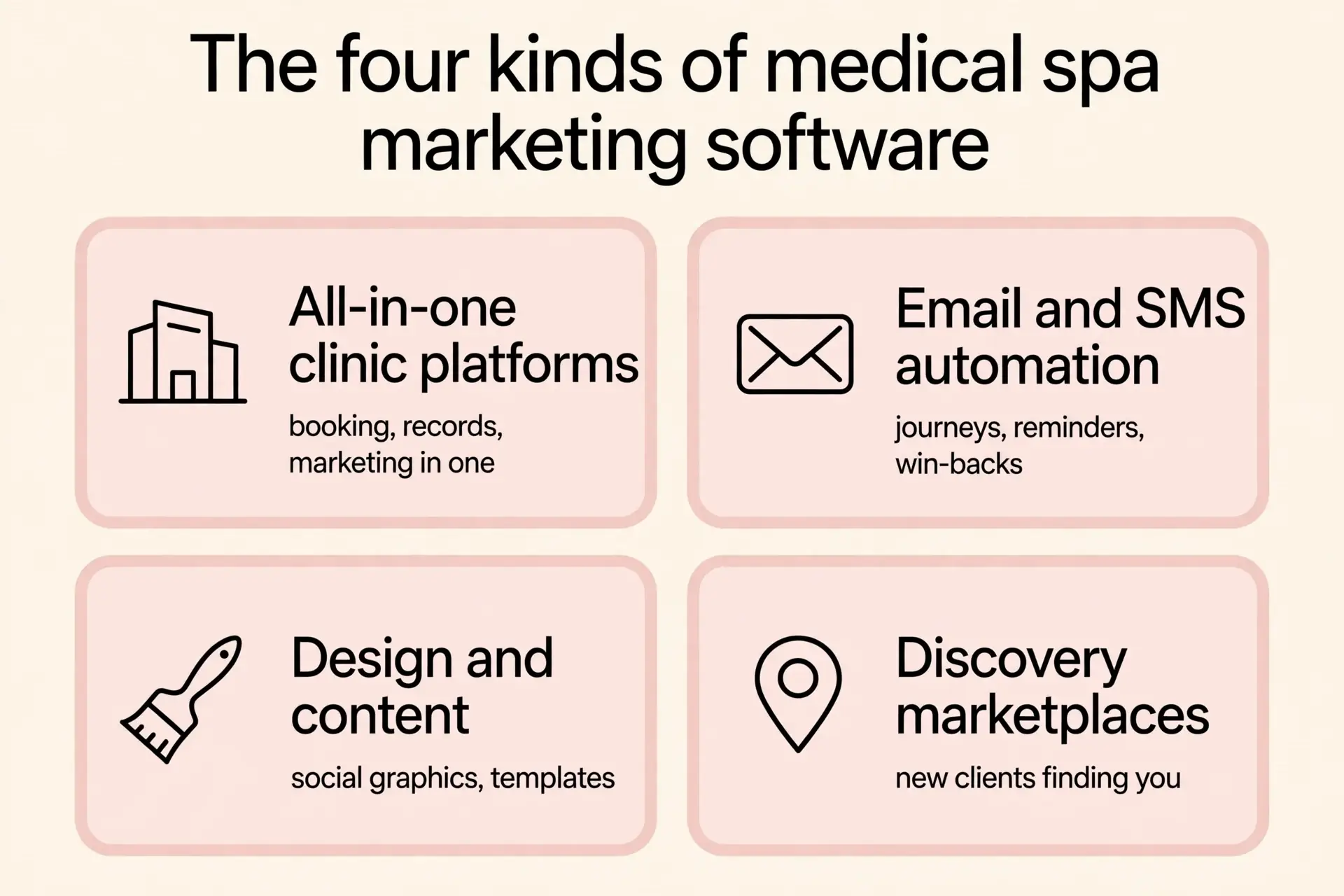
- All-in-one clinic platforms, booking, client records, and marketing (email/SMS campaigns, reminders, loyalty) in one system. Examples: Pabau, Phorest, Zenoti, Fresha. This is where most clinics should start.
- Email and SMS automation tools, deeper journeys and segmentation than a booking system’s built-in campaigns. Example: Mailchimp. Worth adding if email is a serious channel for you.
- Design and content tools, for the social posts, stories and emails themselves. Example: Canva.
- Discovery marketplaces, where new clients find and book you. Example: Treatwell. A channel, not really software, but it affects your marketing budget, so it belongs in the comparison.
One more thing: "medical spa" is the American term. In the UK your clients search for "aesthetics clinic", and this guide uses that language throughout, but the software category is the same.
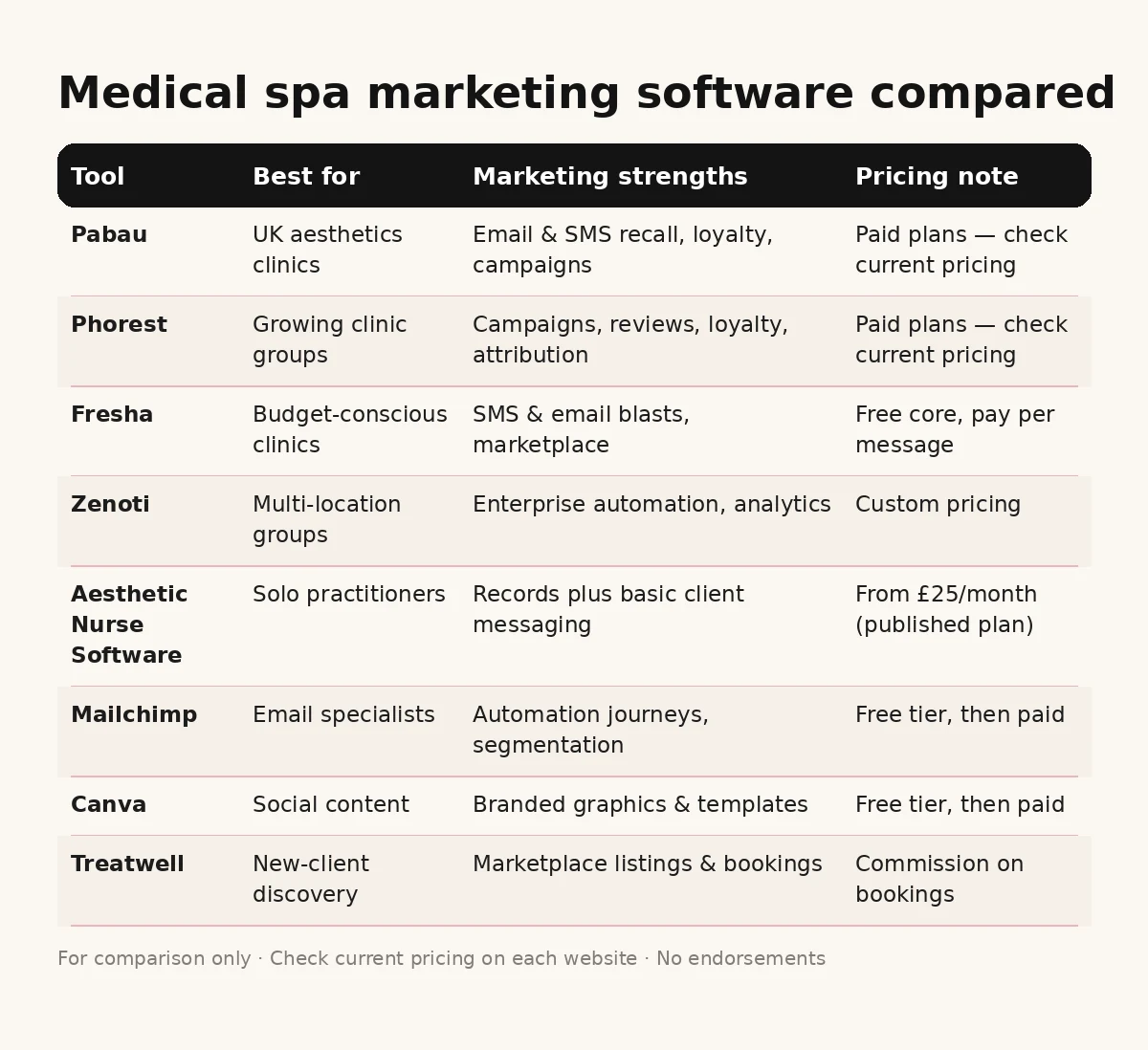
The tools at a glance: med spa marketing software compared
| Tool | Best for | Marketing strengths | Pricing note |
|---|---|---|---|
| Pabau | UK aesthetics clinics | Email & SMS recall, loyalty, campaigns | Paid plans, check current pricing |
| Phorest | Growing clinic groups | Campaigns, reviews, loyalty, attribution | Paid plans, check current pricing |
| Zenoti | Multi-location groups | Enterprise automation, analytics | Custom pricing |
| Fresha | Budget-conscious clinics | SMS & email blasts, marketplace | Free core, pay per message |
| Aesthetic Nurse Software | Solo practitioners | Records plus basic client messaging | From £25/month (published plan) |
| Mailchimp | Email specialists | Automation journeys, segmentation | Free tier, then paid |
| Canva | Social content | Branded graphics & templates | Free tier, then paid |
| Treatwell | New-client discovery | Marketplace listings & bookings | Commission on bookings |
Plans and prices change often, treat the pricing column as a starting orientation, not a quote, and check each website before you commit.
The best medical spa marketing software, reviewed
Pabau, the UK-built all-rounder for aesthetics clinics
Pabau is the closest thing to a medical spa marketing platform built specifically for UK aesthetics clinics. It is a UK company, its data handling is set up for GDPR (which matters when you store clinical records and run marketing from the same database), and it combines the clinical side, digital consent forms, treatment notes, before-and-after photo storage, with the marketing side: email and SMS campaigns, automated recall sequences, loyalty programmes and online booking.
Best for: single clinics and small groups offering injectables, skin and advanced treatments who want records and marketing in one login.
Honest limitation: it is a paid platform with structured onboarding rather than self-serve signup, so expect a proper setup process rather than a five-minute trial. Check current pricing on their site, plans are tiered.
Phorest, the growth platform for clinic groups
Phorest is an Irish company with a large UK client base, and its pitch is connecting marketing activity to revenue. Its marketing suite covers campaigns, client segmentation, online reviews, and loyalty, and its reporting ties campaign performance back to actual bookings, so you can see whether a promotion filled chairs, not just how many emails were opened. UK and Irish aesthetics groups (including multi-site clinic businesses) run on it.
Best for: growing clinics and small groups that want marketing, reviews and loyalty in one system with proper reporting.
Honest limitation: it is priced as a serious business platform, not a budget tool. If you are a solo practitioner in one room, you will pay for depth you may not use.
Fresha, the free core with pay-as-you-go marketing
Fresha is UK-based and its booking software is genuinely free to use, which is why so many small clinics start here. Its marketing features (SMS and email blast campaigns, automated reminders, loyalty and referral schemes) are integrated, but they are charged per message rather than bundled into a subscription. It also lists you on the Fresha marketplace, which brings discovery but takes a commission on new clients acquired through it.
Best for: new or budget-conscious clinics that want to keep fixed costs near zero while they grow.
Honest limitation: the per-message pricing means heavy SMS users can be surprised by the monthly total, and marketplace commissions add up as you grow. Do the maths on your message volume before assuming "free". There is a proper medical spa marketing software app too, the staff app runs the diary, check-ins and point of sale on iOS and Android.
Zenoti, the enterprise option for multi-location groups
Zenoti is built for scale: multi-location operations, enterprise-grade automation, and analytics across sites. If you are running several clinics and need consolidated reporting on marketing, retention and revenue by location, it is in a different league from single-site tools.
Best for: established groups with multiple locations and a team to run the platform.
Honest limitation: pricing is custom/quote-based, implementation is a project, and it is overkill for a single clinic. This is the "call us when you have five sites" option.
Aesthetic Nurse Software, the lightweight UK option for solo practitioners
A UK-built system aimed at solo injectors and small practices: patient records, consent, stock and basic client messaging, with a published Foundation plan from £25/month. It is records-first rather than marketing-first, think of it as a compliant home for your client data with messaging attached, not a marketing automation suite.
Best for: solo practitioners who need proper records and light marketing without enterprise complexity or cost.
Honest limitation: if you want advanced campaigns, segmentation or loyalty mechanics, you will outgrow it and need to add something like Mailchimp.
Mailchimp, the email specialist
If email is doing real work for your clinic, newsletters, treatment education sequences, win-back journeys, a dedicated email tool goes further than any booking system’s built-in campaigns. Mailchimp offers automation builders, segmentation (for example, "had a facial 60+ days ago, no rebooking"), and templates. It also integrates with clinic platforms including Pabau, so your client data can flow across.
Best for: clinics that already have a client list and want proper email journeys, or clinics whose booking system has weak email.
Honest limitation: it is email-first, SMS costs extra via add-ons, and it knows nothing about your diary unless integrated. And every marketing email still needs proper consent under PECR (more on that below).
Canva, the content design tool
Most clinic marketing fails visually before it fails strategically: inconsistent fonts, stretched logos, before-and-after grids that look unprofessional. Canva gives you branded templates for Instagram posts, stories, email headers and in-clinic screens. Its brand kit keeps your colours and logo consistent even when a team member makes the graphic.
Best for: any clinic producing its own social content.
Honest limitation: it designs the message; it does not check it. An ASA-non-compliant claim in a beautiful Canva template is still non-compliant. If creating content weekly feels like a second job, our social media management for salons exists for exactly that.
Treatwell, the discovery marketplace
Treatwell is not marketing software at all, it is a marketplace where clients discover and book beauty treatments. For aesthetics clinics it works best for the non-clinical side of the menu (facials, waxing, nails, massage): it puts you in front of people actively searching to book. You pay commission on bookings rather than a subscription.
Best for: filling the diary with new clients for beauty (non-prescription) treatments.
Honest limitation: commissions are a real cost of acquisition, and you cannot market prescription-only treatments through it the way you would on your own channels. Treat it as one acquisition channel with a known cost, and make sure your own website built to take bookings converts the clients you earn elsewhere.
Which tool should your clinic choose? A decision framework
Do not start with the tool, start with your clinic. Match your situation to the shortlist, trial one, and only add a second tool when you have a specific job the first cannot do.
| Your clinic | Start with | Add later if needed |
|---|---|---|
| Solo practitioner, 1 room | Aesthetic Nurse Software or Fresha | Mailchimp if email becomes a real channel |
| Single clinic, 2 to 6 rooms | Pabau or Phorest | Canva for content; Mailchimp for advanced journeys |
| Multiple locations | Phorest or Zenoti | Treatwell for new-client discovery |
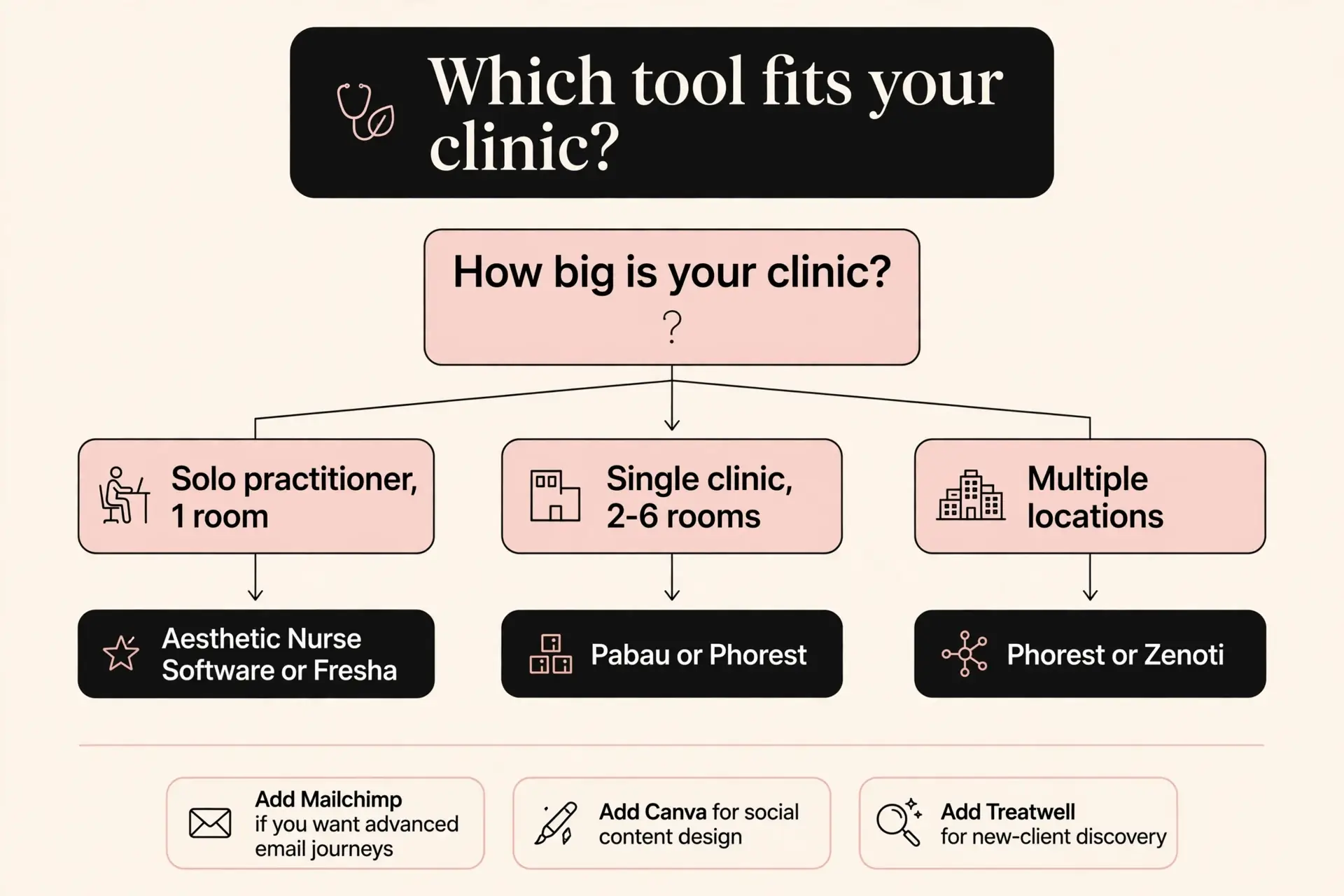
Example, how to run the decision (illustrative): a two-room aesthetics clinic in Manchester offering facials, skin treatments and injectables shortlists Pabau and Phorest, books a demo of each, and checks three things: does the consent and photo workflow fit how the practitioners actually work, can the front desk build a recall campaign without training, and what does the SMS volume cost at their client numbers. The winner is the one the team will actually use daily, the "best" software nobody opens is the most expensive kind.
📋 Get a second opinion on your software stack
Stuck between two tools, or paying for features you never open? Book a free 30-minute call and we will sense-check your setup against your clinic’s size and goals.
Free, 30 minutes, no obligation. We reply within one working day.
The UK rules that change how you use these tools
This is the section US comparisons never include, and for UK aesthetics clinics it matters more than any feature list. However good your med spa marketing automation is, it has to operate inside UK law.
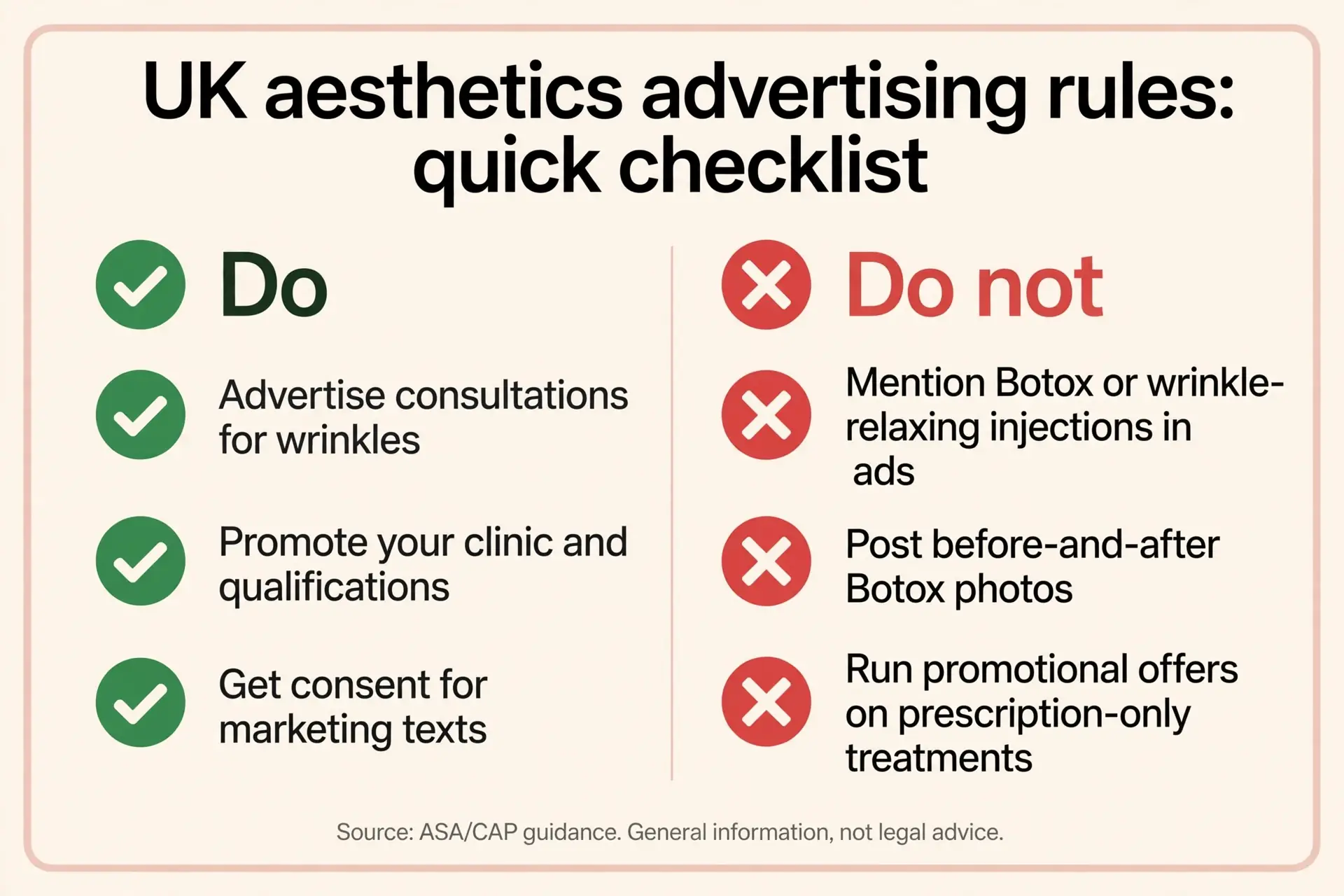
ASA/CAP: prescription-only treatments cannot be advertised to the public. Botox (botulinum toxin) is a prescription-only medicine, and the ASA’s rules are blunt: you cannot mention it, or indirect references like "wrinkle-relaxing injections", in your advertising, including social media posts, leaflets and most website content. You cannot share before-and-after photos of Botox treatments, run promotional offers on it, or have influencers endorse it. What you can do: advertise consultations for wrinkles, promote your clinic and your qualifications, and share genuine testimonials that do not reference prescription-only treatments. The ASA’s own guidance page lays out the dos and don’ts, read it before you schedule a single campaign.
PECR/GDPR: consent for marketing texts and emails. Your shiny new SMS campaigns are regulated. Under PECR you need consent (or the "soft opt-in" for existing clients buying similar services) before sending marketing texts or emails, and every message needs an opt-out. The ICO’s direct marketing guidance explains it plainly. Collect consent at booking, keep a record of it, and never buy a marketing list.
ASA price claims must be provable. "Was £300, now £150" style offers need documentary evidence. Bundle treatments or run genuine first-visit offers with clear dates instead of discount claims you cannot substantiate.
This is general information, not legal advice, if you are unsure, the ASA’s free Copy Advice service will check your ads.
5 mistakes that waste money on med spa marketing software
- Buying software before fixing the free stuff. No platform compensates for an empty Google Business Profile. Claim it, add services with prices, photos and reviews first, our local SEO for salons guide walks through it. Software amplifies what exists; it does not create demand from nothing.
- Automating texts without consent records. The fastest way to turn a marketing tool into a liability is blasting your whole client list on day one. Set up consent capture at booking before you switch on campaigns.
- Running before-and-after Botox content in campaigns. It is the most common ASA breach in aesthetics. Your software will happily schedule it, the rules still apply. Market the consultation, not the prescription-only treatment.
- Paying for depth you will not use. A solo practitioner on an enterprise platform is paying for multi-location analytics they will never open. Match the tool to your size (see the framework above) and upgrade when you grow into it.
- Ignoring per-message costs. SMS reminders, recall sequences and blast campaigns all consume messages. Before committing, estimate your monthly volume (clients × messages per client) and check what that costs on the plan you are considering, the software fee is only half the bill on pay-per-message tools.
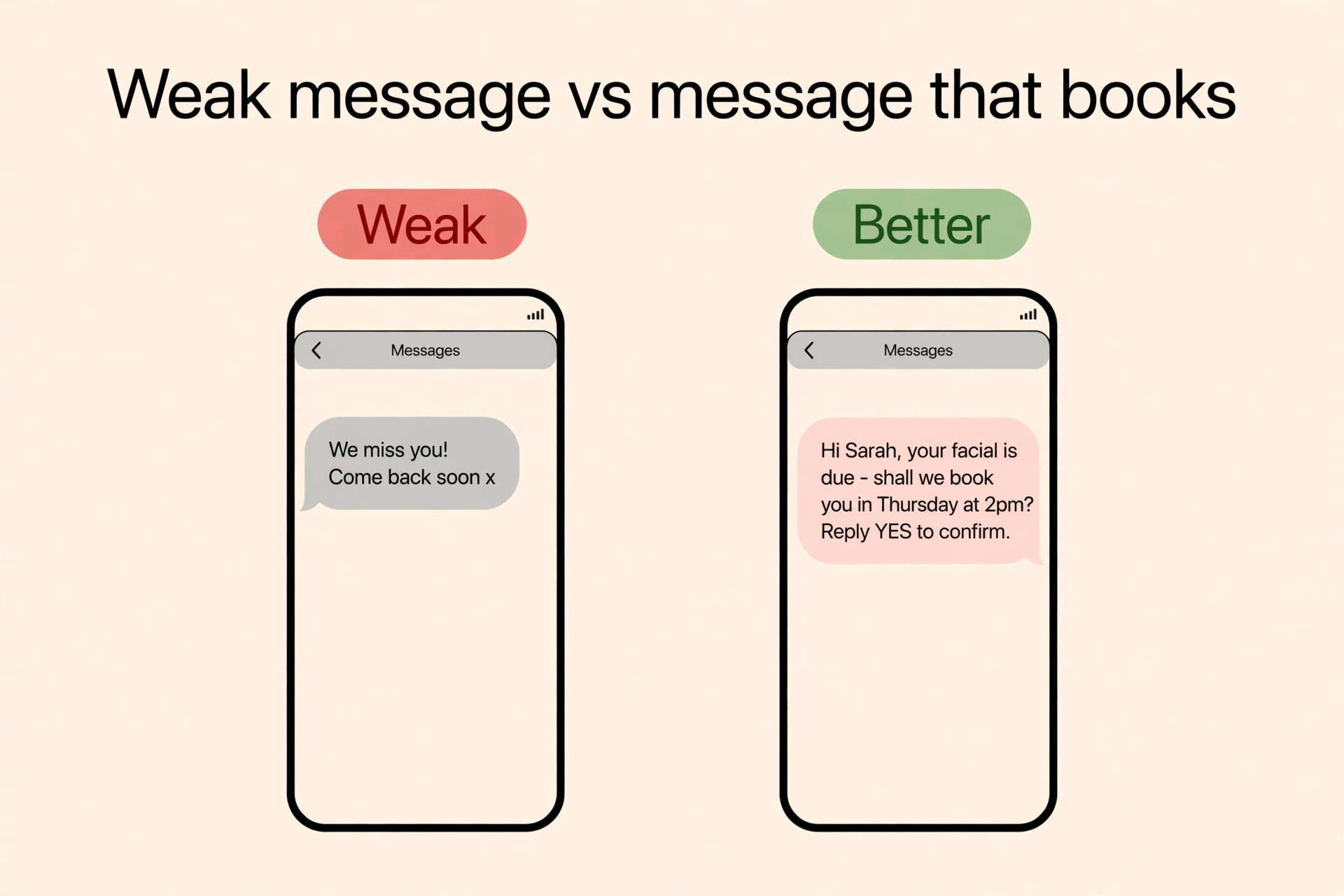
Weak message: "We miss you! Come back soon x"
Better message: "Hi Sarah, your facial is due, shall we book you in Thursday at 2pm? Reply YES to confirm."
The better version works because it names the treatment, proposes a specific time, and makes replying the booking action. Write your automated messages like the second one, not the first.
What will it cost? An honest budget breakdown
We are not printing prices here because they change constantly and vary by users, locations and message volume, any blog that quotes exact figures is either out of date or guessing. Instead, here is what actually drives the cost, so you can compare quotes like-for-like:
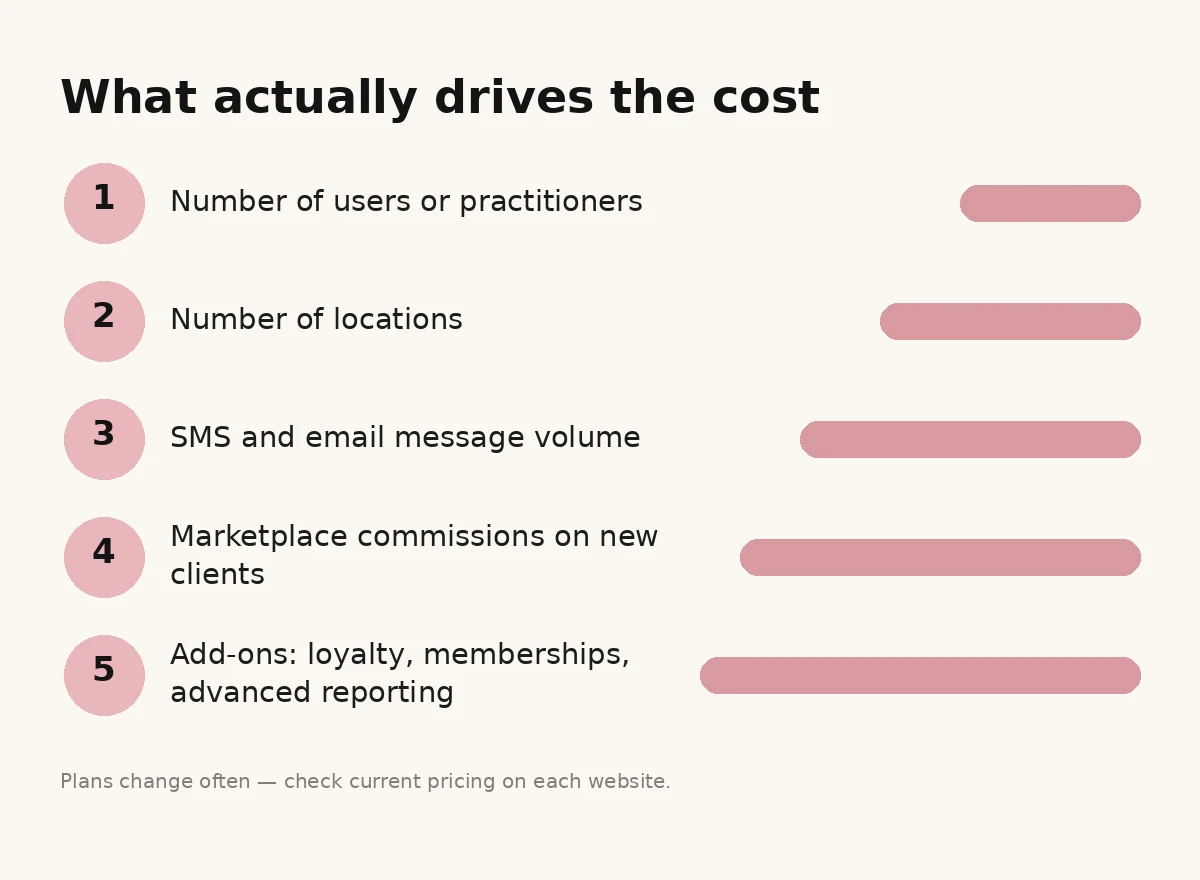
- Users/practitioners, most platforms charge per seat. Count everyone who needs a login, not just practitioners.
- Locations, multi-site pricing is usually per location. Single-site clinics should not pay for multi-site architecture.
- Message volume, SMS and email sends are often metered. Estimate yours: active clients × messages per client per month.
- Marketplace commissions, free booking tools monetise through commissions on new clients. Factor the effective rate into your acquisition cost.
- Add-ons, loyalty, memberships, advanced reporting and integrations frequently sit on higher tiers.
When you demo, ask for: the total monthly cost at your user count, location count and message volume, not the "from" price. And re-check pricing on the vendor’s own site before signing; it moves.
Frequently asked questions
What is the best medical spa marketing software for a small UK clinic?
For most single-site aesthetics clinics, a UK-built all-in-one platform such as Pabau or Phorest covers booking, records and marketing in one system. Solo practitioners can start lighter with Aesthetic Nurse Software or Fresha. Pick the one your team will actually use daily, adoption beats features. (45 words)
How much does med spa marketing software cost in the UK?
It varies too much to quote honestly: platforms charge per user and location, message-based tools charge per SMS/email, and marketplaces take commission. Ask each vendor for the total at your user count and message volume, and always check current pricing on their site before committing. (45 words)
Can I use before-and-after photos in my clinic’s marketing?
It depends what you are showing. The ASA prohibits before-and-after photos of Botox and other prescription-only treatments in advertising. For non-clinical treatments, keep imagery honest and unedited. When in doubt, market the consultation and your qualifications rather than the outcome. (40 words)
Do I need separate email software if my booking system has campaigns?
Usually not at first. Built-in campaigns handle reminders, recalls and simple blasts well. Add a dedicated tool like Mailchimp only when you want proper automation journeys and segmentation that your booking system cannot do, one database, one sender, fewer headaches. (40 words)
Is Fresha really free for clinics?
The core booking software is free, but the business model sits elsewhere: marketing messages are charged per use and there is a commission on new clients acquired through the Fresha marketplace. It is excellent value for small clinics with light messaging, just model the message and commission costs at your volume. (51 words)
The bottom line
The right medical spa marketing software for your clinic is the one that fits your size, keeps your records and marketing in as few places as possible, and operates inside UK advertising rules. Start with one all-in-one platform, automate the unglamorous stuff (reminders, aftercare, reviews, rebooking), and only add specialist tools when you have a specific job they do better.
If you want help choosing, or a second pair of eyes on the marketing the software will be sending, book a free 30-minute strategy call.
Free, 30 minutes, no obligation. We reply within one working day.
Last updated: October 2026