If you’re marketing a nail salon in the UK, you already know the two headaches: quiet gaps in the diary this week, and regulars quietly drifting to the nail bar that opened down the road. This complete guide to nail salon marketing gives you a system built for how nail businesses actually work, the 3-week infill cycle, design trends that change monthly, bridal bookings, and walk-in trade. You’ll get copy-paste templates, honest costs, and UK legal guardrails, all written for nail salon owners. Pick three plays. Start this week.
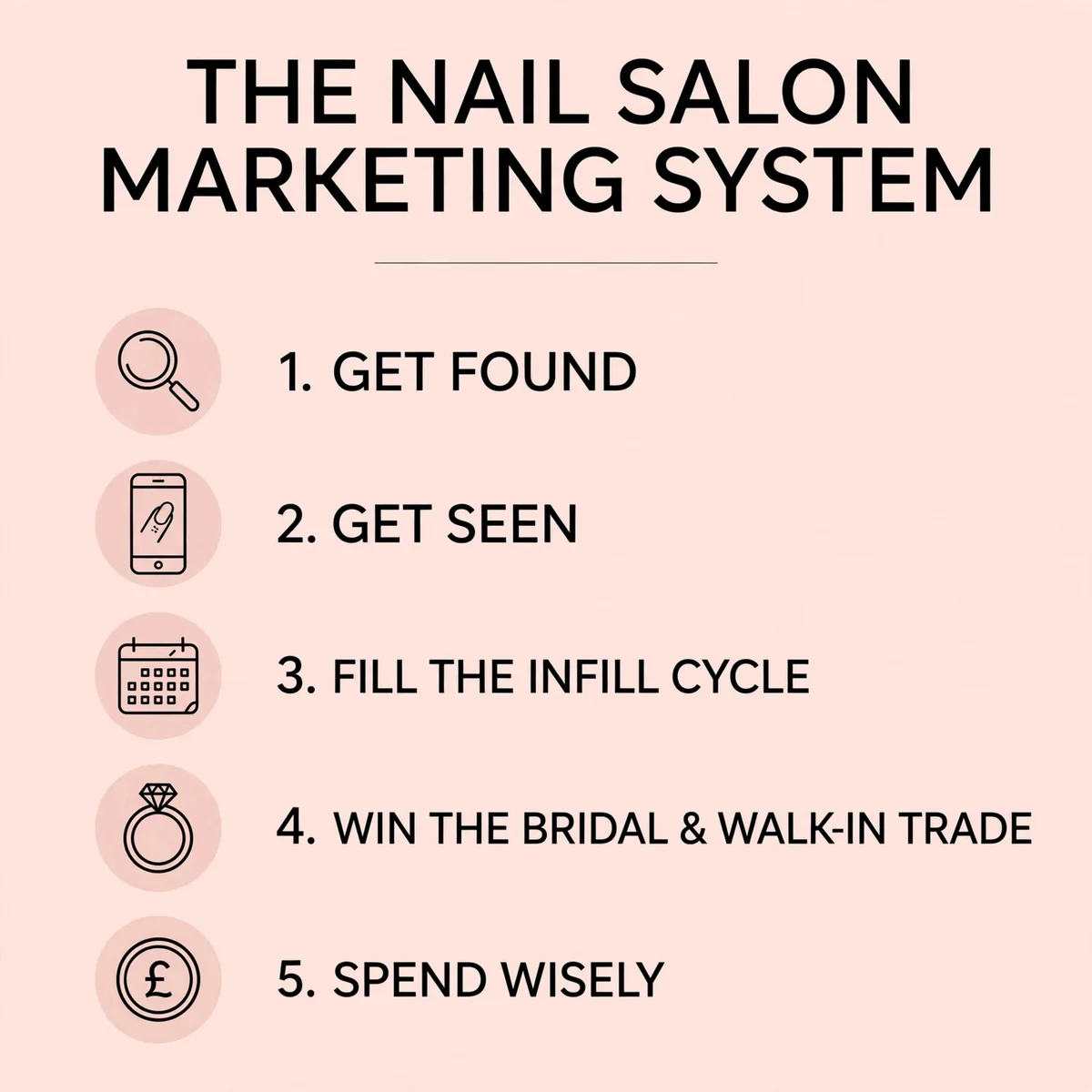
TL;DR, the 5-part nail salon marketing system
- Get found: a complete Google Business Profile with nail services and prices listed
- Get seen: Instagram and TikTok built around monthly design trends, with captions that sell
- Run the infill engine: rebook at the chair, send the day-14 reminder, win back the lapsed
- Win nail-specific trade: bridal parties, walk-ins, pedicure upsells and local partnerships
- Spend wisely: ads only after the foundations exist, with honest budgets and ASA-safe claims
Want a second pair of eyes on your nail salon’s marketing before you start? Book a free 30-minute strategy call, we’ll tell you which three plays fit your salon best.
In this guide: Why nail salons market differently · Part 1: Get found · Part 2: Get seen · Part 3: The infill engine · Part 4: Bridal, walk-ins, partnerships · Part 5: Paid ads · Which plays first + costs + mistakes · FAQ
Why marketing a nail salon is different: the 21-day advantage
Search "marketing nail salon" or "nail salon marketing" and most of what ranks is written by software companies selling booking systems, not people who market salons. And nearly all of it treats a nail salon like any other salon. It isn’t. Three things make nail businesses different, and your marketing should be built around all three.
1. The infill cycle is a built-in rebooking engine. Most gel, BIAB and acrylic clients need infills every 2 to 3 weeks, far more often than a hair client needs a cut. That means a nail salon’s diary is won or lost on retention, not acquisition. Keep a regular and she books 17+ times a year. Lose her and you don’t lose one appointment, you lose a year’s worth.
Example (illustrative, not a client result): 40 regulars on a 3-week infill cycle generate roughly 53 infill appointments a month before a single new client walks in. That is why a quiet week in a nail salon is rarely a "new clients" problem, it is a retention leak.
2. Trends move fast and sell themselves. Nail design trends turn over monthly, chrome, aura, cat-eye, glazed, seasonal sets, and clients bring screenshots to appointments. A nail salon that films the trend of the month has unlimited content. A salon that doesn’t is invisible where its clients actually decide.
3. The trade is local, visual and impulse-driven. Nail salons live on high streets, and a huge share of bookings start with "nails near me" on a phone, a striking window display, or a friend’s Instagram story. Marketing for a nail salon has to win the 30 seconds between the search and the tap.
Everything below is organised around these three realities: five parts, in the order that pays back fastest.
Part 1, Get found: nail salon marketing starts on Google
Internet marketing for a nail salon starts with one unglamorous truth: when someone searches "nails near me" or "BIAB nails [your town]", your Google Business Profile decides whether you exist. Instagram builds desire; Google captures it. Do this before anything else, it takes about 45 minutes.
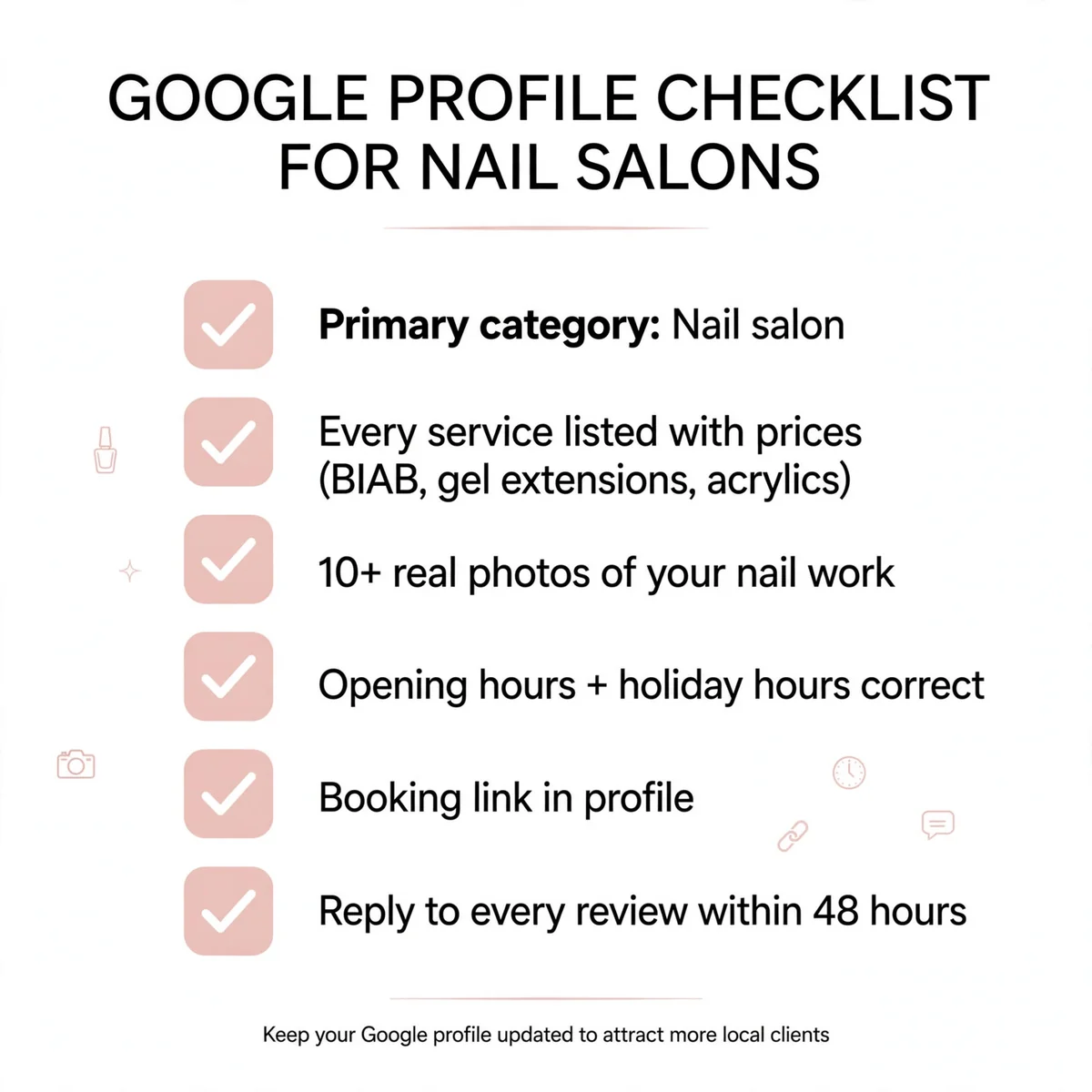
- Claim and verify your profile at Google’s official Business Profile help page.
- Set the primary category to Nail salon (not "Beauty salon", specificity wins local searches).
- List every service as its own entry with a price: "BIAB infill from £32", "Gel extensions from £45", "Luxury pedicure from £40". Clients searching prices book faster, and Google shows priced services more prominently.
- Add 10+ real photos: your best nail sets (close-up, good light), your stations, your shopfront. Not stock images, clients spot them instantly.
- Set correct opening hours, including bank holidays. Mark "walk-ins welcome" in your business description if true.
- Add your booking link (Fresha, Treatwell, Booksy or your own site) as the primary action.
- Reply to every review within 48 hours, good or bad. Review recency and responses both feed the local ranking.
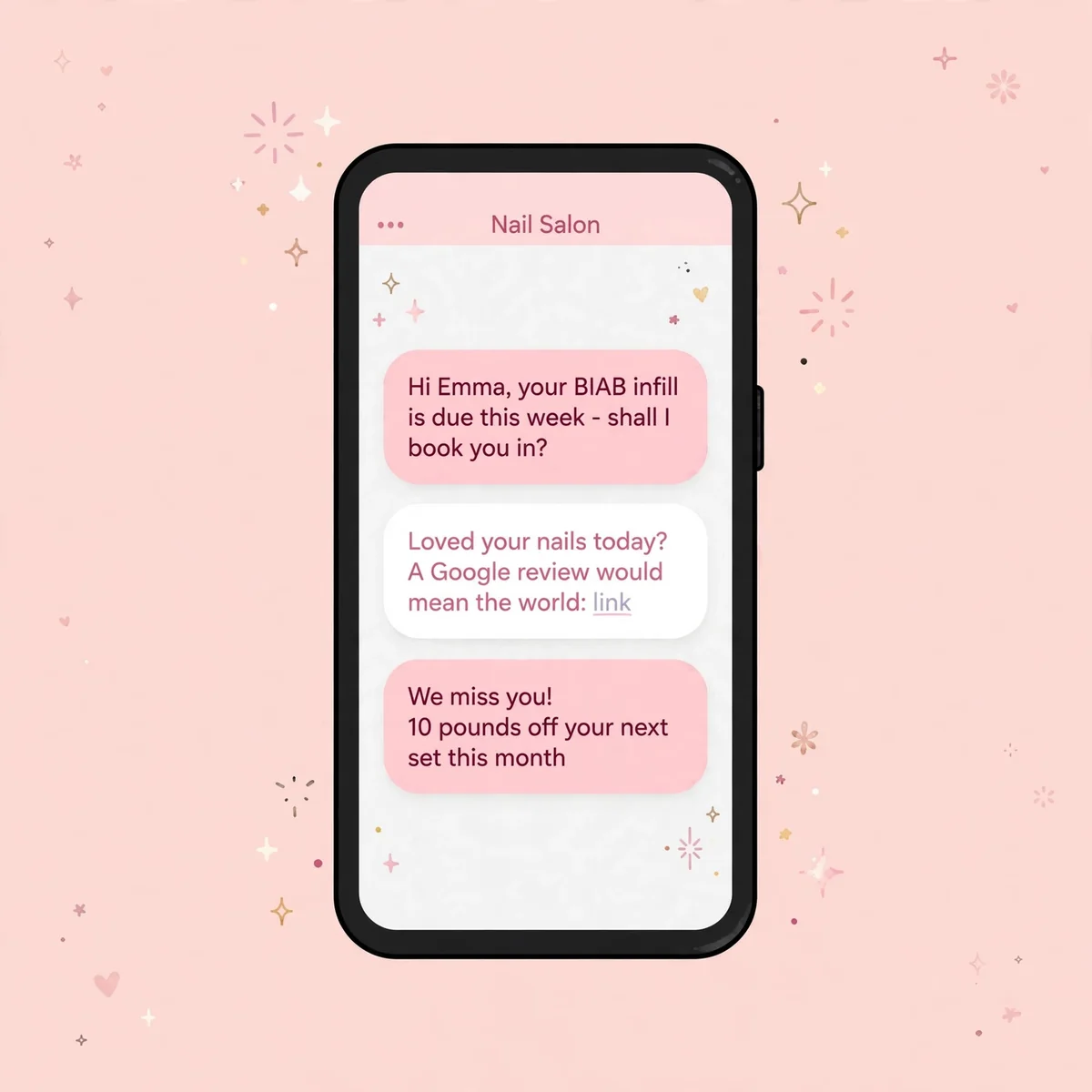
Then build the review engine. After every appointment, send this text within 24 hours (only to clients who agreed to receive messages, see the legal note in Part 3):
Hi [name], loved doing your [set/design] today! If you’re happy, a quick Google review would mean the world to our little salon, it takes 30 seconds: [your review link]
Aim for 2 to 3 new reviews a week. Steady and believable beats a sudden burst every time. For a deeper walkthrough, see our guide to local SEO for salons. And if "no time" is your situation, our local SEO for nail salons service handles the profile, reviews and local rankings for you.
Part 2, Get seen: the design-trend content engine
Nail clients decide with their eyes. Your Instagram and TikTok are your shop window, and the good news is you never run out of material: every set you do is content, and every monthly trend is a reason to post.
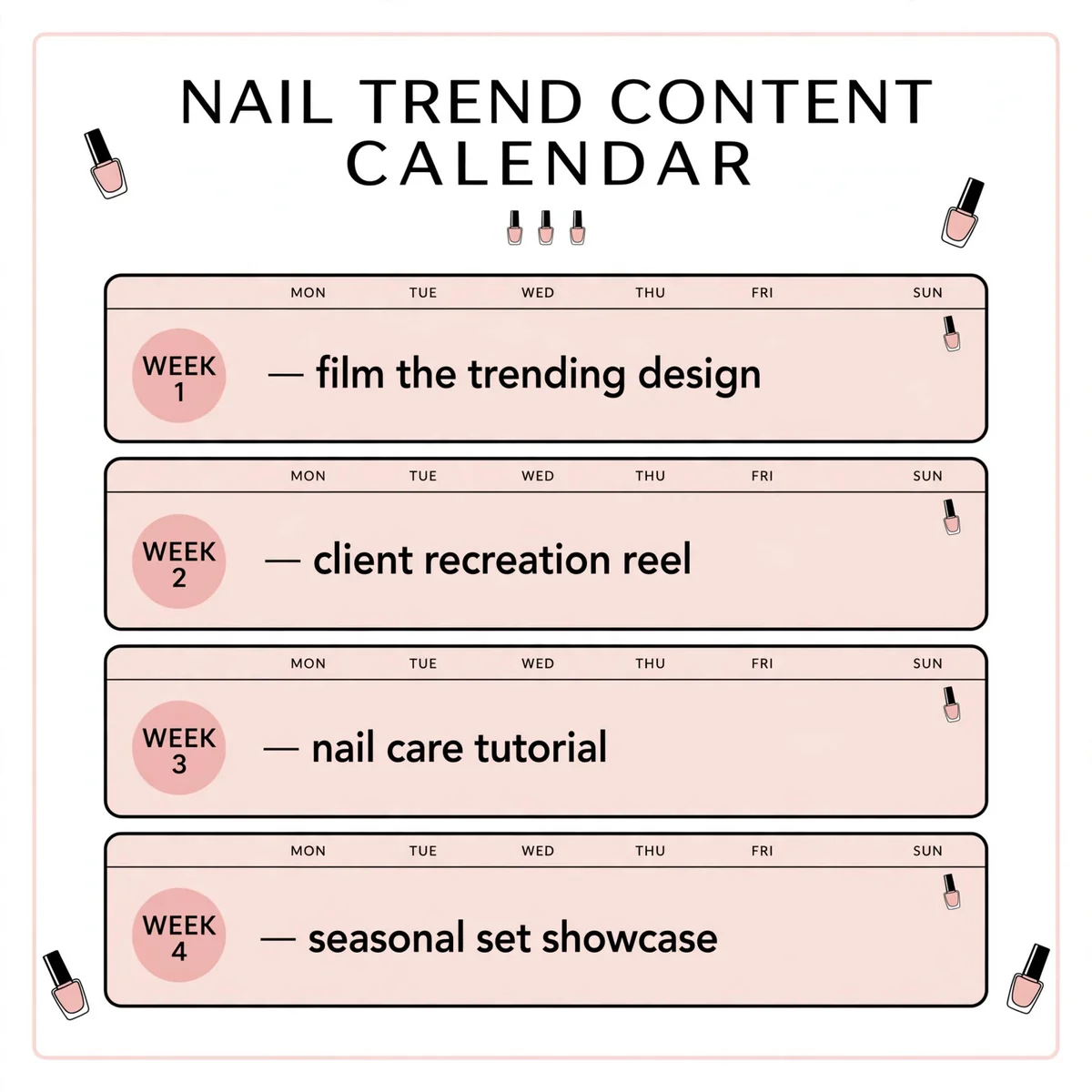
The monthly trend calendar, one job a week, about an hour total:
- Week 1: Film the trending design. Recreate the month’s big trend (chrome, aura, cat-eye, whatever clients are screenshotting) and post it as a Reel within days of it peaking.
- Week 2: Post a client recreation Reel, "she brought the screenshot, we did the set."
- Week 3: A 30-second nail care tutorial (cuticle oil routine, why infills matter at 3 weeks, how to make gel last).
- Week 4: A seasonal set showcase, Christmas, Valentine’s, summer brights, autumn tones.
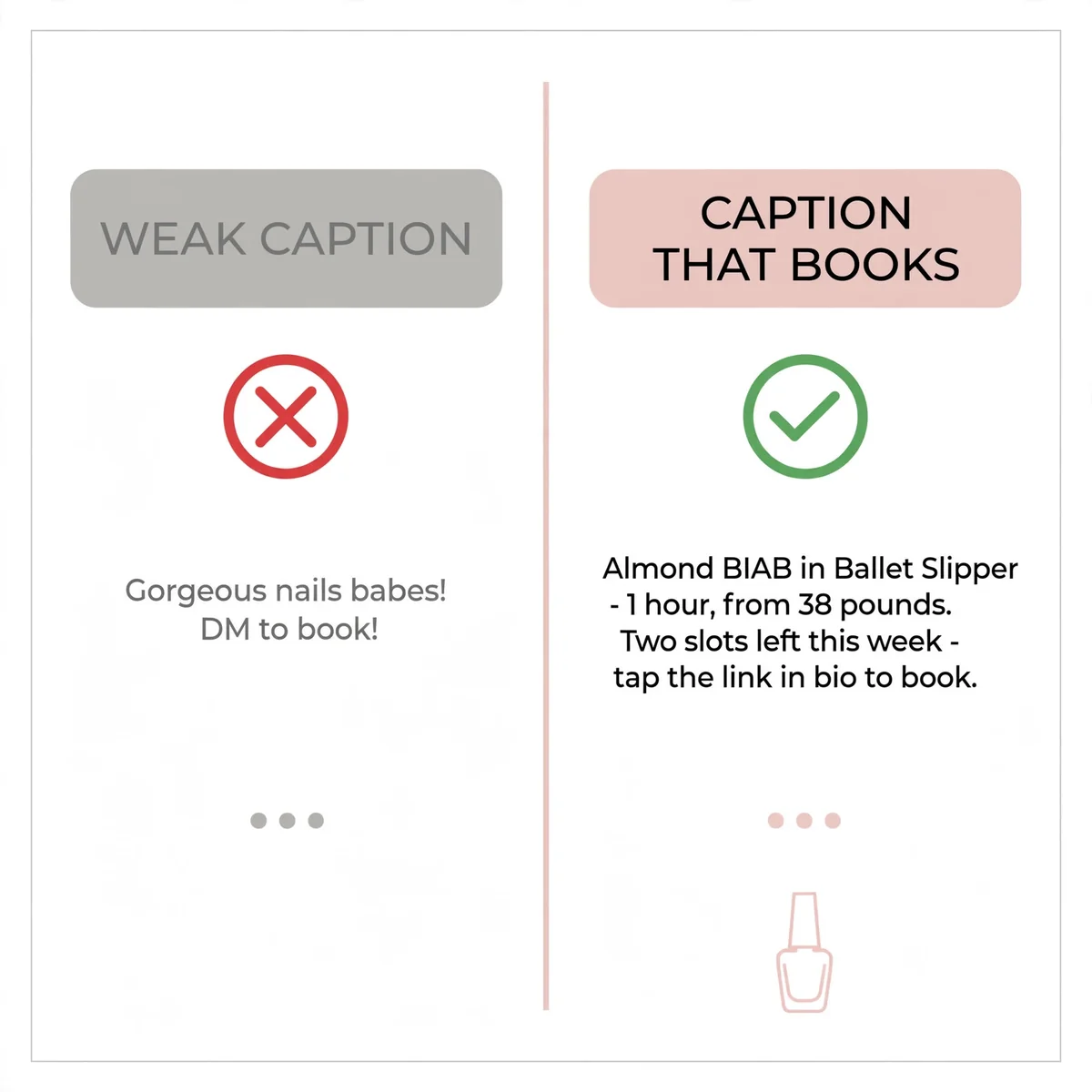
Captions must sell, not just show. Most nail accounts post beautiful sets with captions like "Obsessed 😍 DM to book 💅". That wastes the photo. Compare:
Weak caption: "Gorgeous nails babes! DM to book!"
Better caption: "Almond BIAB in Ballet Slipper, 1 hour, from £38. Two slots left this week, tap the link in bio to book."
The better version answers the three questions every viewer has: what is it, what does it cost, how do I book. Use your town in hashtags (#nailsleeds, #biabmanchester) and tag your location on every post, local discovery beats global likes. And post your sets to your Google profile too; it takes 30 seconds and most nail salons never do.
If creating this content weekly feels like a second job on top of full columns, that’s exactly what our social media management for nail salons takes off your plate.
Part 3, The infill engine: turn the 3-week cycle into bookings
This is the section that pays for the whole guide. A nail salon doesn’t have a marketing problem as often as it has a rebooking problem. Build this four-step engine and the diary starts filling itself.
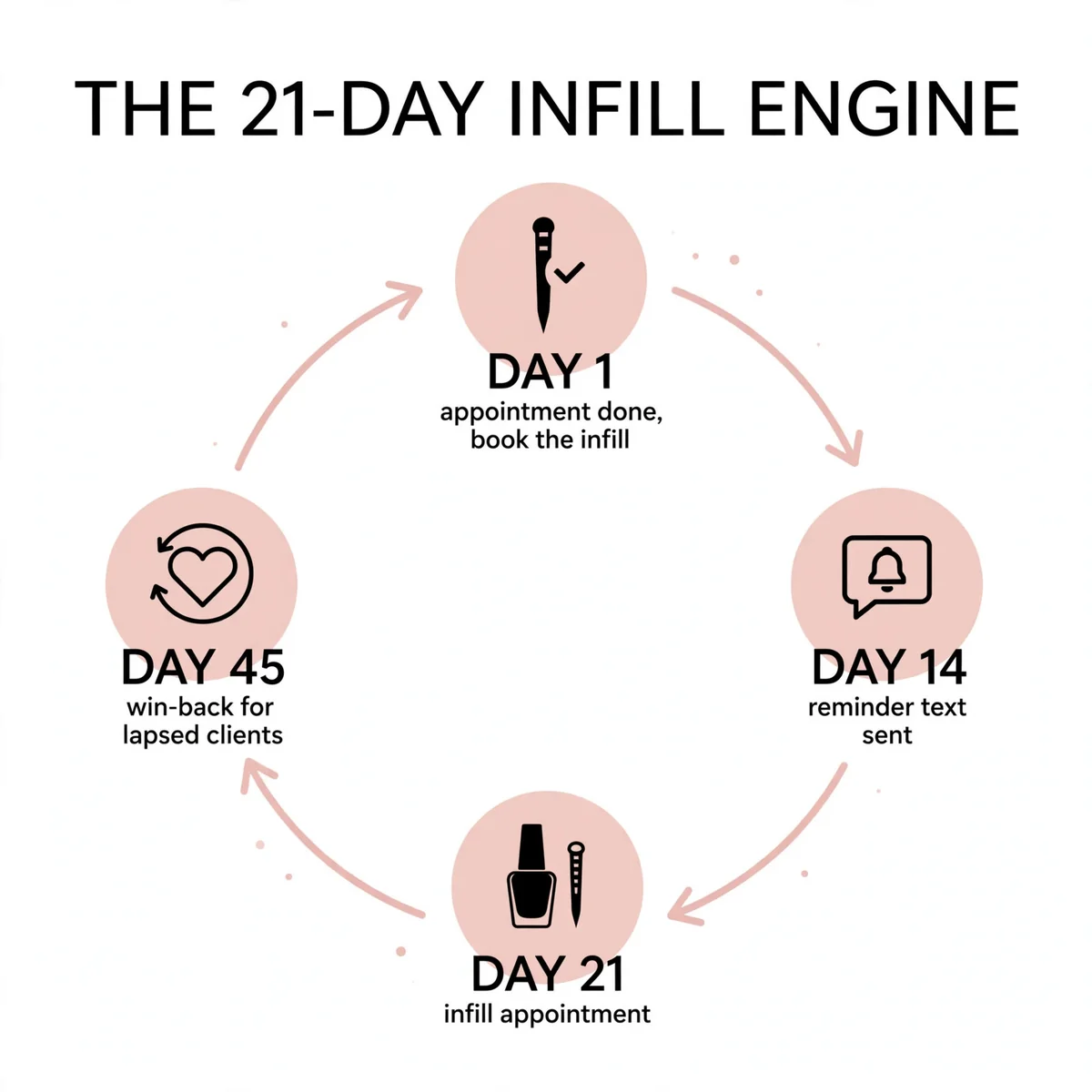
Day 1, Rebook at the chair
The cheapest booking you’ll ever take is the one you make before the client stands up. At the end of every appointment, say:
"Your BIAB will need an infill in about 3 weeks, shall I book you in for [date]? We get busy around then."
Train every technician to do it. It takes 20 seconds. This one habit is the single biggest lever in nail salon marketing.
Day 14, The reminder text
Not everyone rebooks at the chair. For the rest, send a reminder two weeks after the appointment:
Hi [name], it’s [your name] from [salon]. Your infill is due next week, shall I book you in? We have [day] and [day] free: [booking link]. Reply STOP to opt out.
Legal note: under PECR, the UK’s electronic marketing rules, you need consent (or the "soft opt-in" for existing customers) before sending marketing texts, and every message must offer an opt-out. Collect consent at booking, one tick box, plainly worded, and the ICO’s direct marketing guidance explains the rules clearly. This is general information, not legal advice.
Day 45, Win back the lapsed
Clients who haven’t booked in 6+ weeks already trust you, they just drifted. Send this (only to clients who agreed to marketing messages):
Hi [name], it’s [your name] from [salon], we haven’t seen you in a while and we’d love to have you back. Here’s £10 off any set booked before [date]: [booking link]. Reply STOP to opt out.
Send to 20 lapsed clients. Even a handful of replies fills a quiet week for the cost of a few texts.
The cancellation waitlist
Fresha’s 2026 research, reported by Hairdressers Journal, found salon owners aged 35 to 44 lose an average of 8% of monthly revenue to cancellations and no-shows, on a £12,000 monthly turnover, that’s £960 (HJI). A waitlist doesn’t stop cancellations, but it stops them costing you. Keep a simple list of clients who want earlier slots; when someone cancels, message the list. The gap fills within the hour.
💅 Make the infill engine run itself
These four steps work, but they work faster when someone builds the system around your diary, your prices and your client list. Book a free 30-minute strategy call and we’ll map your nail salon’s retention engine together.
Free, 30 minutes, no obligation. We reply within one working day.
Part 4, Nail-specific growth plays: bridal, walk-ins and partnerships
Bridal parties: the highest-value nail booking
One bride books herself, three bridesmaids and the mother of the bride, five sets, one morning, full price. Yet most nail salons have no bridal offer at all. Build one:
- A simple package: "Bridal party nails, bride’s set plus party manicures, prosecco on arrival, from £X per person." Price it as a package, not a discount.
- A trial appointment 4 to 6 weeks before the wedding (brides book trials; it also fills a quiet weekday).
- Get found for it: add "bridal nails" to your Google services and your website, and post every bridal set with your town in the caption.
- Partner up: introduce yourself to two bridal boutiques and one wedding planner nearby. One referral relationship can deliver a wedding party a month in season.

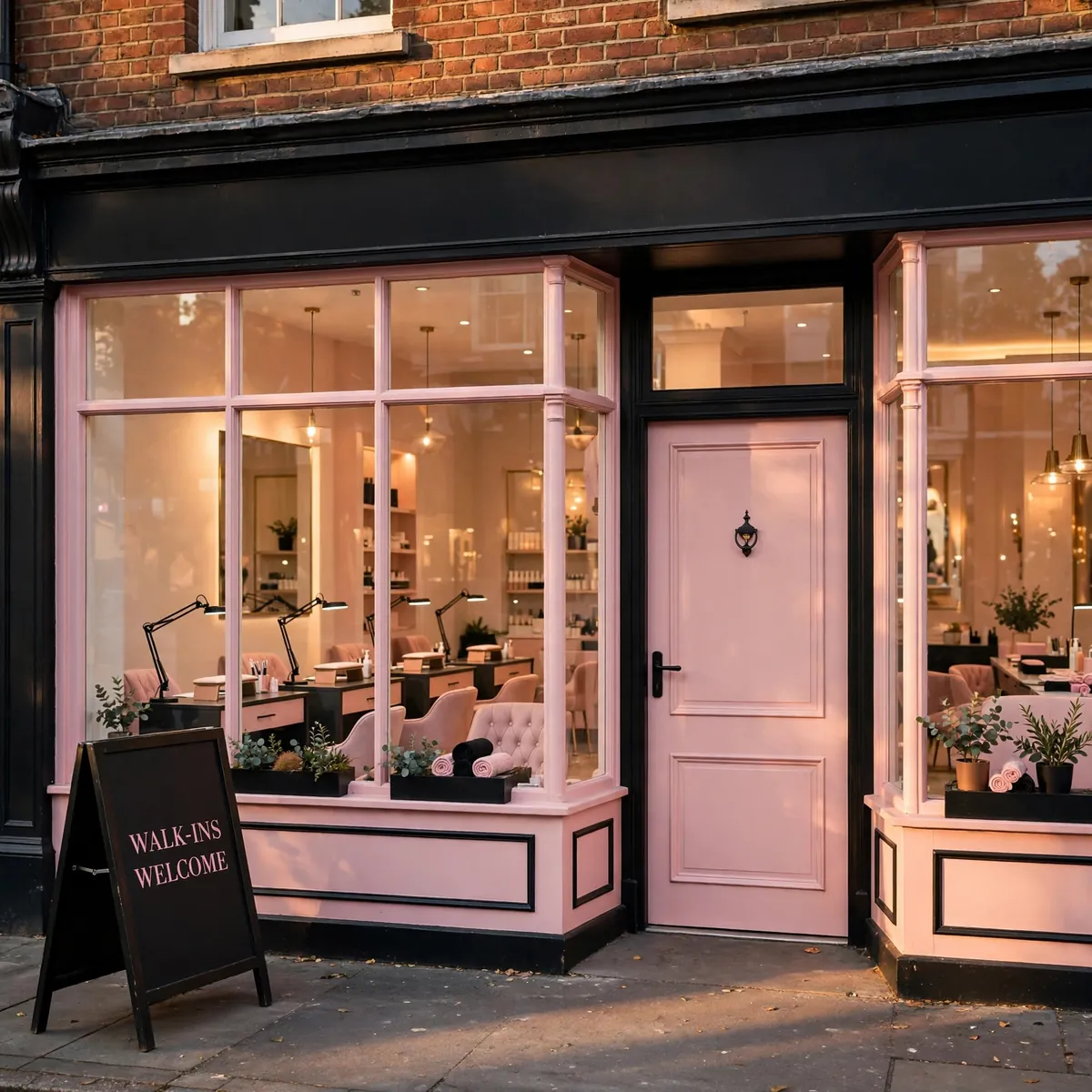
Walk-ins: your shopfront is a billboard
Nail salons get more walk-in trade than almost any other salon type, but only if the street knows you’re there. The checklist:
- An A-board outside: "WALK-INS WELCOME" beats your logo. Change the message weekly ("Christmas party nails, walk-ins today").
- A window display of this month’s trend sets, refreshed monthly. Printed photos of real work, well lit.
- "Open now" hours correct on Google, walk-in searches happen on phones outside your door.
- One express service for the impulse buyer: "Express file and polish, 30 minutes, £22." Low commitment, high conversion to full sets later.
Partnerships and the nail-and-spa crossover
Find three nearby businesses whose clients look like yours: a bridal boutique, a hair salon, a gym, a hotel. Offer something mutual, they display your cards, you display theirs, each offers the other’s clients 10% off a first visit. One partnership this month, not ten.
If you run nails inside a spa, marketing a nail and spa business together is stronger than either alone: "Book any 60-minute treatment, add a gel manicure for £25" fills nail chairs with spa clients who already trust the building. Nail and spa marketing works best as one offer, not two businesses sharing a reception desk.
Don’t forget pedicures
Pedicures are the quiet earner most nail salons under-market. Run a "sandals season" push from April (not June, when everyone else starts), sell pedicure gift vouchers for Mother’s Day, and offer a manicure-pedicure bundle in the quieter winter months. Marketing a pedicure salon service inside your nail salon costs nothing extra, it’s the same chair, the same client, a second booking.
Part 5, Spend wisely: paid ads for nail salons
Paid ads work for nail salons, but only after Parts 1 to 3 exist. Running ads to a half-finished Google profile or an Instagram with no prices is paying to disappoint people. When the foundations are in place:
- Instagram and TikTok ads for trend sets work best: a 15-second Reel of the month’s design, targeted to a 5-mile radius around your salon, linking straight to booking. Start at £5 a day for two weeks and judge it on bookings, not likes.
- Google ads for "nails near me" and "BIAB [town]" capture high-intent searches. These clicks cost more, so cap the daily budget and send them to a page with prices and a booking button, never your homepage.
- Boost with a brain: if you boost a post, set a budget, a deadline, and a booking link. If you can’t say what one booking cost you, you can’t say the ad worked.
Keep every claim ASA-safe. Under UK advertising rules, discount claims must be genuine and provable, the ASA has banned brands for "was/now" prices they couldn’t substantiate (see this Pinsent Masons summary of ASA rulings). "New clients: 20% off your first set in November" with clear dates is safe. "Up to 50% off" with nothing to back it up is not. One complaint can get the ad banned and your name published in a ruling.
If ads feel like a gamble you’d rather not take alone, our social media ads for salons run them with tracking from day one. And if your website doesn’t turn ad clicks into bookings, prices, location and a booking button above the fold on mobile, see what a website built to take nail bookings looks like.
Which plays first, what it costs, and mistakes to avoid
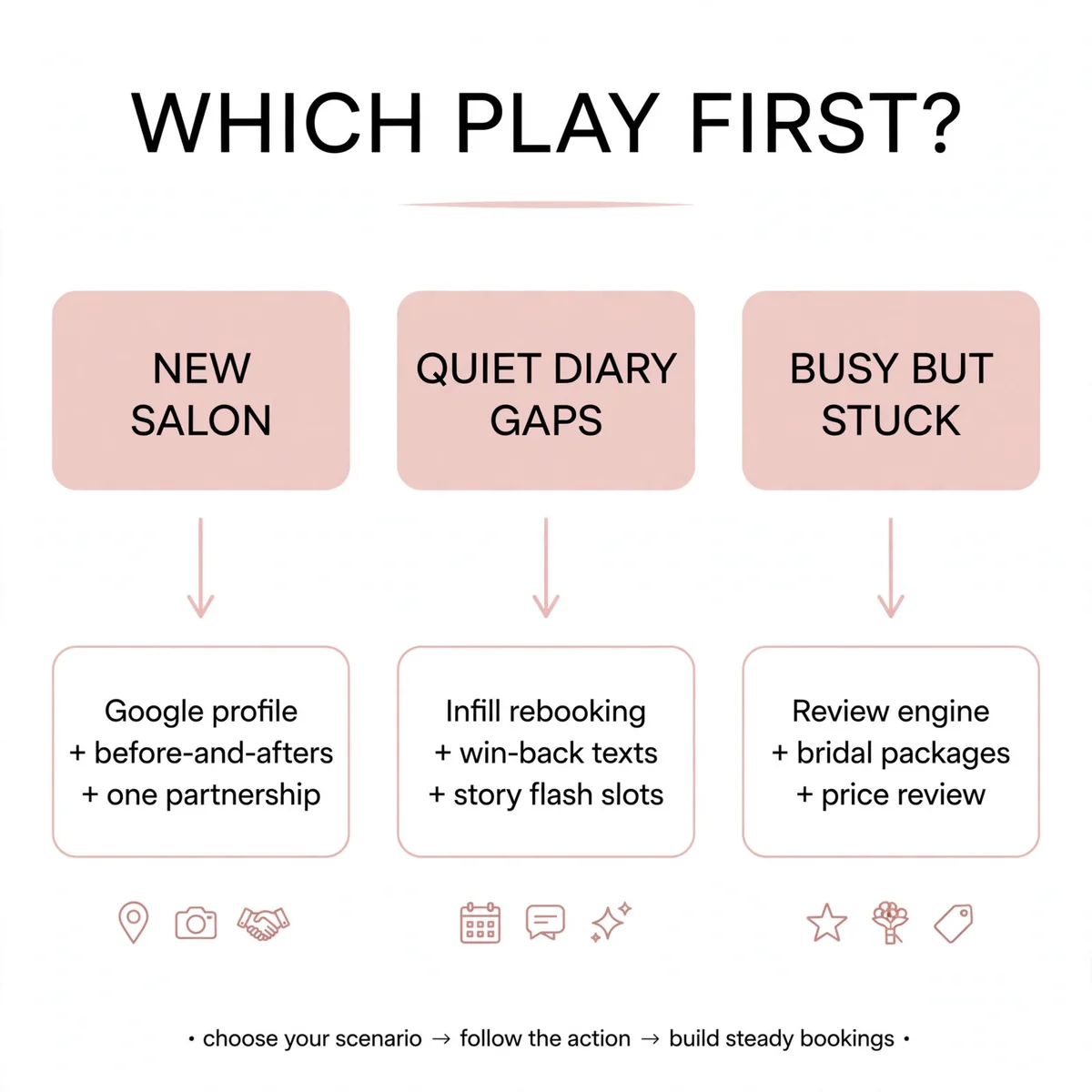
Don’t try everything at once. Pick your situation and start there.
| Your situation | Start with these three |
|---|---|
| New salon, few clients | Google Business Profile · Trend Reels + selling captions · One local partnership |
| Established but diary has gaps | Rebook at the chair · Win-back texts · Story flash slots for cancellations |
| Busy but want better clients | Review engine · Bridal packages · Walk-in shopfront upgrade |
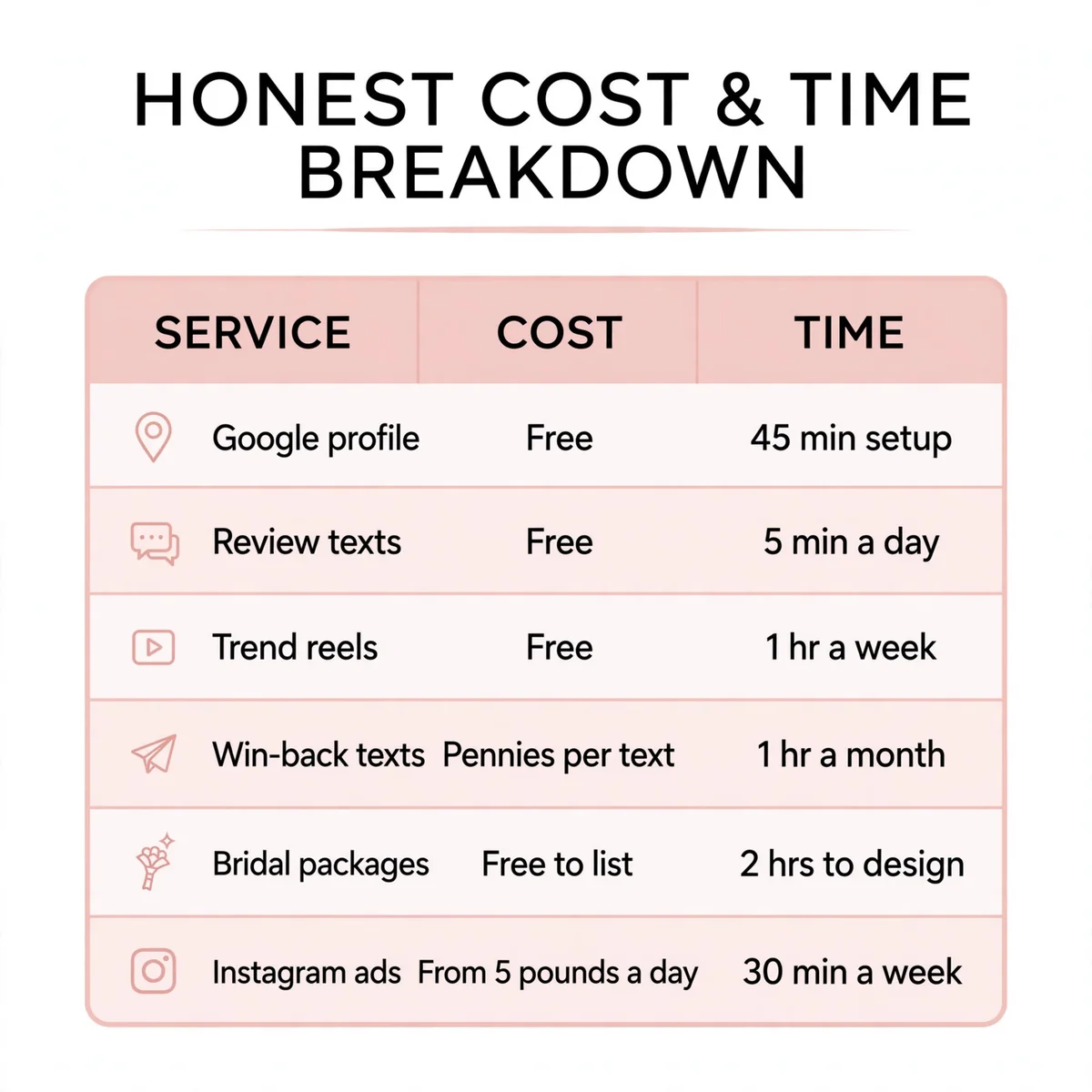
Most of nail salon marketing costs nothing but your time:
| Play | Cost | Time |
|---|---|---|
| Google Business Profile | Free | 45 min setup, 10 min/week |
| Review texts | Free | 5 min/day |
| Trend Reels | Free | 1 hr/week |
| Infill reminder texts | Pennies per text | 30 min/month |
| Win-back texts | Pennies per text | 1 hr/month |
| Bridal packages | Free to list | 2 hrs to design |
| Walk-in signage | £15 to £40 for an A-board | One afternoon |
| Instagram/TikTok ads | From £5/day | 30 min/week |
5 mistakes that cost nail salons bookings
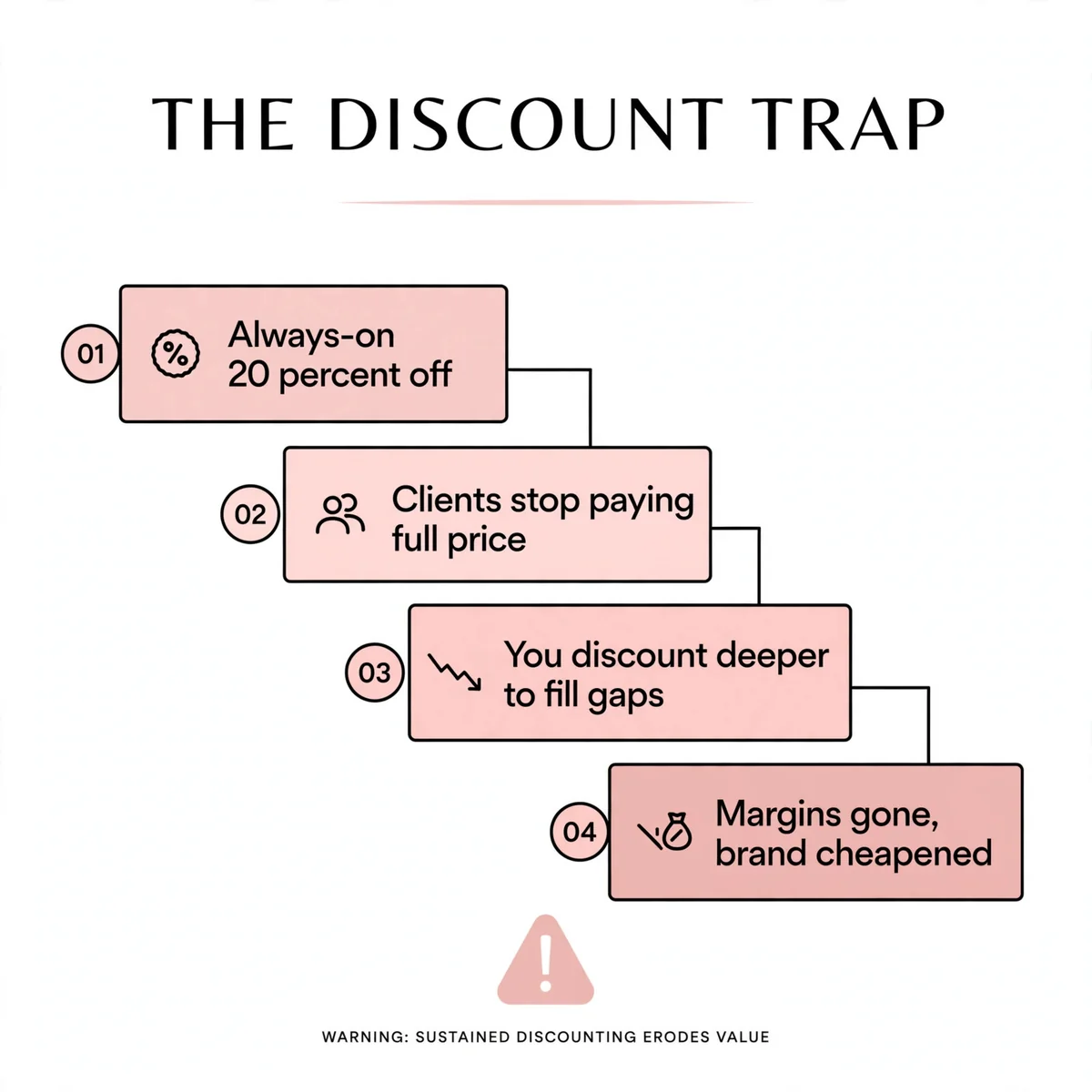
- The always-on discount. If there’s always 20% off, clients learn to never pay full price, then you discount deeper to fill gaps, and the brand gets cheaper every month. Discount with a reason and a deadline, or bundle instead.
- "Up to 50% off" claims you can’t prove. The ASA requires documentary evidence for price claims. One complaint can mean a banned ad and your name in a published ruling.
- Texting people who never consented. Bought lists and old client numbers without marketing consent breach PECR. Build your own list from real clients with a clear tick box at booking.
- Boosting posts with no booking link or tracking. Likes don’t pay rent. Every pound of ad spend needs a destination (booking page) and a number (cost per booking).
- Posting beautiful sets with no price and no way to book. Every post should answer: what is it, what does it cost, how do I book. Miss one and the client scrolls on.
Frequently asked questions
How do I get more clients for my nail salon?
Start where clients already look: a complete Google Business Profile with your nail services, prices and recent reviews. Add Instagram Reels of monthly design trends with captions that state the price and booking link. Then keep every client with the infill engine, rebook at the chair and send day-14 reminders. (51 words)
How do nail salons advertise on a small budget?
Spend nothing first: Google profile, review texts, trend Reels and win-back messages are all free. When you do spend, start with £5-a-day Instagram ads for one trend set, targeted within 5 miles and linked straight to booking. Judge every pound on bookings, never on likes. (45 words)
How often should a nail salon post on Instagram?
Two to three times a week is plenty if every post sells: one trend Reel, one client set with price and booking instructions, and Stories for same-day gaps. One strong post with a clear call to action beats seven pretty photos with "DM to book". Consistency matters more than volume. (50 words)
How do I get more Google reviews for my nail salon?
Ask every happy client, every time. Send a short text within 24 hours of the appointment with your direct review link, and ask in person at checkout too. Aim for 2 to 3 new reviews a week and reply to each within 48 hours, steady, recent reviews rank better than one old burst. (54 words)
How much should a nail salon spend on marketing?
Start with the free plays in this guide, most cost nothing but time. When you spend, keep it measurable: £5 to £10 a day on tracked social ads, or help from people who do this daily. Never spend what you can’t afford to lose while you’re still learning what works for your salon. (54 words)
The bottom line
Nail salon marketing isn’t complicated once it’s built around how nail businesses actually work. Be easy to find on Google with prices on show. Post the month’s trends with captions that sell. Rebook every client before she leaves, remind the ones who drift, and win back the ones who lapsed. Add bridal, walk-ins and partnerships, and spend on ads only when the foundations hold.
If you want help building it properly, content, Google presence and reviews handled for you, book a free 30-minute strategy call.
Free, 30 minutes, no obligation. We reply within one working day.
Last updated: October 2026