Hair Salon Marketing Guide: Fill Your Chairs in 2026 (UK)
Salon Socials
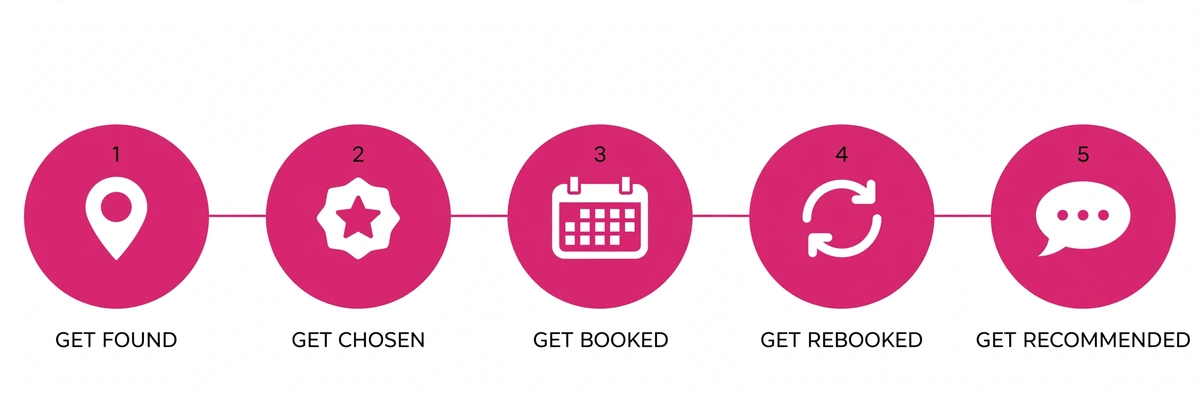
If you are searching for hair salon marketing, you probably want the whole picture: what actually fills chairs in the UK, what it costs, and where to start, not another list of 50 random ideas. This guide is for hair salon owners: independent salons, small teams, and anyone doing marketing for a hair salon on top of everything else. It gives you the complete system, built around the five jobs every hair salon’s marketing must do: get found, get chosen, get booked, get rebooked and get recommended.
Hair salon marketing has one job: full chairs, every day. This guide builds the complete UK system around the five jobs.
Key takeaways, the five jobs of hair salon marketing
Get found: hair salon hyperlocal marketing, own “balayage [your town]” on Google and Maps.
Get chosen: a portfolio that sells, transparent prices, and a review engine.
Get rebooked: the colour cycle, rebook at the chair and win back the drifters.
Get recommended: referrals, stylist personal brands and simple loyalty.
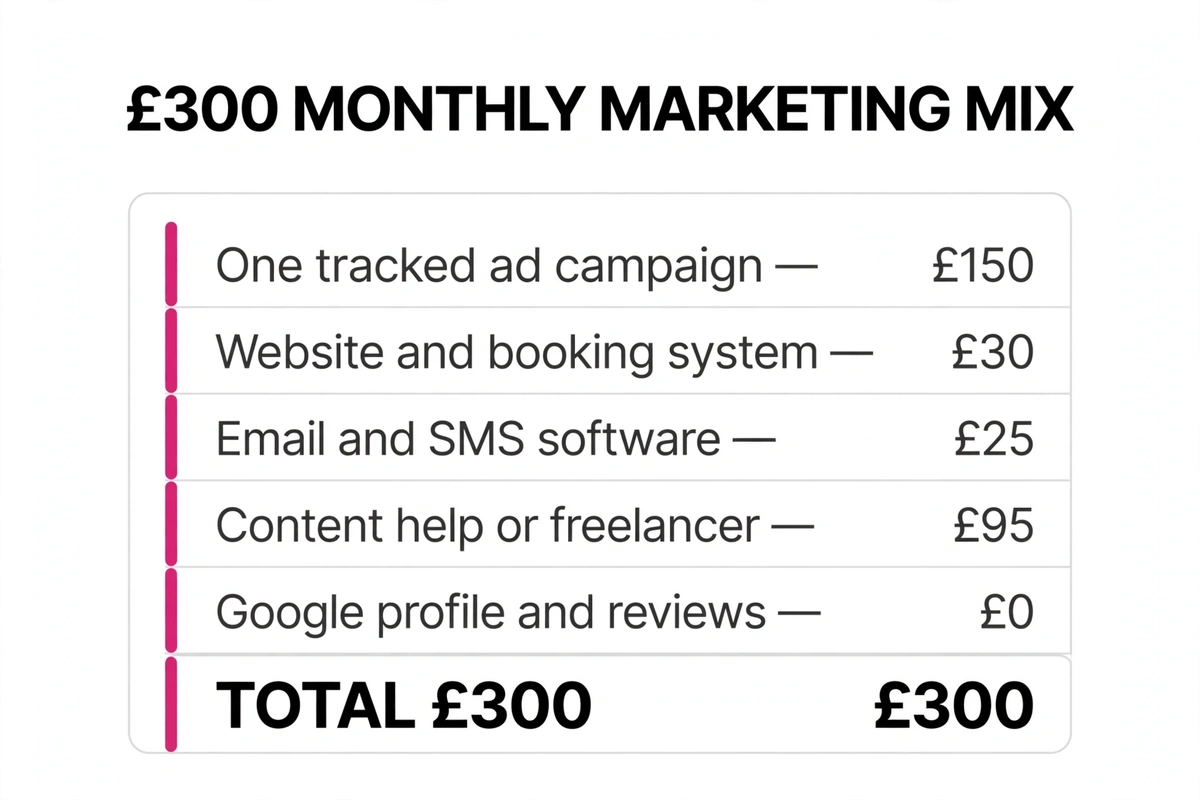
The mix: most salons can run the whole system on around £300 a month.
The five jobs, in order. Fix them left to right, a salon that can’t be found can’t be booked.
Want a second pair of eyes on your hair salon’s marketing? Book a free 30-minute strategy call, we will tell you which of the five jobs to fix first.
Contents
What is hair salon marketing?
Job 1, Get found: hair salon hyperlocal marketing
Job 2, Get chosen: proof, prices and reviews
Job 3, Get booked: consultations and instant booking
Job 4, Get rebooked: the colour cycle
Job 5, Get recommended: referrals, stylist brands, loyalty
Your marketing mix for a hair salon: a worked example
Five mistakes that cost hair salons clients
Frequently asked questions
The bottom line
What is hair salon marketing?
Hair salon marketing is everything you do so the right people find your salon, choose it over the one down the road, book an appointment, come back on time, and tell their friends. That is it. Every tactic in this guide serves one of those five jobs.
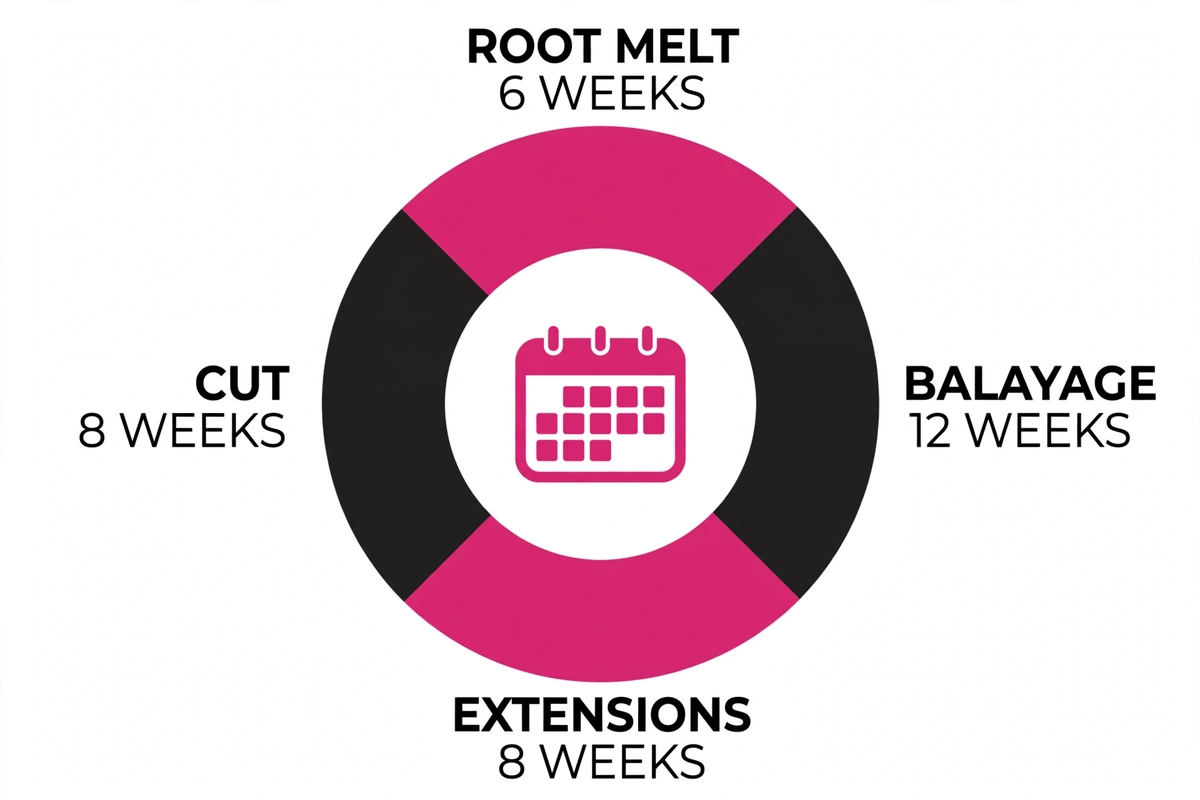
Marketing a hair salon is different from marketing a beauty salon or spa, and the difference matters. Hair has a built-in repeat cycle: cuts every 6 to 8 weeks, root melts every 6, balayage every 12. That means retention, job 4, is where most of the money lives. Hair is also consultation-driven: nobody commits to £120 of colour without knowing the price and trusting the stylist first. And hair clients shop with their eyes, which makes visual proof non-negotiable.
If you have ever searched “marketing hair salon” hoping for a plan rather than a brainstorm, this is the plan. Five jobs, in order, each with what to do, what it costs, and where to start this week.
Job 1, Get found in your patch: hair salon hyperlocal marketing
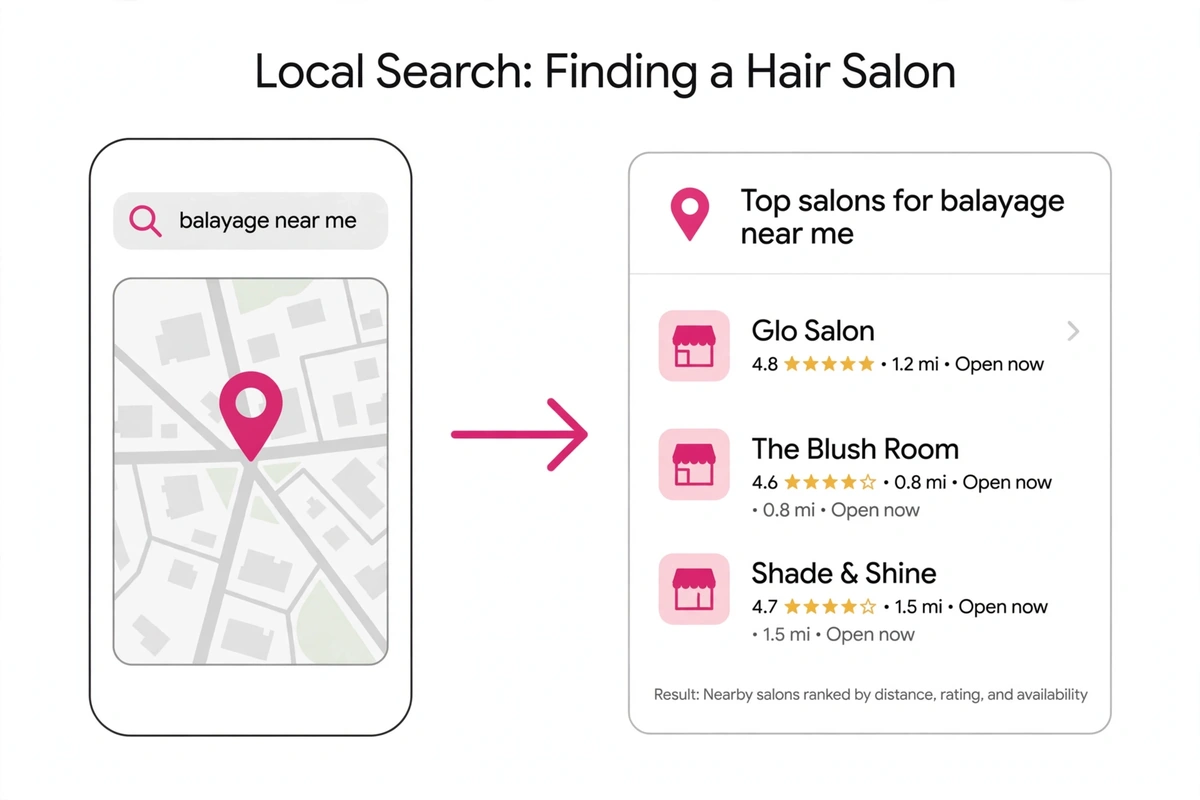
When someone’s roots are showing, they do not browse, they search. “Balayage near me.” “Curly hair salon Manchester.” “Hair salon open late Leeds.” These searches carry booking intent, and almost all of them end at the Google map pack: those three salon listings with star ratings under the map. Hair salon hyperlocal marketing is the work of being one of those three.
Do this before anything else (about an hour):
Claim and complete your Google Business Profile. Primary category: “Hair salon”, not the generic “Salon”. Add every service with a price (“Balayage from £85”), 10+ real photos of your work and your salon, your opening hours, and a booking link.
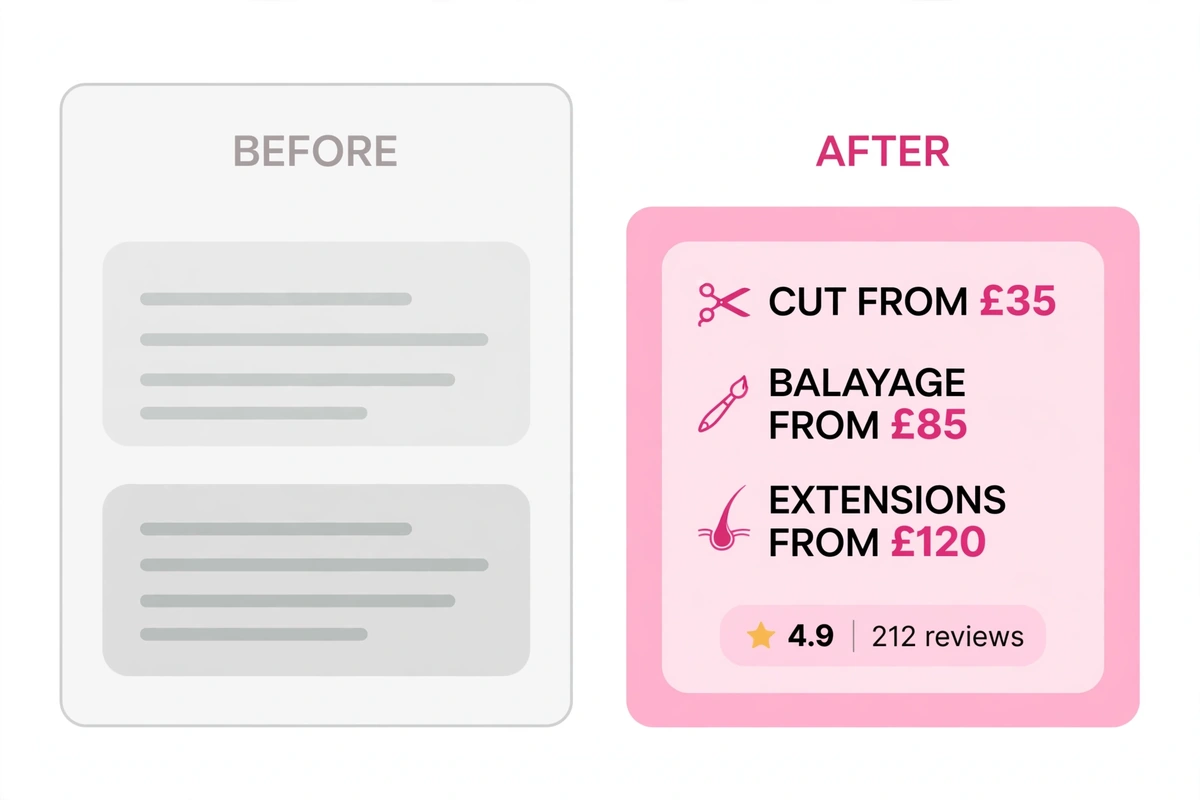
Write your description like a menu, not a mission statement. Weak: “A friendly, professional salon offering a wide range of hair services in a relaxing environment.” Better: “Balayage, lived-in colour, precision cuts and extensions in [town]. Cut from £35, balayage from £85. 4.9★ from 212 reviews. Book online in 60 seconds.”
The profile on the right answers the three questions every searcher has: what do you do, what does it cost, can I trust you?
Target the searches hair clients actually type. How a “balayage near me” search turns into a map-pack listing, the three salons under the map win the booking. Your Google profile should name your money services and your area: balayage, colour correction, curly hair specialist, extensions. Most hair salon searches are “[service] + [place]”, meet them there.
Hair salon marketing in London vs marketing a small hair salon
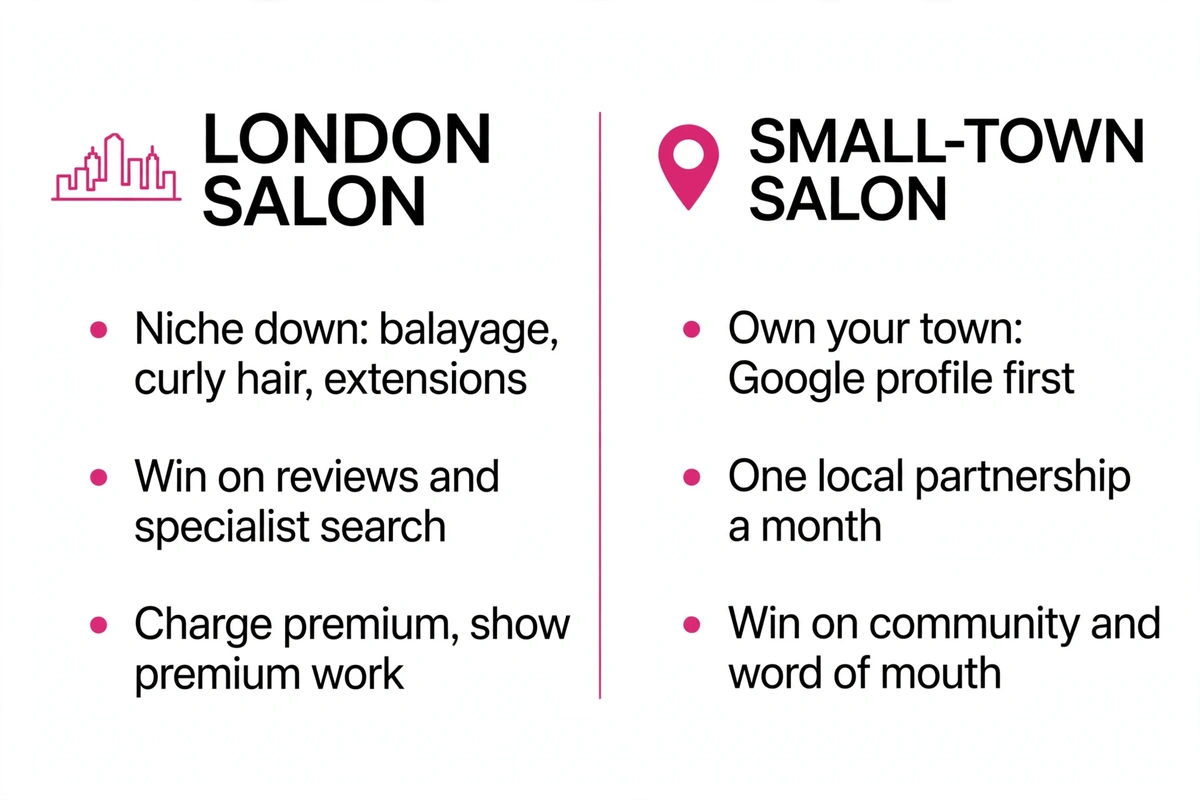
The strategy splits by patch. Hair salon marketing in London is a specialist’s game: nobody searches “hair salon London” and books the first result, they search “balayage Shoreditch”, “curly hair specialist Brixton”, “silk press London”. Niche down, collect reviews that name your specialism, and charge premium prices backed by premium proof.
Marketing a small hair salon is an ownership game. In a town of 20,000 people, a complete Google profile, 100+ reviews and one local partnership (bridal boutique, gym, café) can make you the obvious choice for every “[service] near me” search. You do not need to outspend anyone, you need to out-complete them.
London is a specialist’s game, a small town is an ownership game, the tactics split by patch.
Job 2, Get chosen: proof, prices and reviews
Being found gets you considered. Being chosen gets you booked. Three things decide it, and hair clients check all three before they ever message you.
1. A portfolio that sells. Your Instagram and your Google photos are your shop window. Post real work with the price and the booking route in the caption, “Lived-in balayage, 3 hours, from £120. Two colour slots left this week, link in bio.” Transformation content is hair salons’ unfair advantage; use it everywhere, including your Google profile photos. If producing this content weekly feels like a second job, our social media management for hair salons takes it off your plate.
2. Transparent prices. Colour pricing is the number one reason hair clients bounce. “Price on consultation” reads as “expensive and awkward”. “Balayage from £85, full head £120” reads as confidence. Show from-prices for every colour service on Google, Instagram highlights and your website.
3. A review engine. BrightLocal’s 2026 Local Consumer Review Survey found that 97% of consumers read reviews before choosing a local business, and the average review-reader checks six different sites before deciding (BrightLocal). Your system:
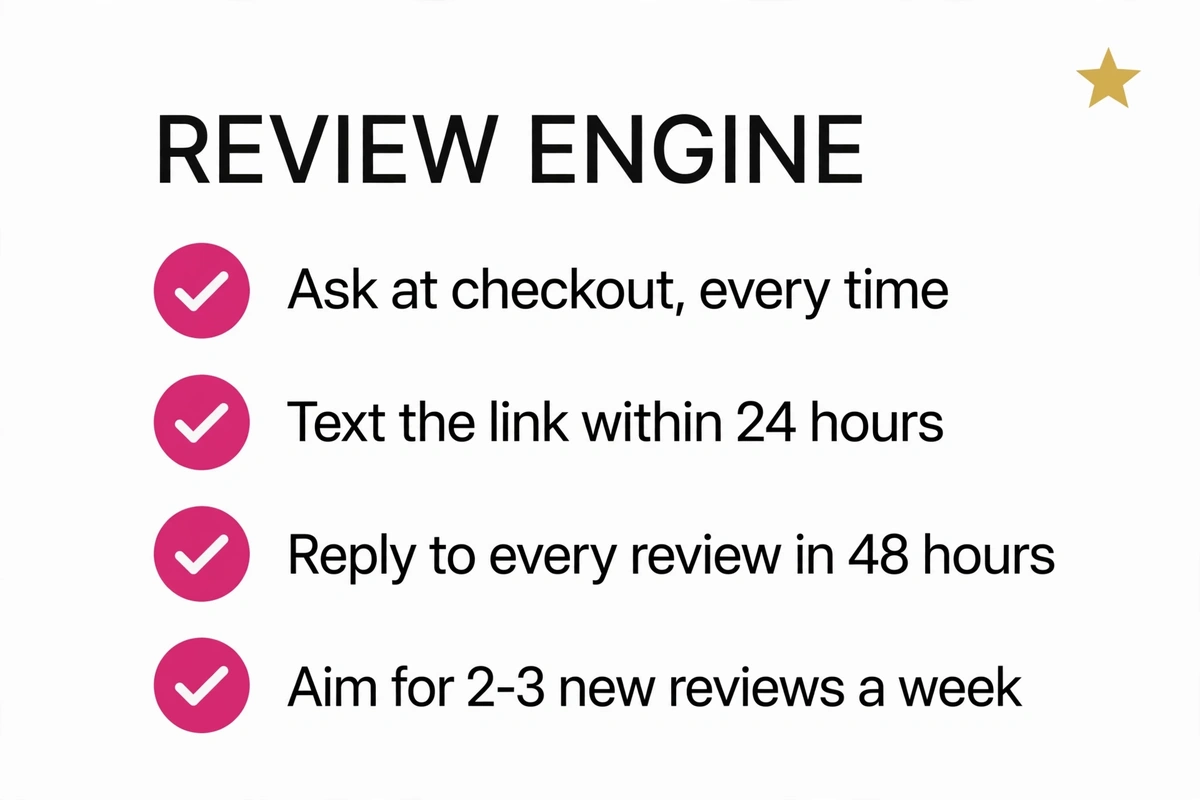
Four habits, ten minutes a week. Reviews compound, a 4.9 with 200 recent reviews beats a 5.0 with 12 old ones.
Ask at checkout, every time: “If you loved your hair today, a Google review would mean the world to us, I’ll text you the link.” Then text it within 24 hours, reply to every review within 48, and aim for 2 to 3 new reviews a week. That steady drip is what separates the 4.9-star salon from the 4.2. If reviews need proper management, see our reputation management for hair salons.
Your website’s one job is to turn “found you” into “booked you”: services, prices, location, real photos and a booking button above the fold on mobile, loading fast. If your current site does not do that, see what a website built to take bookings looks like.
Job 3, Get booked: consultations and instant booking
Hair clients hesitate at the booking button for one reason: fear of the unknown price and the unknown result. Consultations remove both, which makes the consultation a marketing tool, not just an appointment type.
Offer free 15-minute colour consultations. Promote them everywhere: Google profile, Instagram bio, website header. A consultation converts a nervous browser into a booked colour appointment, and it lets you quote honestly instead of guessing. Take a deposit for long colour appointments at booking, it protects your most expensive column hours from no-shows.
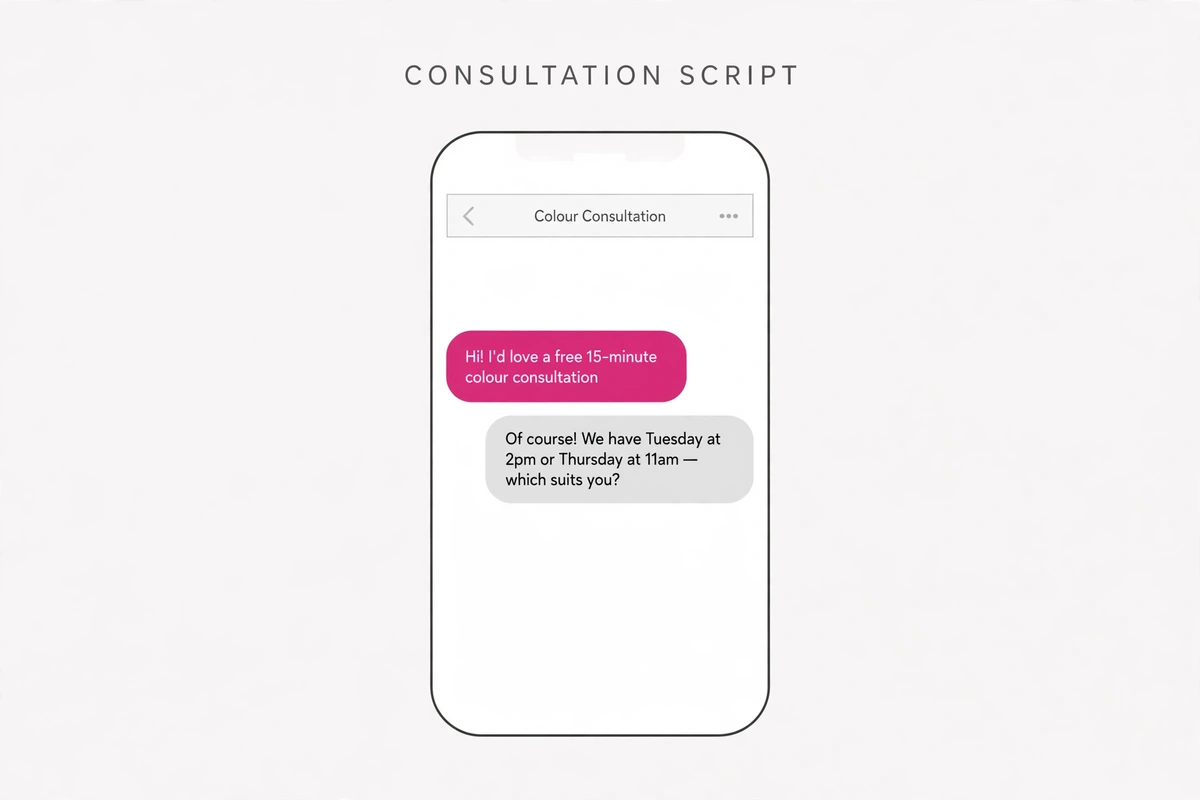
Copy and paste this consultation script for DMs and texts:
Hi [name], thanks for getting in touch! Our free 15-minute colour consultations run on [days]. Could you send 2 to 3 photos of your hair now, plus one inspiration photo? We’ll confirm your slot and give you an honest price range before you book., [Your name], [Salon]
Always offer two specific slots. “When suits you?” gets forgotten; “Tuesday 2pm or Thursday 11am?” gets answered.
Make booking instant. Most hair appointments are booked outside salon hours, on the sofa, at 10pm. If your booking route is “DM us” or “call during opening hours”, you are losing bookings to the salon with a 60-second online form. Fresha and Treatwell both bring discovery traffic, but take commission on new clients, weigh that against the cost of driving clients to your own booking link.
Run first-visit offers the ASA-safe way. A genuine, dated first-visit offer is fine: “New clients: 20% off your first colour service this month.” What is not fine: “was/now” prices you cannot prove, or “up to 50% off” unless a meaningful number of services are genuinely discounted that much. The ASA requires documentary evidence for price claims, one complaint can get your ad banned.
Job 4, Get rebooked: the colour cycle
This is hair salons’ superpower and the job most salons neglect. Hair grows. Roots show. Every colour client has a natural rebooking date, and every week they drift past it is money walking to a competitor.
Every service has a cycle. Rebook at the chair and the diary fills itself months ahead.
Rebook at the chair. The cheapest booking you will ever take is the one you take before the client leaves. End every appointment with:
“Your colour will need refreshing in about 8 weeks, shall I book you in for [date]? We get busy around [half-term / Christmas], so it’s worth locking in.”
Twenty seconds, every client, every stylist. Train the whole team and put the script by every till.
Example (illustrative, not a real salon): a colour client has a full-head balayage at £85 every 12 weeks. That is about £370 a year, before cuts, toners and retail. If a salon has 150 colour clients and 30% drift off-cycle each year, that is 45 clients × £370 ≈ £16,650 of annual revenue quietly slipping away. Rebooking at the chair costs nothing and protects exactly this.
Win back the drifters. Pull your list of clients who have not booked in 3+ months and send this, only to clients who agreed to marketing messages:
Hi [name], it’s [stylist] from [salon]. We haven’t seen you in a while, your colour will be due a refresh! Reply BOOK and we’ll find you a slot this week. Reply STOP to opt out.
Legal note: under PECR, the UK’s electronic marketing rules, you need consent (or the “soft opt-in” for existing customers) before sending marketing texts or emails, and every message must offer an opt-out. The ICO’s direct marketing guidance explains it plainly. This is general information, not legal advice.
Run a cancellation waitlist. Fresha’s 2026 research, reported by Hairdressers Journal, found salon owners aged 35 to 44 lose an average of 8% of monthly revenue to cancellations and no-shows, on a £12,000 monthly turnover, that is £960 walking out the door (HJI). A waitlist does not stop cancellations; it stops them costing you. Keep a simple list of clients who want an earlier slot. When someone cancels, message the list. The gap fills within the hour.
💇 Fill next month’s diary now
The colour cycle is your cheapest marketing channel, but only if rebooking is built into how your salon runs. Book a free 30-minute call and we will map your rebooking system together.
Free, 30 minutes, no obligation. We reply within one working day.
Job 5, Get recommended: referrals, stylist brands, loyalty
New clients are expensive; recommended clients arrive pre-sold. Three systems worth building:
1. A referral reward that runs itself. Keep it simple and write the terms on a card at reception: “Refer a friend and you both get £10 off your next visit. No limit.” Then check the maths on your own prices before you set the amount, the reward must never cost more than the client is worth to you.
2. Stylist personal brands. Hair clients follow stylists, not salons. Let each stylist run their own Instagram, posting their own work with their chair’s booking link, and feature them on the salon account. A stylist with 2,000 local followers is a marketing channel you do not pay for.
3. Simple loyalty. You do not need an app. A card at reception works: “Every 5th blow-dry, the 6th is half price.” Or an extensions maintenance club: a standing 8-week refit appointment clients never have to think about.
Plan around the UK hair calendar. Demand follows the seasons, and hair has its own rhythm: January refresh packages, Mother’s Day gift vouchers, summer wedding and holiday prep (updos, extensions), back-to-school cuts in late August, Christmas party season booked ahead in October, your one genuine, planned, ASA-safe sale at Black Friday. One seasonal campaign per quarter, done well, beats twelve random discounts.
Real work, shot well, with the price in the caption. That is the entire content strategy.
Your marketing mix for a hair salon: a worked example
What does the whole system cost? Less than most owners fear. Here is a worked example of a marketing mix for hair salon owners, around £300 a month:
Channel
What it covers
Illustrative cost/month
One tracked ad campaign
A single Meta or Google ad with a booking link, a budget and a deadline, measured, or switched off
£150
Website and booking system
Hosting plus your online booking software
£30
Email and SMS software
Your client list, monthly messages, automated review requests
£25
Content help
A few hours of a freelancer, or hours of your own time
£95
Google profile and reviews
The highest-ROI channel in the mix
£0
Total
£300
Example only, run your own numbers. The point: the foundations are free; spend goes to what you can measure.
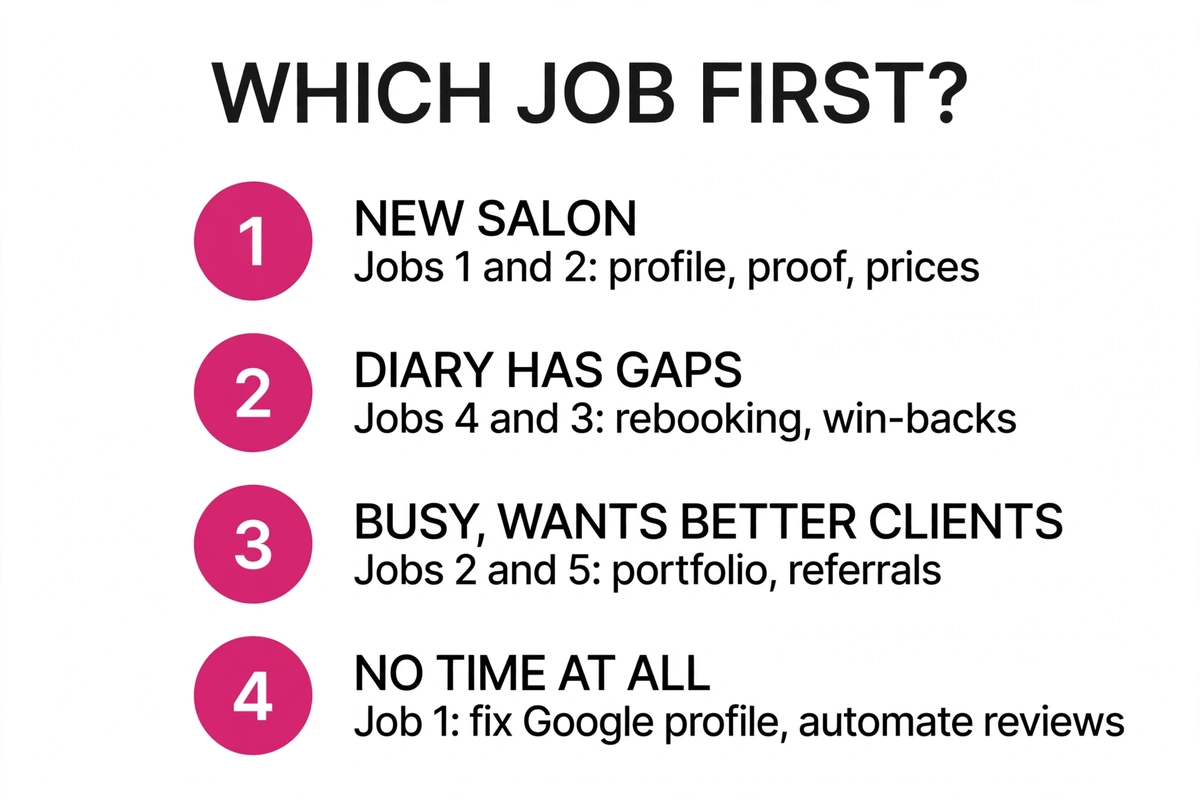
Which job should you fix first? Do not start at job 1 out of habit. Start where your salon is:
Which job to fix first depends on your situation, start where the leak is biggest.
Your situation
Start with
New salon, few clients
Jobs 1 and 2: profile, proof, prices
Diary has gaps
Jobs 4 and 3: rebooking, win-backs, consultations
Busy, wants better clients
Jobs 2 and 5: portfolio, niche, referrals
No time for marketing at all
Job 1 only: fix the Google profile, automate review requests
Every ad, post and profile promises an experience. Make sure the salon delivers it.
Five mistakes that cost hair salons clients
Hiding colour prices. “Price on consultation” does not create intrigue; it creates bounce. From-prices on Google, Instagram and your website are the single cheapest conversion fix in hair.
Discounting so often nobody pays full price. If there is always a sale on, clients learn to wait. Discount with a reason and a deadline, or bundle instead of slashing.
“Up to 50% off” claims you cannot prove. The ASA requires documentary evidence for price claims. One complaint can mean a banned ad and your name published in a ruling.
Boosting posts with no tracking. If you cannot say what one booking cost you, you cannot say the ad worked. One campaign, one booking link, one deadline, or do not run it.
Chasing new clients while old ones drift. A colour client is worth hundreds a year on the cycle. Win the rebooking habit before you spend a pound on acquisition.
Frequently asked questions
How do I get more clients for my hair salon?
Start where clients already look: a complete Google Business Profile with prices, photos and recent reviews. Add one social channel done well, a review system, free colour consultations and rebooking at the chair. These five beat any single advertising campaign for a growing hair salon. (45 words)
What is the best marketing for a small hair salon?
Own your patch: a finished Google profile, 100+ reviews, transparent prices and one local partnership. In a small town that combination beats ad spend every time. Add rebooking at the chair and a win-back text system, and your diary fills from clients you already have. (45 words)
How much should a hair salon spend on marketing?
Start with the free foundations, Google profile, reviews, rebooking, referrals cost nothing but time. When you spend, the worked example above shows a full system running at around £300 a month. Spend only on what you can measure, and never spend what you cannot afford to lose. (47 words)
How do I market my hair salon on Instagram without spending money?
Post real transformations with the price and booking route in the caption, film 30-second Reels answering questions clients already ask, and let each stylist build their own following. Clear booking instructions matter far more than follower counts, followers do not pay, bookings do. (43 words)
How long does hair salon marketing take to work?
Rebooking at the chair and review requests move the needle within weeks. Google profile improvements typically show in 4 to 8 weeks. Content and reputation compound over 3 to 6 months. If an agency promises page-one rankings or full diaries in days, be sceptical. (44 words)
The bottom line
Hair salon marketing is not complicated: be findable in your patch, be the obvious choice with proof and prices, make booking effortless, rebook on the colour cycle, and turn clients into referrers. Do those five jobs in order and the quiet gaps start filling, mostly with clients you have already won once.
If you would like help making all five jobs work, Google presence, content, reviews and bookings handled for you, book a free 30-minute strategy call.
Free, 30 minutes, no obligation. We reply within one working day.
Written by the Salon Socials team. We are a UK marketing studio with 6 years of hands-on social media, SEO and branding for beauty businesses, practical, plain-English, no inflated promises.