If you are looking for a marketing strategy for hair salon growth, you probably have two problems: quiet gaps in your diary, and no clear plan for filling them that survives contact with a busy salon week. This guide fixes both. Below is a complete hair salon marketing plan built for UK salons: how to position your salon, set one goal with the maths behind it, pick the right channels, and follow a copy-paste monthly marketing plan you can start this week, plus honest costs, hair-specific tactics (colour-cycle rebooking, extensions, bridal season, back-to-school), and the UK legal rules on texts, emails and discount claims. No fluff, no fake statistics, no “just post consistently”.
Key takeaways
- Step 1: Decide who your salon is for (your position). Everything else follows from this.
- Step 2: Set one goal and do the maths (e.g. +40 appointments a month at £55 = £2,200 extra revenue).
- Step 3: Pick three channels and ignore the rest. For most hair salons: Google, Instagram, and your own client list.
- Step 4: Run the monthly plan below, foundations week, colour-cycle week, consultation week, win-back week.
- Step 5: Measure one number a month: appointments booked. If it is not rising, change one thing, not everything.
Want a second pair of eyes on your marketing plan before you start? Book a free 30-minute strategy call, we will review your positioning and your next 90 days with you.
What a hair salon marketing strategy actually is (and what it isn’t)
A hair salon marketing strategy is simply a one-page answer to five questions: who your salon is for, how new clients find you, why they choose you over the salon down the road, how you get them to come back, and what you do each month to make all of that happen. If your “strategy” is posting whenever you remember and discounting whenever it goes quiet, you do not have one, and you are not alone. Most salon owners are in the same boat, because marketing advice for salons is usually a list of disconnected ideas rather than a plan.
What a strategy is not: a £500 boosted post sent to a Google profile with no prices, a permanent 20%-off banner, or a content calendar copied from an Etsy download that has nothing to do with how hair salons actually make money. Hair is a repeat-purchase business with natural cycles, colour grows out, roots need touching up, weddings happen in summer, kids need cutting before term starts. A good hair salon marketing strategy is built around those cycles, not around whatever is trending on TikTok this week.
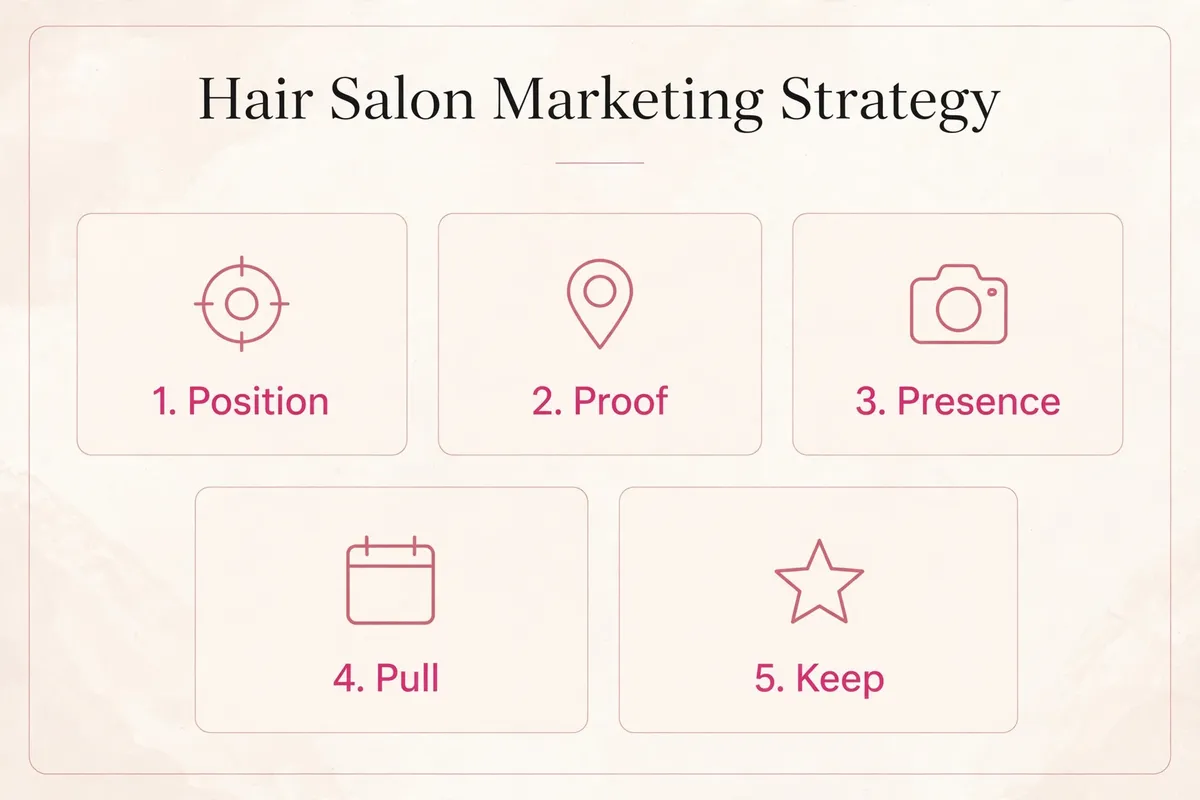
Here is the framework this guide uses, five pillars, in order:
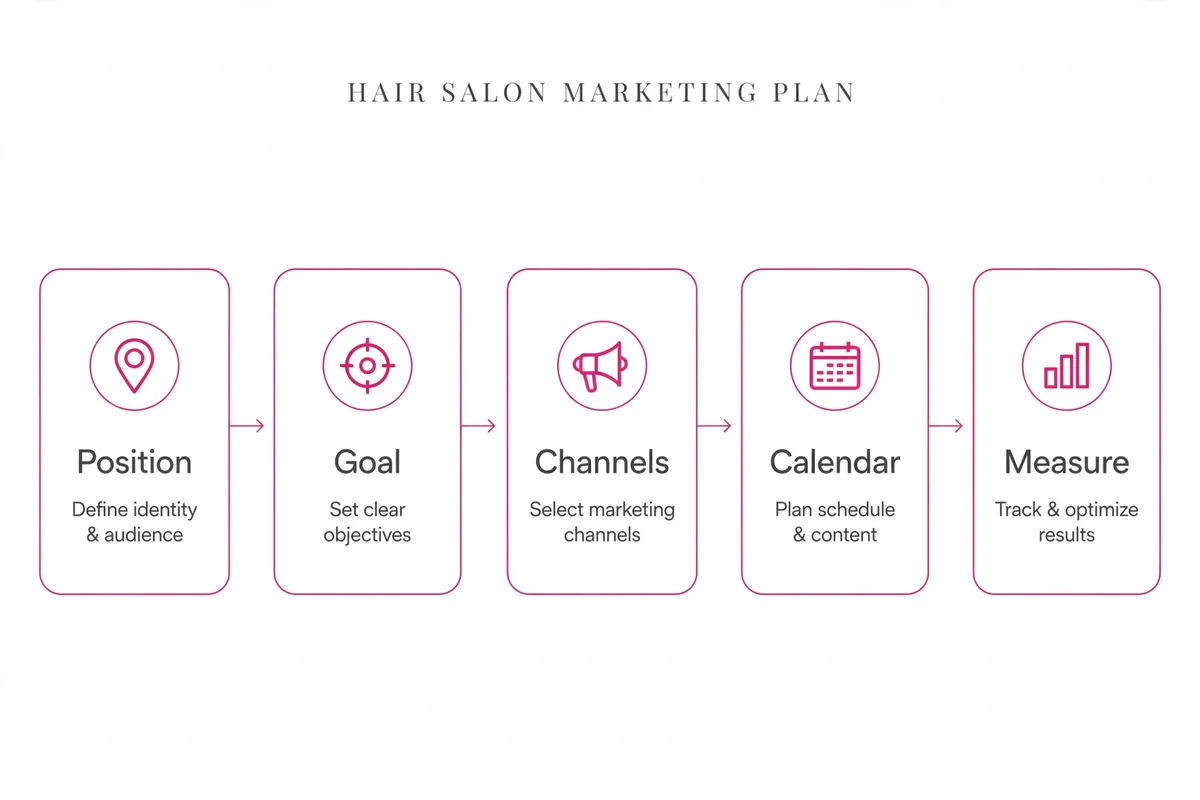
- Position, who your salon is for and why they pick you.
- Proof, reviews, real photos with prices, and a finished Google profile that make strangers trust you.
- Presence, one or two channels done well (Google and Instagram for most hair salons).
- Pull, the monthly activity that pulls new bookings in: content, consultations, partnerships.
- Keep, rebooking, win-backs and seasonal nudges that keep existing clients returning.
Get these five in place and you have something most competitors do not: a hair salon marketing strategy that runs on a monthly rhythm instead of panic.
Step 1: Decide who your salon is for
Every marketing decision gets easier once you can finish this sentence: “We are a [type of] salon in [town] for [client] who want [outcome].”
Hair-specific examples that actually work:
- “We are a colour-specialist salon in Leeds for women who want lived-in balayage that still looks good at week ten.”
- “We are a family salon in a commuter town for busy parents who need great kids’ cuts and a quick blow-dry without the faff.”
- “We are an extensions and bridal studio for brides and event clients who want it done properly the first time.”
- “We are a curly-hair salon for clients who are tired of stylists who do not understand their texture.”
Notice what this does: it tells you what to post (balayage transformations, not generic “hair goals”), where to be found (“balayage Leeds” on Google, not just “hair salon”), what to charge (specialists charge more), and who to partner with (bridal boutiques, not gyms). A salon that is “for everyone” markets to no one, and pays for it in discounting.
One practical test: look at your last 20 bookings. If 14 of them were the same type of service and the same type of client, that is your position whether you chose it or not. Build the plan around them.
And it shows up in your content. Positioning is also what turns a forgettable Instagram caption into one that books:
Weak caption: “Obsessed with this transformation”
Better caption: “Box dye to lived-in balayage, 3 hours, from £120. We do this every week in our Leeds studio. Two colour slots left this week: tap the link in bio or DM BALAYAGE and we will find you a time.”
The better version names the service, the price, the place and the next step. That is positioning doing the selling for you.
Step 2: Set one goal, then do the maths, a marketing strategy for hair salon example
A plan without a number is a wish. Pick one goal for the next 90 days, appointments booked, and work out what it is worth. Here is a worked marketing strategy for hair salon example with realistic numbers (illustrative, not a client result):
Example: a 4-chair colour salon in a UK market town
- Average appointment value: £55
- Current reality: roughly 30% of available slots sit empty each month
- Goal: fill 40 extra appointments a month within 90 days
- Value: 40 × £55 = £2,200 of extra monthly revenue
Now the rebooking maths, because this is where hair salons quietly leak money:
- 120 colour clients on the books
- Current rebooking rate: 60% (72 clients rebook)
- Target rebooking rate: 80% (96 clients rebook)
- Difference: 24 extra appointments a month × £65 average colour ticket = £1,560 a month, from clients you already have
Notice what happened: more than half the goal is achievable without a single new client, just better rebooking. That is why Step 2 comes before channels. If your maths shows the money is in retention, your plan should be 70% retention tactics, not 70% Instagram.
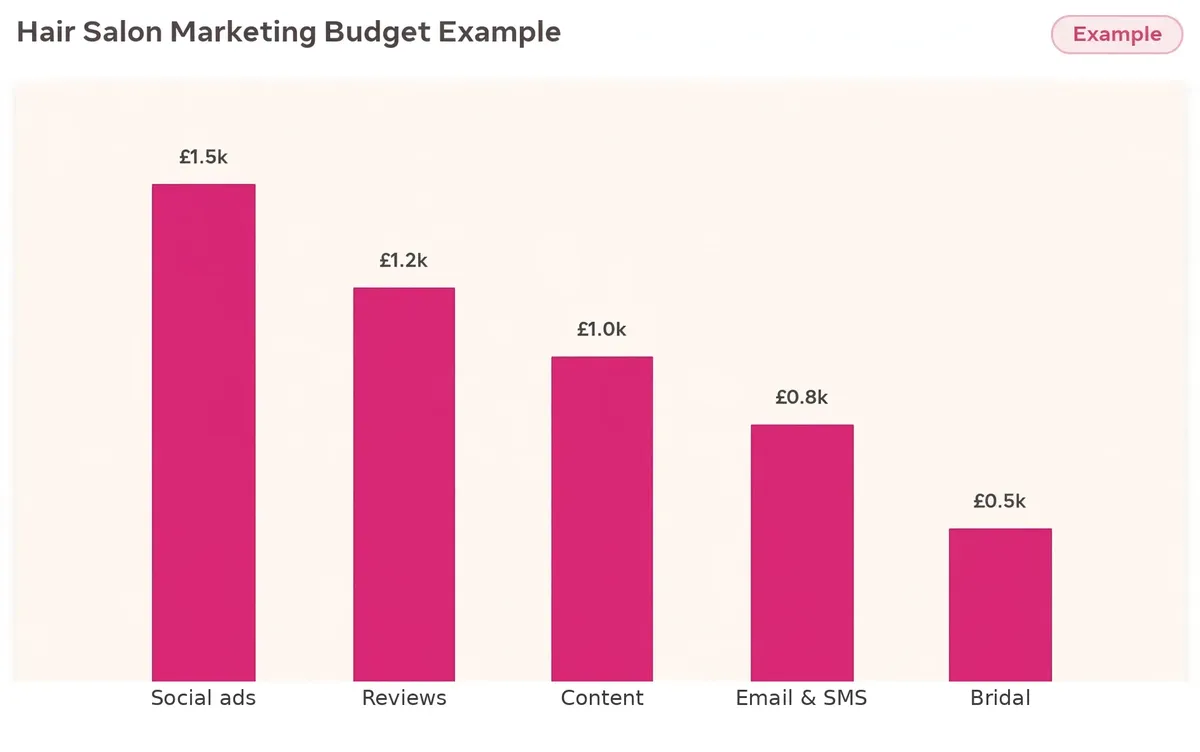
Finally, set a budget you can afford to lose while you learn. A common rule of thumb for small service businesses is around 5% of revenue for marketing once established, more when growing, but the honest version is this: spend only what you can measure. A £150-a-month ad budget with a booking link you track beats a £1,500 spend you cannot connect to a single appointment.
Step 3: Pick your channels, the best hair salon marketing strategies
There are only so many hours in your week, so the best marketing strategies for hair salon owners are the ones you will actually do. Pick three. Do them properly. Ignore the rest until these three are working.
Use this decision framework to choose:
| Your situation | Your three channels |
|---|---|
| New salon, empty diary | Google Business Profile + Instagram + referral rewards |
| Diary has gaps mid-week | Reels answering client questions + Stories selling same-day gaps + win-back texts |
| Busy but clients are price-sensitive | Review engine + before-and-afters with prices + rebooking at the chair |
| Want high-ticket work (colour, extensions, bridal) | Consultation content + local SEO for your specialty + bridal/wedding partnerships |
A quick word on each channel that matters for hair:
- Google (your most important channel). When someone searches “balayage near me”, your Google Business Profile is the first thing they see. Complete it: every service with a price, 10+ real photos, and replies to every review. Our walkthrough of local SEO for salons covers the full setup, and if you want it handled for you, see our local SEO for hair salons service.
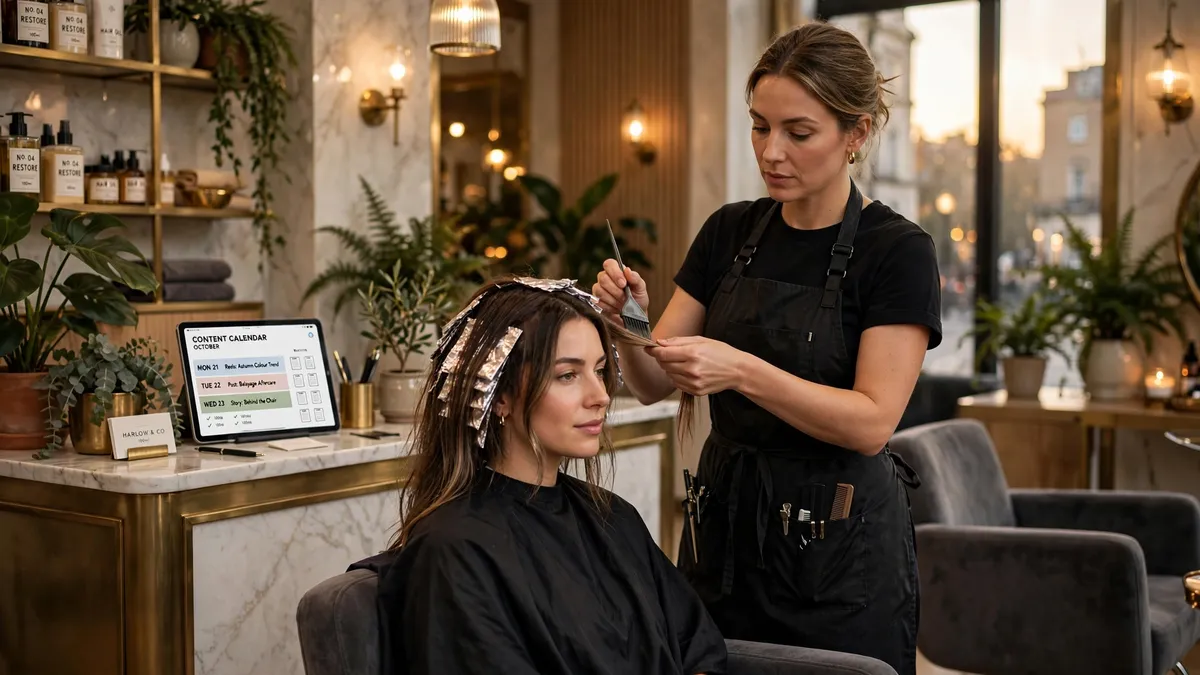
- Instagram. Before-and-afters with prices, 30-second Reels answering real client questions (“how long does a balayage take?”), Stories for same-day gaps. If creating this weekly feels like a second job, our social media management for salons exists for exactly that.
- Your website. One job: turn searches into bookings. Services, prices, location and a booking button above the fold on mobile. If your site does not do that, read what a website built to take bookings looks like.
- Your own client list (email and SMS). The cheapest channel you own. One useful message a month, seasonal offers, last-minute gaps, birthday texts. Under PECR, the UK’s electronic marketing rules, you need consent (or the “soft opt-in” for existing customers) before sending marketing texts or emails, and every message must offer an opt-out. The ICO’s direct marketing guidance explains it plainly. (This is general information, not legal advice.) Never text a bought list.
- Paid ads, only after the foundations. Ads amplify what exists. Running Meta ads to a half-finished Google profile and a website with no prices is paying to disappoint people faster.
Your copy-paste hair salon marketing plan: the monthly template
This is the heart of the plan. Copy the table below into a document, fill in your salon’s details, and repeat it every month. Each week has one theme, three social posts, one local-search task and one retention task. Total time: about 3 to 4 hours a week once you are in the rhythm.
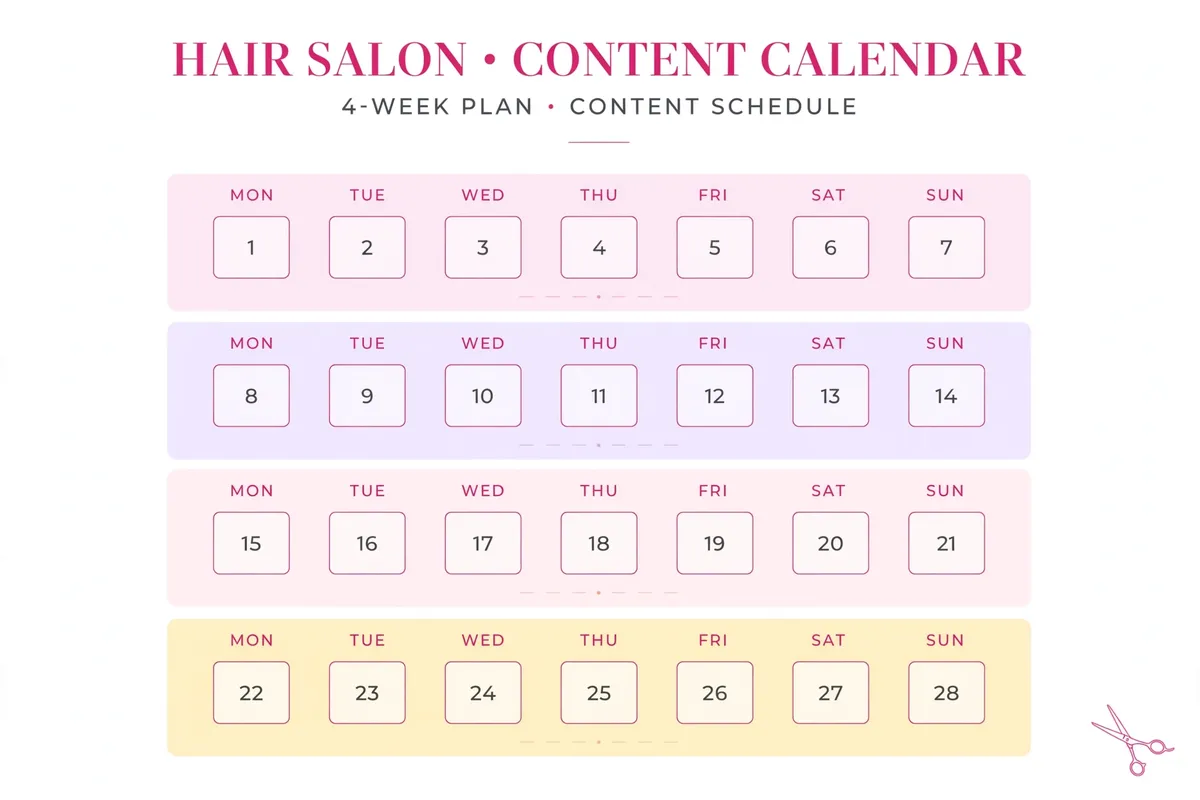
| Week | Theme | Social (3 posts) | Local / search (1 task) | Retention (1 task) | Cost |
|---|---|---|---|---|---|
| 1 | Get found | Post your price list as a carousel; Reel: “what to expect at your first visit”; Story: this week’s availability | Audit your Google Business Profile, photos, prices, opening hours (claim it via Google’s official help page if you have not) | Text your 5 happiest recent clients asking for a Google review | Free |
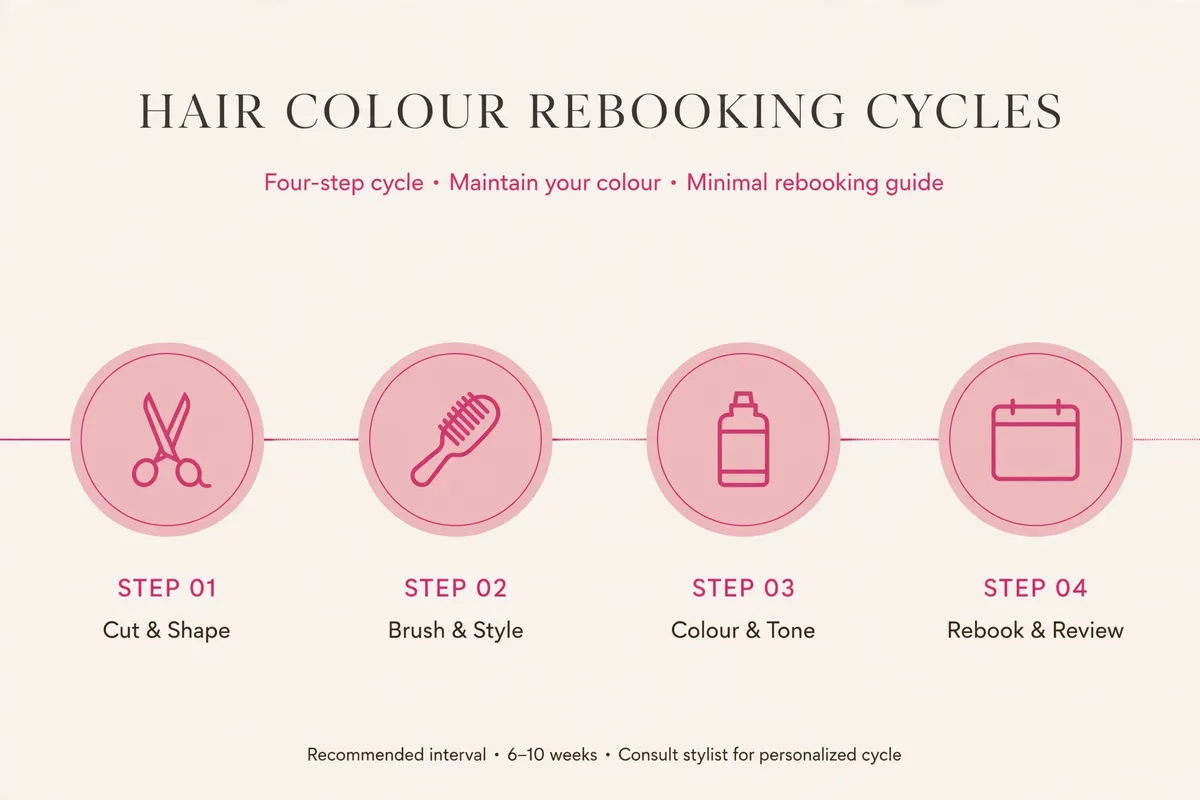
| 2 | Colour-cycle week | Before-and-after with price and time; Reel: “how often should you refresh balayage?”; Story: rebooking reminder | Add your colour services as Google Business Profile products with prices | Message clients due for a refresh (root tint 4 to 6 weeks, highlights 6 to 8, balayage 8 to 12, toner 3 to 4) | Free |
| 3 | Consultation week | Reel: “what happens at an extensions consultation”; bridal trial transformation; stylist intro | Ask one local business (bridal boutique, photographer, dress shop) about cross-promotion | Follow up last month’s consultations who never booked | Free |
| 4 | Win-back week | Client Q&A Reel; “this month at the salon” roundup; seasonal offer (see note below) | Reply to every review from the month; add 5 new photos to your Google profile | Text 20 lapsed clients (3+ months, consent on file) with a reason to return | A few pence per text |
How to use the hair-specific weeks:
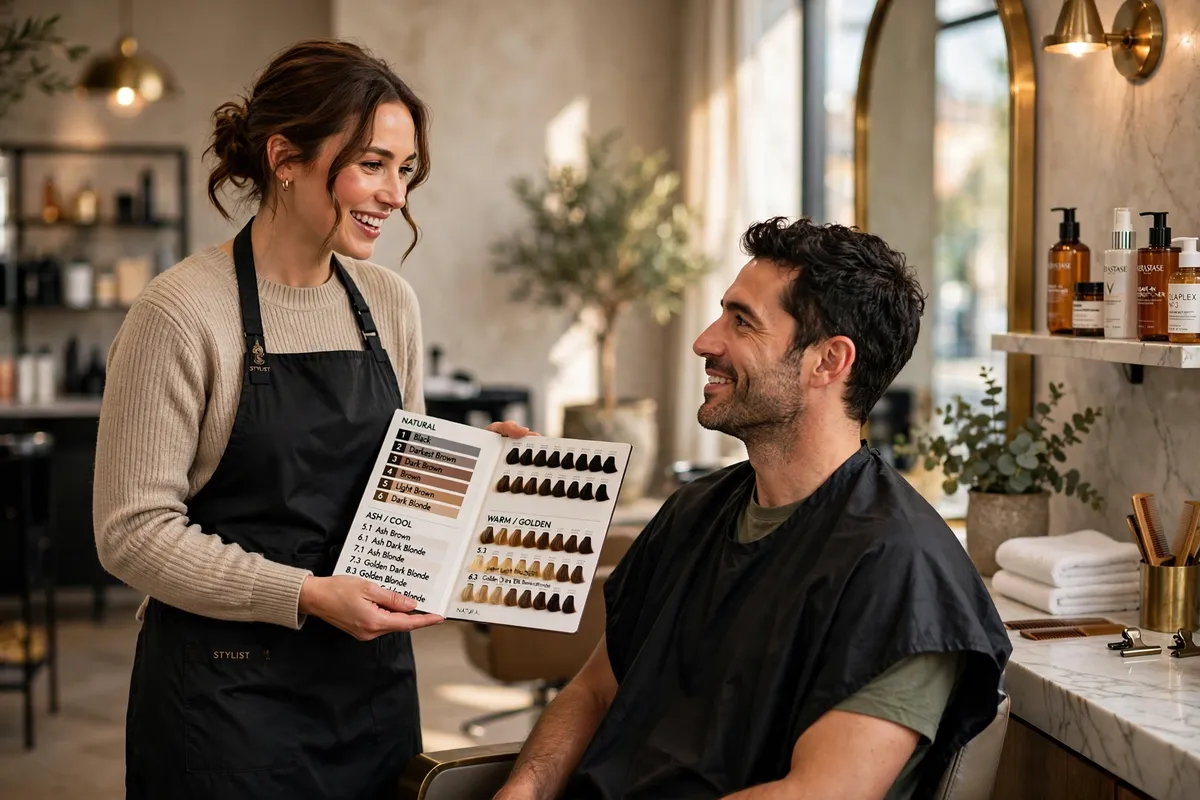
- Colour-cycle week (week 2) is the engine of the whole plan. Hair colour grows out on a schedule, which means your marketing can run on one too. Pull a list of clients whose refresh is due, most booking systems (Fresha, Treatwell) can filter by last appointment date, and message them before they drift to another salon. This single habit is worth more than most ad campaigns.
- Consultation week (week 3) is for high-ticket work. Extensions and bridal are consultation-led: nobody books a £300+ service from a price list alone. Post the consultation process itself, what you assess, how you quote, what the maintenance looks like. Bridal enquiries for summer weddings peak around January to March, so run this week harder in the new year; trials typically happen 6 to 8 weeks before the wedding. Back-to-school (late August) is the same idea for family salons: “fresh start September” cuts for kids and parents.
- Seasonal offers (week 4) get one campaign per quarter, not a rolling discount. Mother’s Day gift vouchers, Christmas party-season book-ahead in October, one genuine Black Friday offer. Under UK advertising rules, discount claims must be genuine and provable, the ASA has banned brands for “was/now” prices they could not substantiate (Pinsent Masons summary of ASA rulings). Bundle instead of slashing: “cut, colour and treatment, £95 package” beats “50% off” you cannot prove.

Get your monthly plan built for you
The template above works, but it works faster when it is built around your salon, your prices and your quiet days. Book a free 30-minute strategy call and we will map your next 90 days together.
Free, 30 minutes, no obligation. We reply within one working day.
What it will cost you: an honest breakdown
Most of this plan costs time, not money. Here is the honest version:
| Tactic | Cost | Time per month |
|---|---|---|
| Google Business Profile optimisation | Free | 1 to 2 hours |
| Instagram content (3 posts + Stories/week) | Free | 4 to 6 hours |
| Review engine (asking + replying) | Free | 1 hour |
| Rebooking at the chair | Free | 20 seconds per client |
| Win-back / birthday texts | A few pence per text | 1 hour |
| Email list (basic software) | Free, £20/month | 1 to 2 hours |
| Meta ads (optional, only after foundations) | £150+/month, only what you can measure | 2 to 3 hours |
| Getting it done for you (content + Google + reviews) | Varies, see our services | 0 |
If your budget is £0, do everything in the “Free” rows, that is a complete plan. If you have £150 to £200 a month, put it into tracked Meta ads for your highest-value service (colour, extensions, bridal) with a booking link, and only once your Google profile and website are finished. Never spend what you cannot afford to lose while you are still learning what works.
5 mistakes that waste a hair salon’s marketing budget
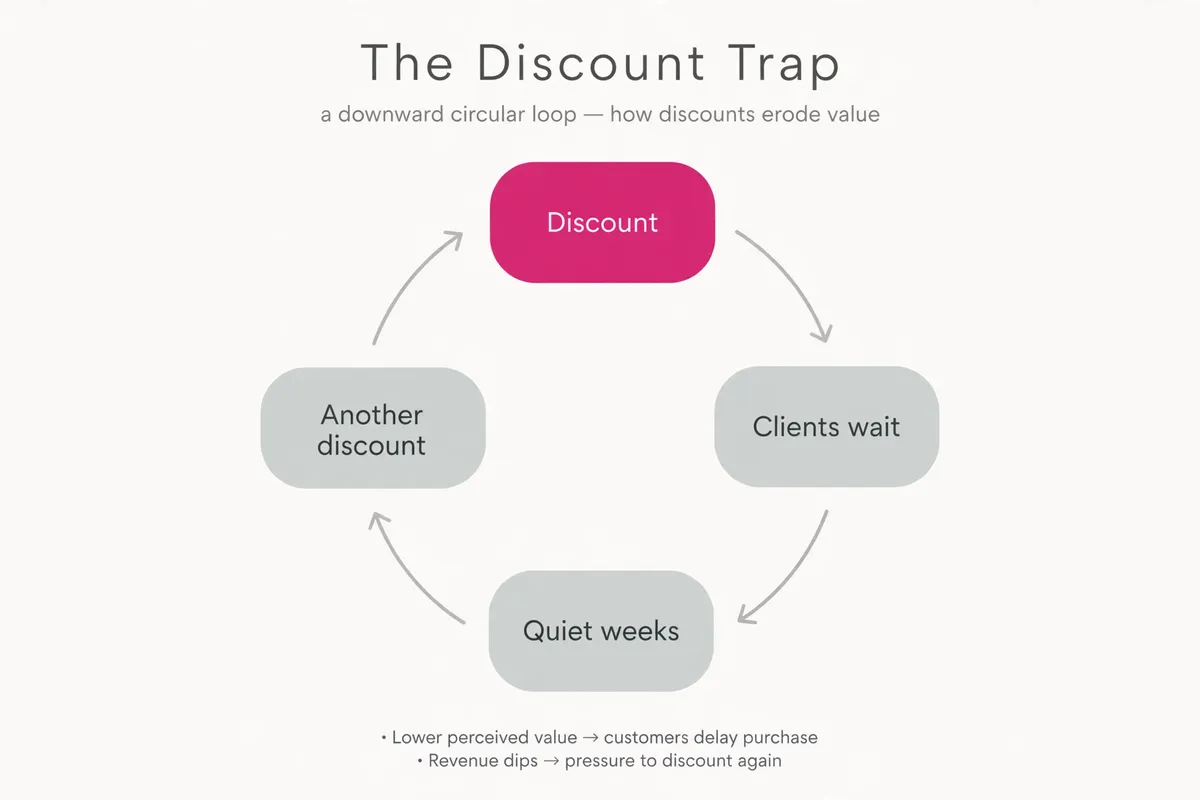
- Discounting so often that nobody pays full price. If there is always a sale on, clients learn to wait for it. This is the discount trap: quiet weeks lead to discounts, discounts train clients to wait, waiting creates more quiet weeks. Discount with a reason and a deadline, or bundle instead.
- Boosting Instagram posts with no tracking. If you cannot say what one booking cost you, you cannot say the ad worked. Set a budget, a deadline and a booking link, or do not run it.
- Ignoring Google while obsessing over Instagram. Instagram builds desire; Google captures it. A client who sees your Reel then searches your name needs to find a finished, review-rich profile, not a blank one. Search traffic is the client telling you they want to book right now.
- Having no rebooking system. Fresha’s 2026 research, reported by Hairdressers Journal, found salon owners aged 35 to 44 lose an average of 8% of monthly revenue to cancellations and no-shows, on a £12,000 monthly turnover, that is £960 walking out the door (HJI). Rebooking at the chair and a cancellation waitlist cost nothing and recover a share of it.
- Texting or emailing without consent. Bought lists almost never carry the specific consent PECR requires, and one complaint can do real damage to a small salon’s reputation. Build your own list from real clients, with a clear opt-in at booking and an opt-out in every message. (General information, not legal advice.)
Frequently asked questions
How do I create a marketing plan for a hair salon?
Decide who your salon is for, set one measurable goal (appointments booked) with the maths behind it, pick three channels you will actually maintain, and run a monthly calendar: one week each for getting found, colour-cycle rebooking, consultations, and win-backs. Review the one number monthly and change one thing at a time.
What is the best marketing strategy for a hair salon in the UK?
The combination of a complete Google Business Profile with prices and reviews, Instagram content showing real work with prices, and retention habits, rebooking at the chair, colour-cycle reminders and win-back messages. Paid ads help once these foundations exist; running ads to a half-finished profile wastes money.
How much should a hair salon spend on marketing?
Start with the free tactics in this plan, most of it costs time, not money. A common benchmark is around 5% of revenue once established, but the honest rule is: spend only what you can measure. A £150-a-month tracked ad beats a £1,500 spend you cannot connect to a single booking.
How can a hair salon get more clients without discounting?
Get found (finished Google profile with prices), get trusted (reviews and before-and-afters with prices), get rebooked (ask at the chair, message clients when their colour is due), and win back lapsed clients with a personal message. Bundles and limited seasonal offers beat permanent discounts without training clients to wait.
How long does a hair salon marketing plan take to work?
Rebooking and win-back tactics can fill gaps within weeks because they target clients who already trust you. Google and Instagram compound over 2 to 3 months. Give the full plan one 90-day cycle before judging it, and change one variable at a time so you know what worked.
The bottom line
A marketing strategy for a hair salon is not a stack of tactics, it is a position, one goal with the maths behind it, three channels done properly, and a monthly rhythm built around how hair actually grows back. Copy the template above, start with week 1 this Monday, and measure one number: appointments booked.
If you would rather have the whole thing, content, Google presence and reviews, handled by people who do this for salons every day, book a free 30-minute strategy call.
Free, 30 minutes, no obligation.
Last updated: October 2026