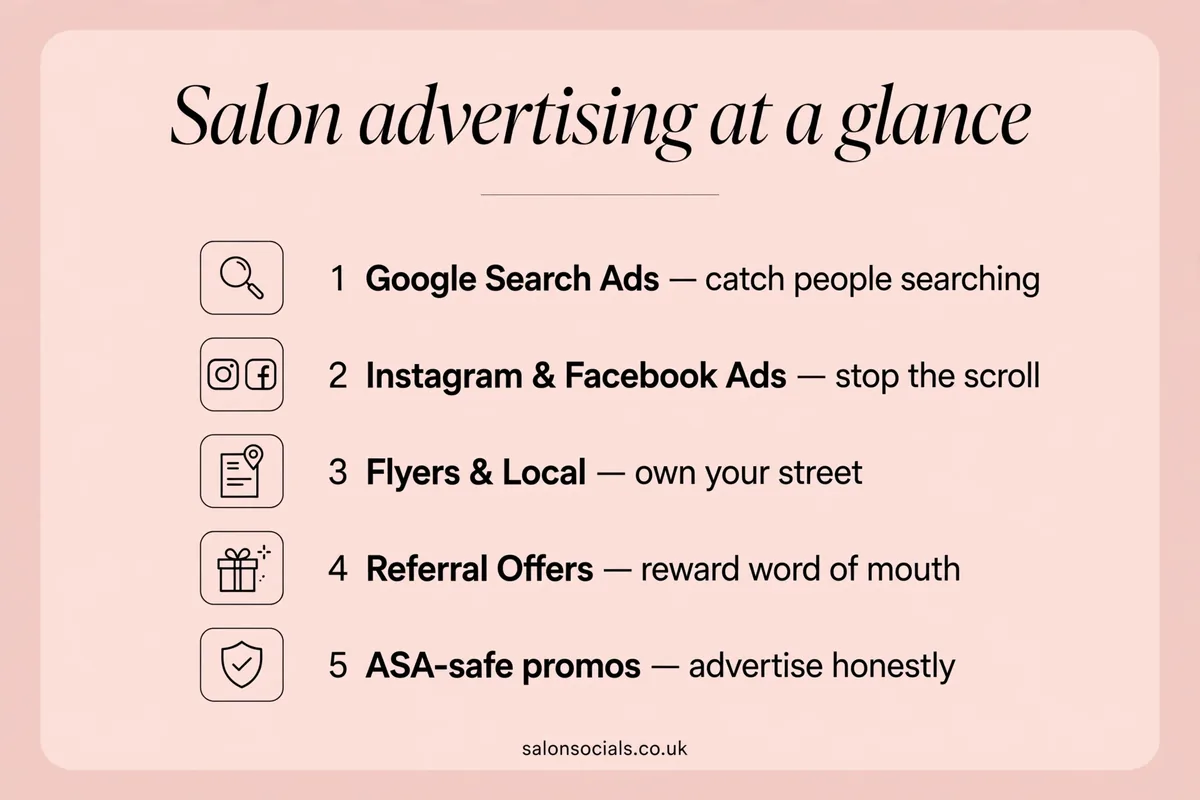
Before you spend a penny on salon advertising, you want to see what it actually looks like. What does a good Google ad for a salon say? What does an Instagram ad that books look like? What goes on a salon flyer that actually works?
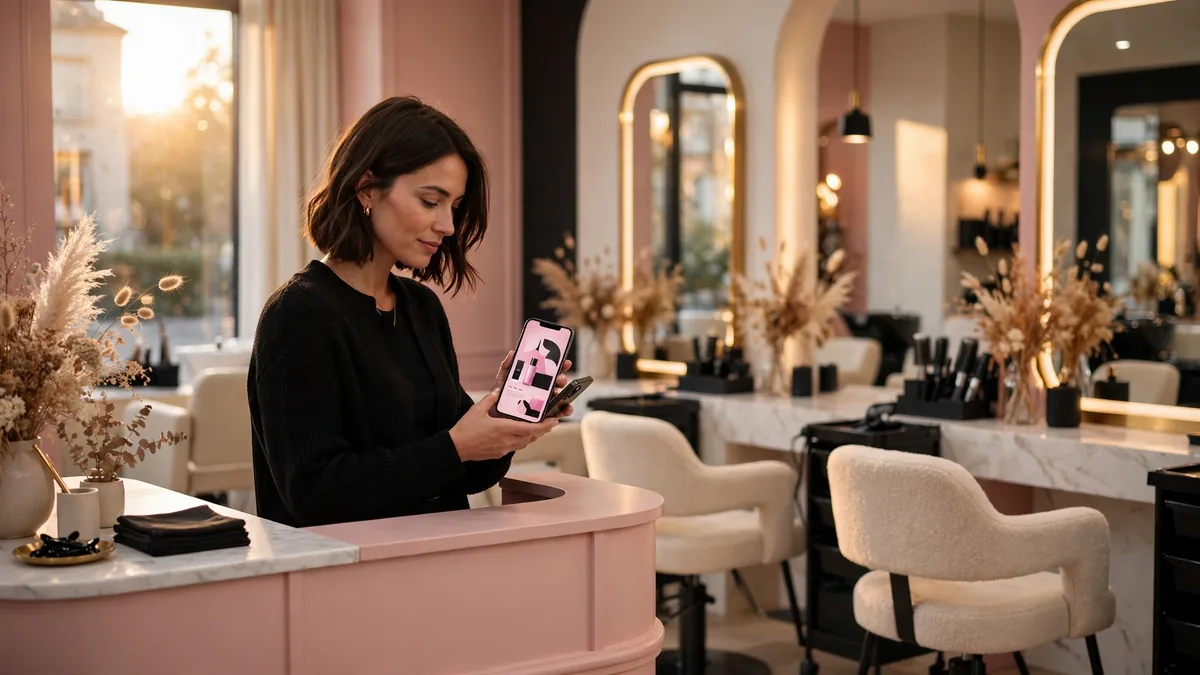
This guide is a swipe file of stylised salon advertising examples, every one a clearly-labelled mockup of a fictional brand, so you can copy the structure freely. You will also get salon advertising ideas suited to UK hair and beauty salons, honest cost guidance with no invented numbers, the UK advertising rules that keep you out of trouble, and a plan to launch your first ad in under an hour. It is written for salon owners who want bookings, not jargon.
TL;DR, salon advertising in 30 seconds
- Most salon advertising that works does one job: turn a local search or scroll into a booking.
- Google ads catch people already searching (“balayage Leeds”). Instagram and Facebook ads create the desire.
- Every ad needs the same three things: one service, one price or clear offer, one booking action.
- UK law applies to your ads: the ASA requires you to prove every discount claim you make.
- You can launch a first test ad in under an hour, learn from it, then decide whether to scale.
About to run your first salon ad? Book a free 30-minute strategy call, we will sense-check your ad copy and targeting before you spend anything.
Google salon advertising: the example to copy
When someone types “balayage Leeds” or “nails near me” into Google, they are not browsing. They are ready to book. Google salon advertising puts your salon at the very top of that search, above every organic result, at the exact moment someone wants an appointment.
Here is what a good one looks like:
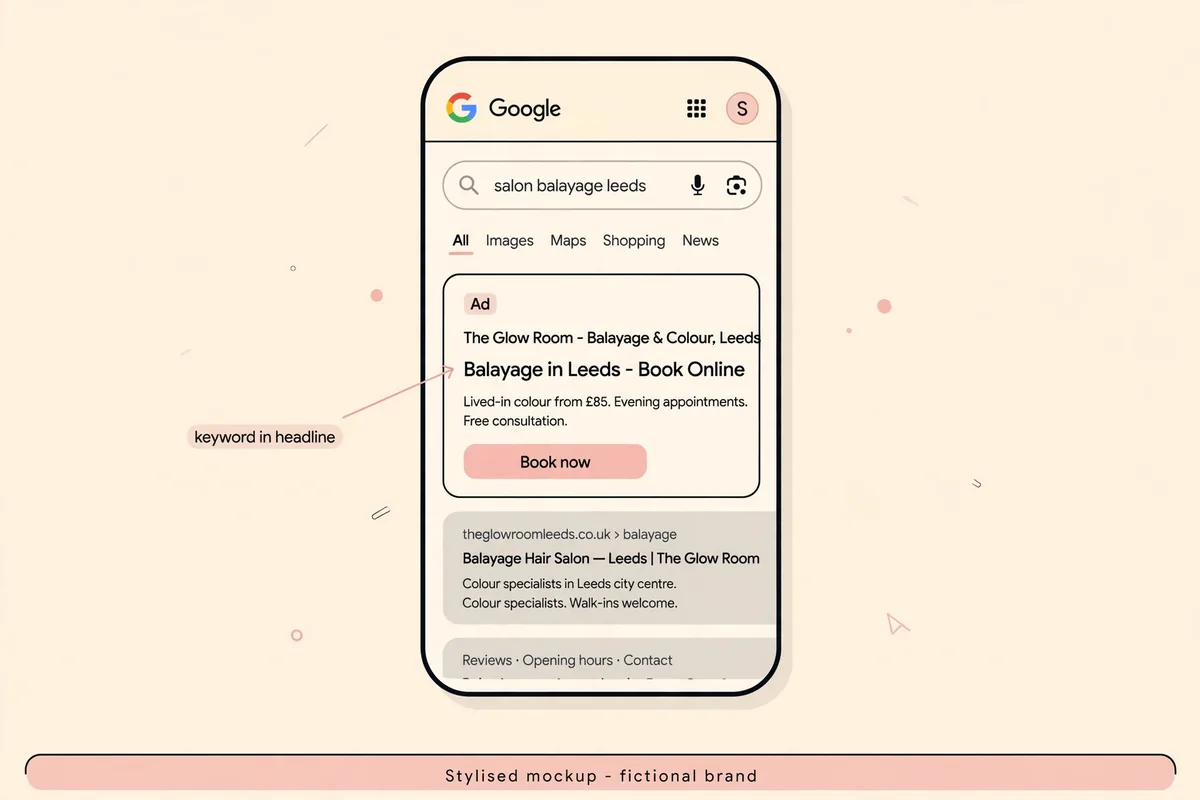
What makes this ad work:
- The headline mirrors the search. The person searched “salon balayage leeds” and the headline answers back “Balayage in Leeds”. That match is what gets the click.
- The description answers the two questions every searcher has: what does it cost (“from £85”) and is it practical for me (“evening appointments”).
- One action, one destination. “Book now” should land on a booking page for that service, never your homepage.
Copy and paste this structure for your own Google ad:
Headline: [Service] in [Town], Book Online
Headline 2: From £[price] · [practical detail, e.g. evening slots]
Description: [One-line benefit]. Free consultation. Book in 60 seconds: [your booking link]
Google ads work best for advertising salon services people already search for, colour, nails, facials, bridal. If nobody in your area searches for your service (search it yourself and see), Instagram ads will suit you better.
Instagram and Facebook salon advertising: examples that stop the scroll
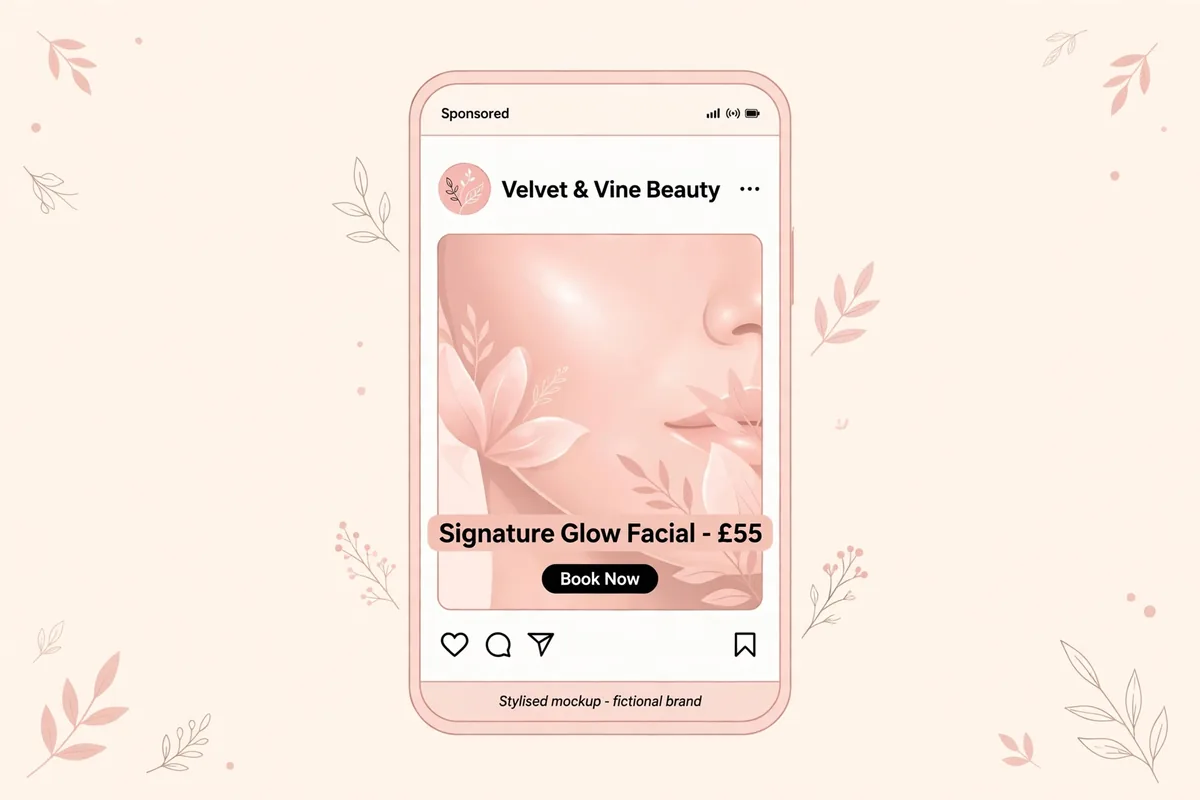
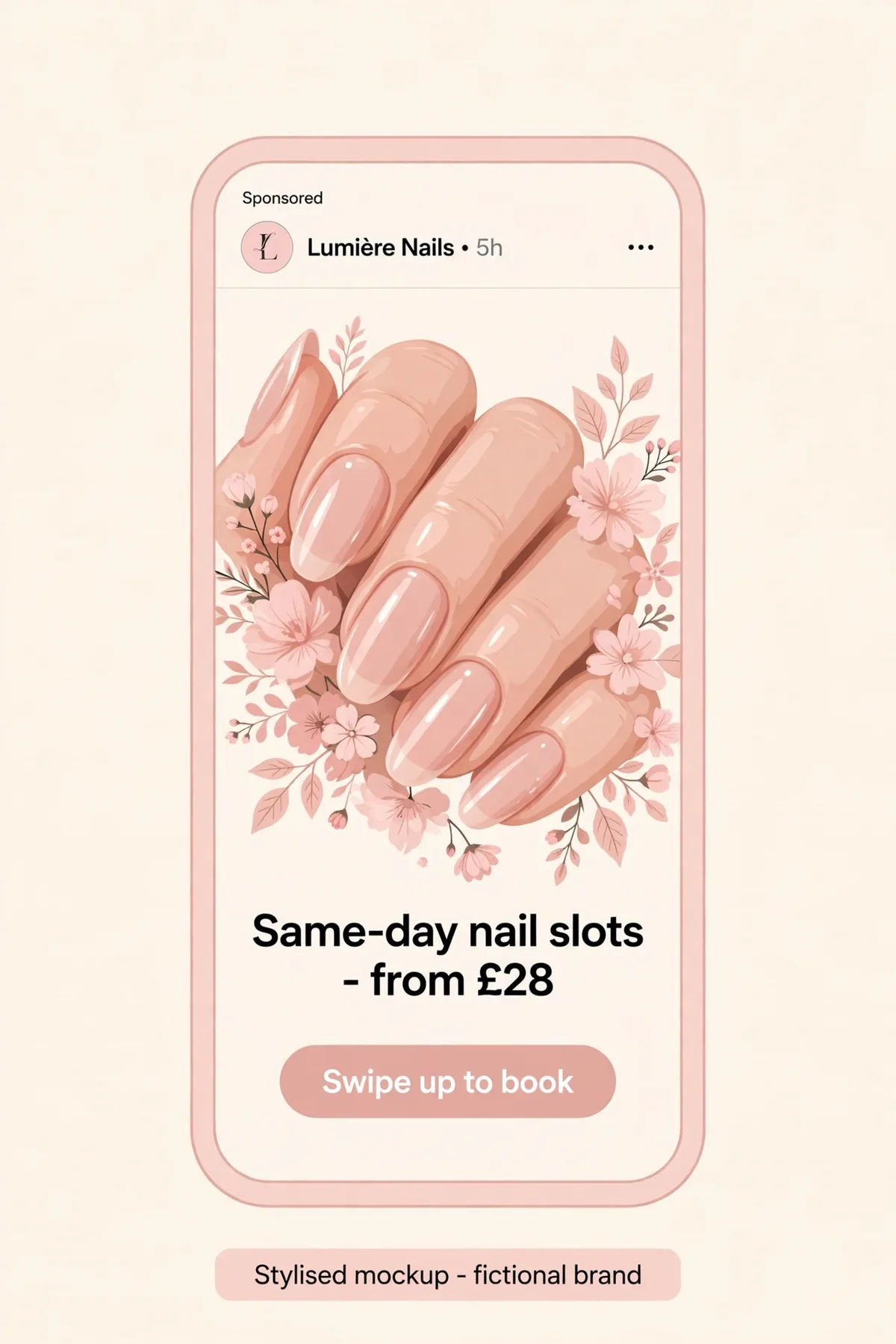
Digital salon advertising on Meta (Instagram and Facebook) works the opposite way to Google. Nobody is searching, they are scrolling. Your ad has about one second to earn a second look, so the image does the heavy lifting and the words stay short.
Example 1, the feed ad. One service, one price, one button:
Example 2, the Story ad. Stories are full-screen and vertical, which suits salons perfectly, a set of nails or a hair transformation fills the whole phone:
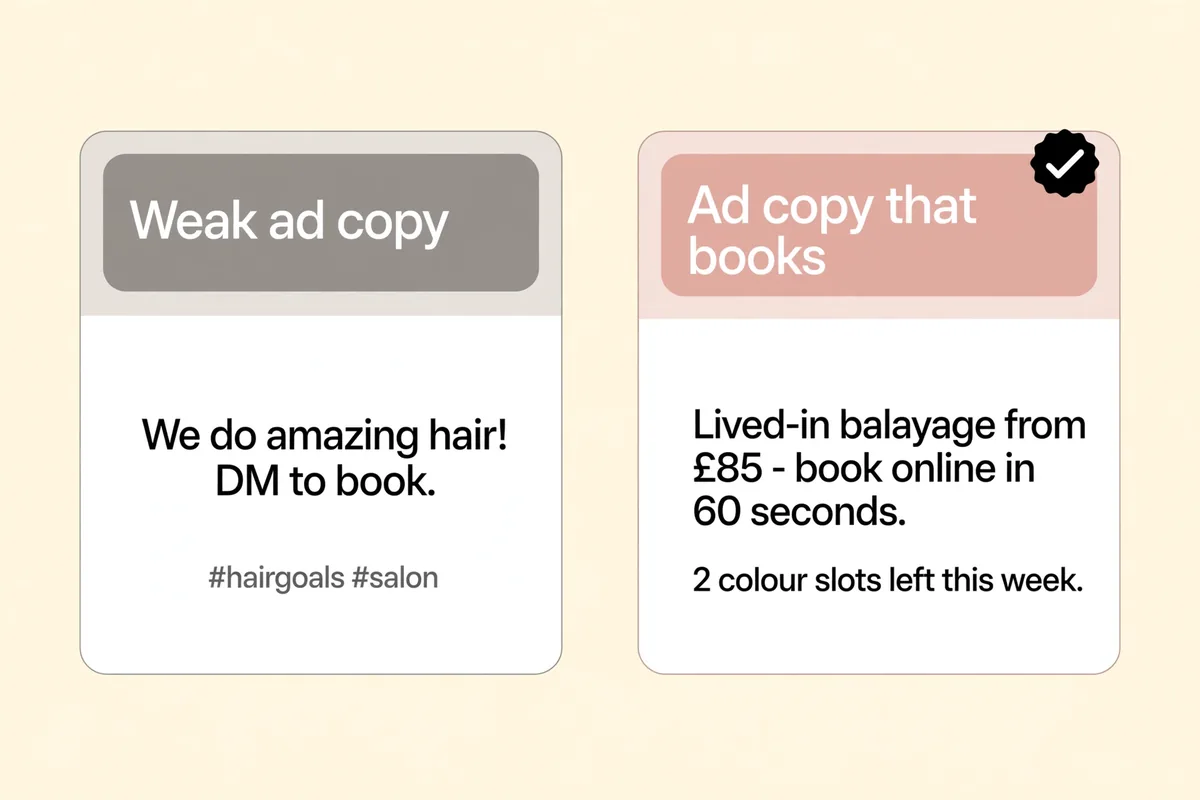
And here is the difference good copy makes, the same service, two ways of writing it:
Copy and paste this structure for your Meta ads:
[Hook, one line, the offer or the problem]: Same-day nail slots in [town], from £28.
[Proof, one line, only if true]: [Your real number] Google reviews at [your real rating]★
[Action, one line]: Tap Book Now, appointments available this week.
One warning: the “Boost post” button is not an ad strategy. Boosting a post with no booking link and no tracking is the fastest way to spend money and learn nothing. If you run Meta ads, run them properly, one offer, one local radius, one booking link, or look at social media ads for salons and let someone who does this daily set them up. Good ad creative also starts with a recognisable brand; if your visuals look homemade, see brand design for salons.
Offline salon advertising ideas: the flyer that still works
Not all salon advertising ideas are digital. If you are advertising a new salon, or you want to own the streets around your door, a well-designed flyer still earns its print cost, but only if it behaves like a good online ad:
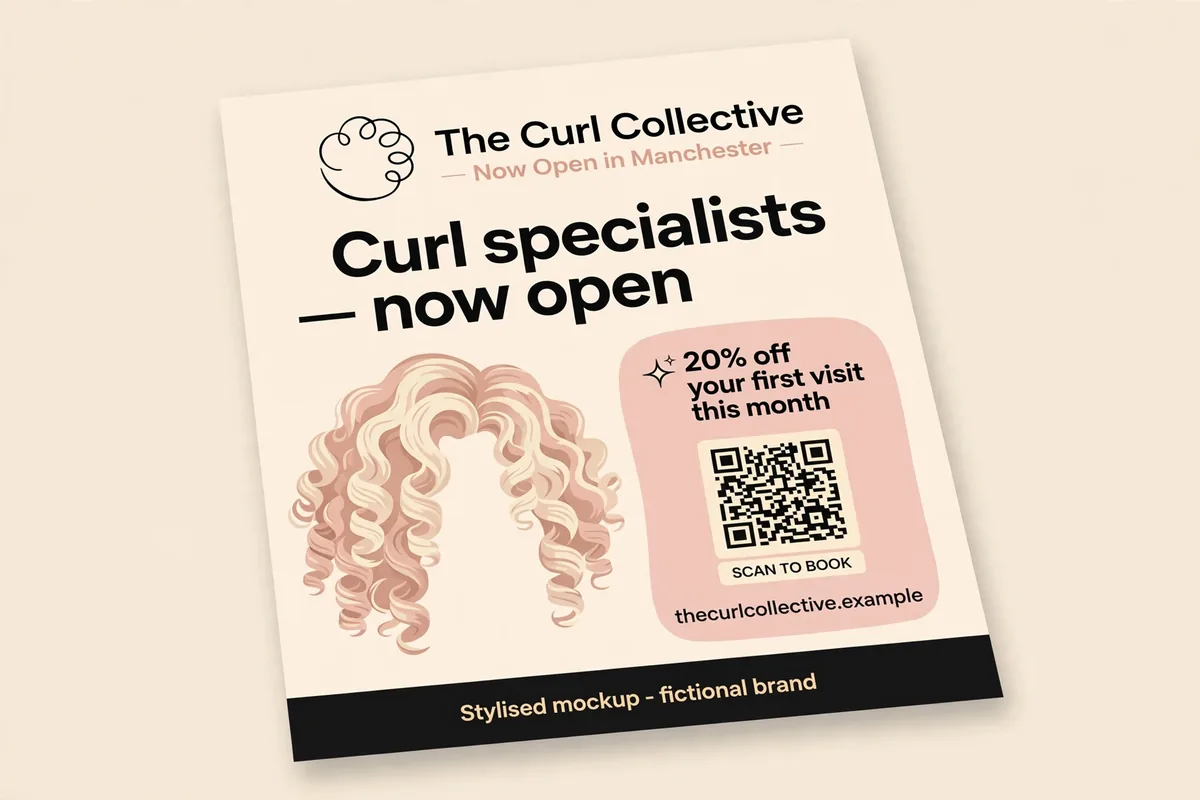
The rules are the same as digital: one service, one offer with dates, one booking action. The QR code is doing the job the “Book now” button does online, it must open your booking page on a phone in seconds.
If you are advertising a new salon with no clients yet, run these three in this order:
- Google Business Profile + reviews, free, and it is where “near me” searches land. Start here before spending anything.
- One first-visit offer on flyers and Instagram, with dates on it, ASA-safe (more on that below).
- One small paid test, Google or Meta, one service, one month, tracked.
Our guide to local SEO for salons walks through step one in detail.
What salon advertising actually costs in the UK
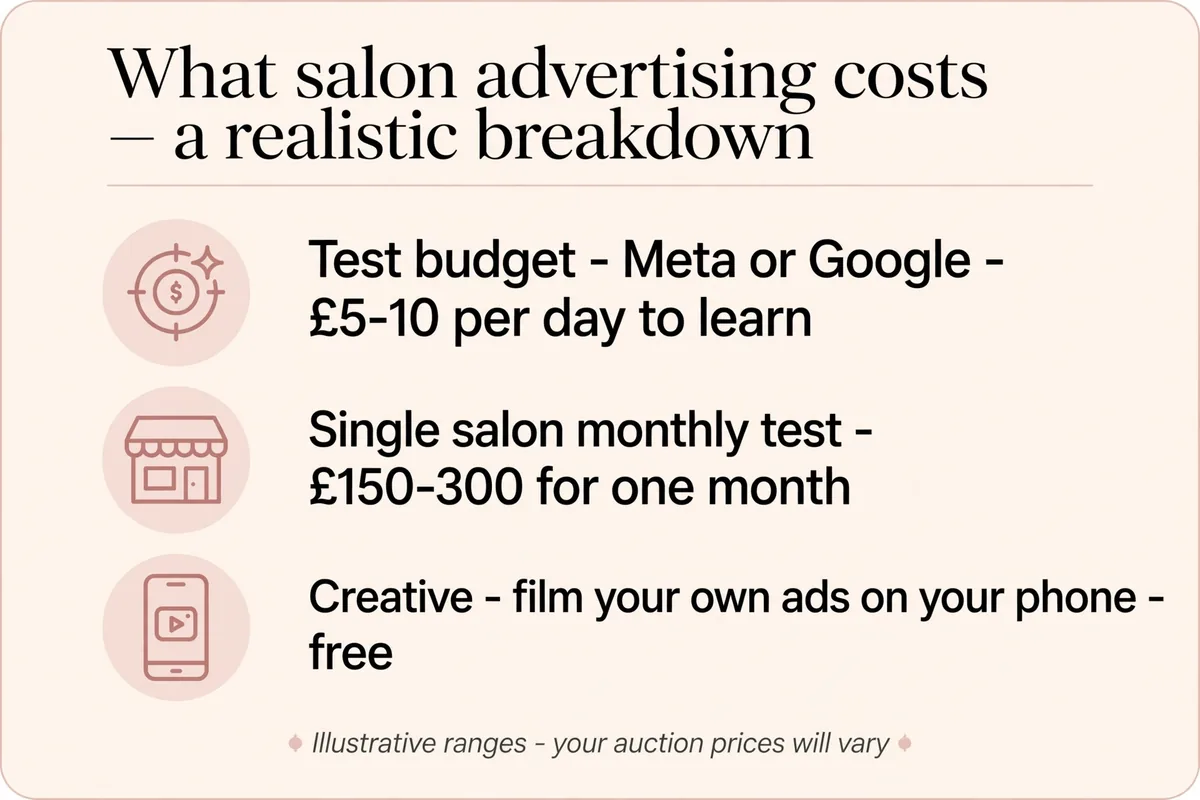
Here is the honest answer nobody in the top search results gives you: there is no price list. Google and Meta both run auctions. You bid against other advertisers for attention, so what you pay per click or per view moves with competition in your town, how relevant your ad is, and how well the page it sends people to converts.
What we can give you are real, sourced UK benchmarks, not salon-specific promises, but the honest range:
- Across all UK industries, average Google Ads cost-per-click sits around £1.20 to £2.80; Health & Wellness averages £1.00 to £2.50; typical small-business monthly spend runs £300 to £2,000 (UK pricing guide, Rezaid, 2025, full guide).
- Treat these as cross-industry averages from 2025, not guarantees. London postcodes cost more than smaller towns, and your actual auction price will move week to week.
And here is how to think about your own budget, example (illustrative maths, not a promise or a client result):
You set aside £200 for a one-month test (£50/week). If your clicks average roughly £1.50, that buys about 130 visits to your booking page. If 1 in 10 visitors books, that is about 13 bookings. Your numbers will differ, which is exactly why the first month is a test, not a commitment.
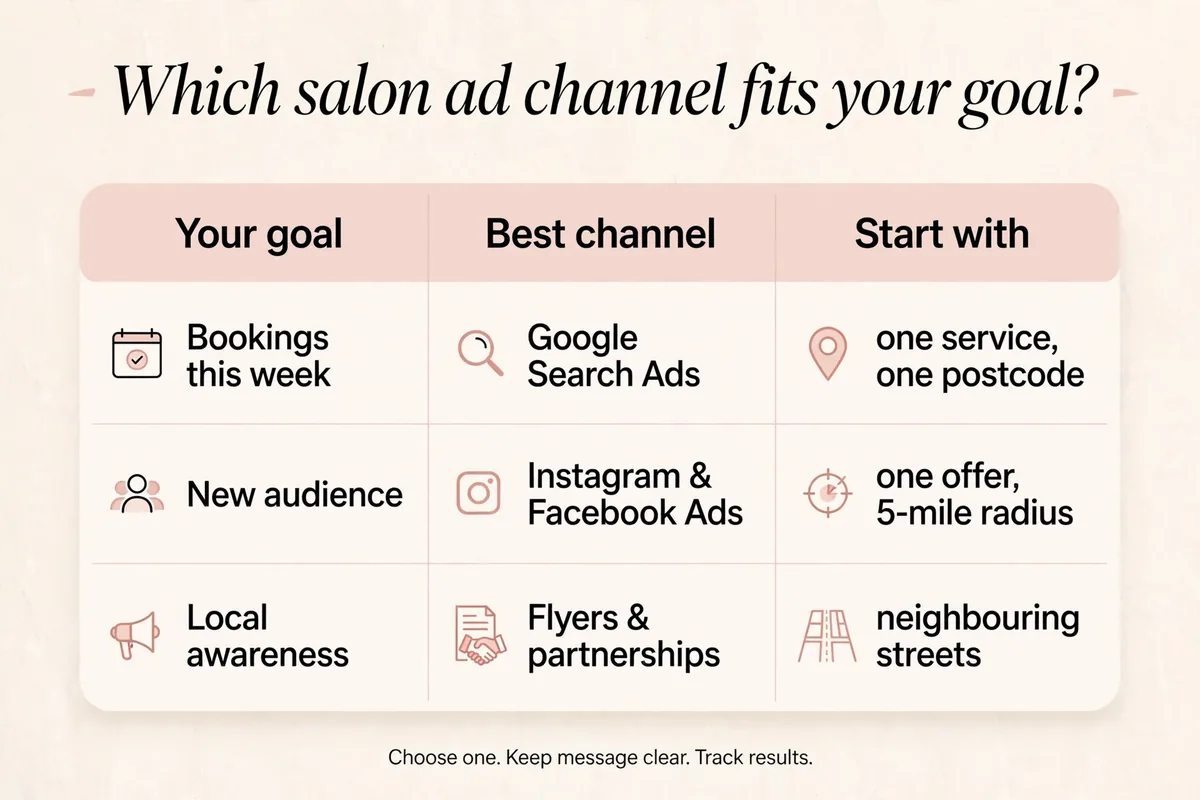
Which channel should get your first test? Use this decision framework:
💷 Plan your first ad test with us
A £200 test only works if every booking is tracked. Book a free 30-minute strategy call and we will help you plan a first test, budget, targeting and tracking, around your salon.
Free, 30 minutes, no obligation. We reply within one working day.
ASA rules for salon advertising: what the UK actually requires
Advertising a salon in the UK means following the same advertising rules as everyone else. The Advertising Standards Authority (ASA) enforces the CAP Code, and it covers your Google ads, Meta ads, flyers and even your Instagram bio claims. Four rules matter most for salons:
- Discount claims must be provable. Under the ASA’s promotional savings guidance, “up to 50% off” requires a significant proportion of your services to actually be discounted that much, and “was £60, now £40” requires £60 to have been your genuine usual price for longer than the sale ran. Screenshots of old prices are not enough, the ASA has ruled against advertisers who could not produce proper records (Pinsent Masons’ summary of the rulings).
- “Free” means free. Do not call a treatment free if the client has to pay anything else to receive it.
- Do not fake proof. Invented reviews, “award-winning” with no award, or results you cannot evidence all breach the substantiation rules. Honest claims are also better ads, clients can smell a fake.
- Mark ads as ads. If you gift treatments to local influencers in exchange for posts, those posts must be clearly labelled as ads (#ad). The same applies to your own boosted posts, which is another reason to run proper ad campaigns instead.
This is general information, not legal advice, but the practical rule is simple: if you cannot prove it, do not print it.
5 salon advertising mistakes that waste money
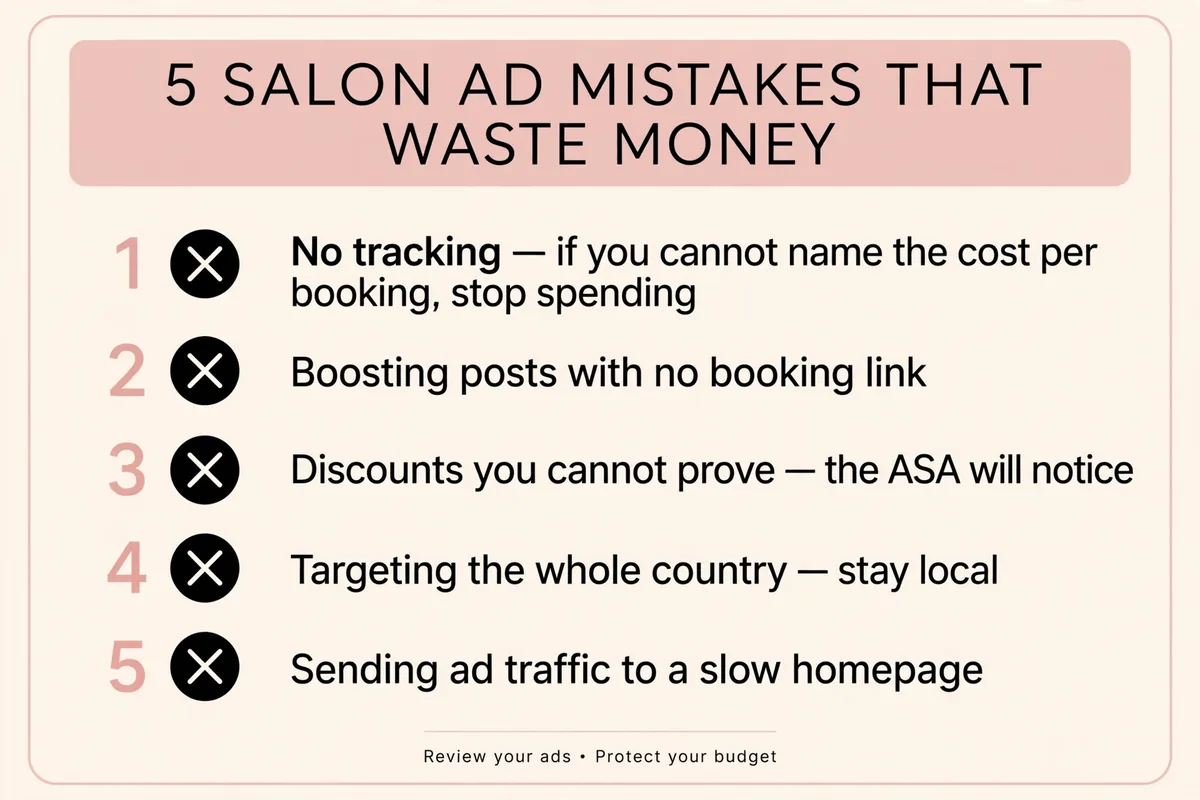
- No tracking. If you cannot say what one booking cost you, pause the ad. “It feels like it’s working” is not a measurement.
- Boosting posts with no booking link. Likes do not pay rent. Every paid placement needs a tap-to-book action.
- Discounts you cannot prove. “Up to 50% off” without the evidence is an ASA complaint waiting to happen, and it trains clients to wait for sales.
- Targeting the whole country. A salon ad should rarely travel further than a client will drive. Keep it local: your town on Google, a tight radius on Meta.
- Sending paid traffic to a slow homepage. Your ad promises one service, the page it lands on should show that service, its price and a booking button, nothing else. If yours does not, see what a website built to take bookings looks like.
A final round of salon advertising tips: start with one channel, keep every claim provable, and judge every ad on cost per booking, never on likes.
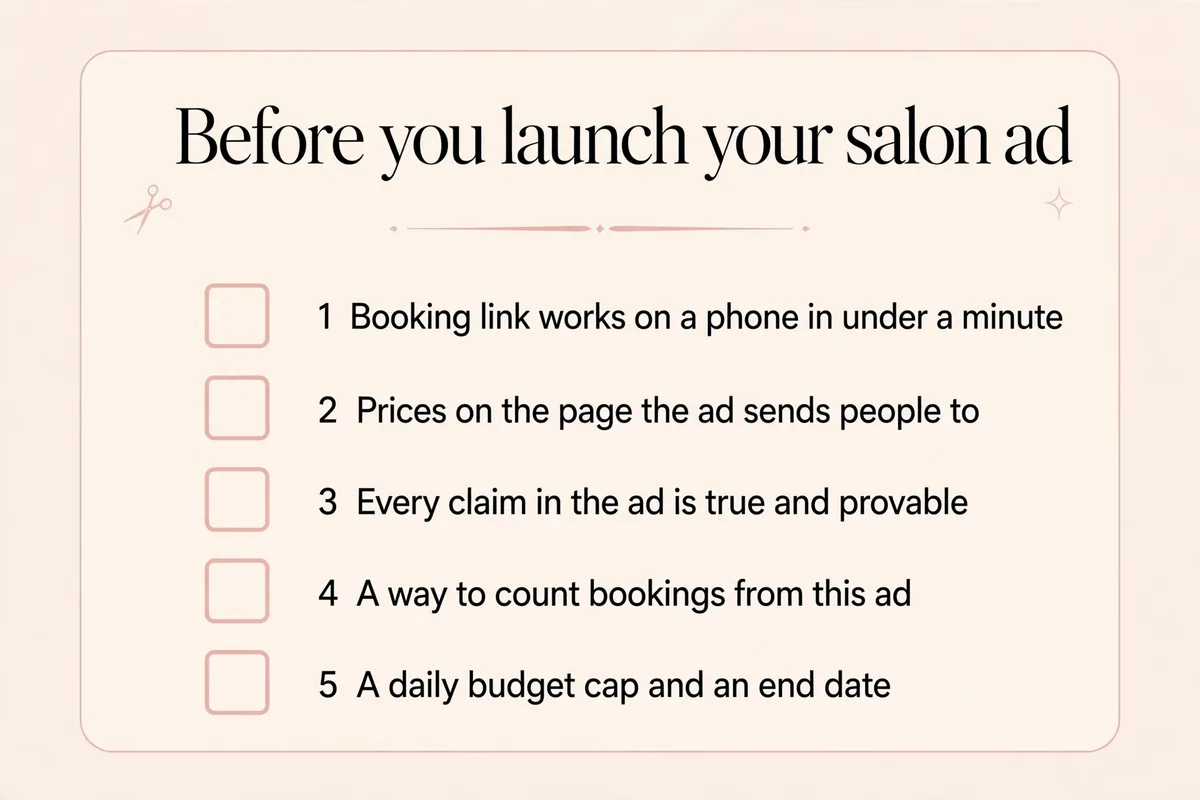
Launch your first salon ad in under an hour
Here is the whole process, start to finish. Set a timer.
- Pick one service (5 min). Your most profitable, most in-demand treatment, balayage, gel nails, signature facial. One service only.
- Write the ad (10 min). Use the templates above: one service, one price, one booking link. Steal the structure from the mockups, not the words.
- Pick one channel (5 min). Use the decision framework, bookings this week means Google; new audience means Meta.
- Set the budget and boundaries (10 min). £5 to £10 a day, a 7-day end date, your town (Google) or a tight radius (Meta). If you collect emails from the landing page, you need consent before sending marketing, the ICO’s direct marketing guidance explains the rules plainly.
- Use one real photo (10 min). Your best recent work, unfiltered, well lit. Real work outperforms stock every time.
- Launch, then review after 7 days (5 min). The only number that matters: what did each booking cost? Keep it, fix it or kill it.
Frequently asked questions
How much does salon advertising cost in the UK?
There is no fixed price, Google and Meta run auctions, so costs move with competition in your area. UK cross-industry benchmarks put average Google cost-per-click around £1.20 to £2.80 (Rezaid, 2025). A sensible first test is £150 to £300 over one month, with every booking tracked so you know your true cost per client.
Where is the best place to advertise a salon?
Google Ads if you want bookings this week, it catches people already searching for your service locally. Instagram and Facebook ads if you want to reach new people who are not searching yet. Flyers and local partnerships still work for new salons owning their neighbourhood. Pick one channel per goal.
How do I advertise my salon on Instagram?
Run proper ad campaigns (not boosted posts) with one offer, a tight local radius and a tap-to-book link. The creative should show real results, name one service and its price, and carry a single “Book Now” button. Track cost per booking, not likes, and give every test a budget cap and end date.
Is salon advertising regulated in the UK?
Yes. The ASA’s CAP Code covers your Google ads, Meta ads, flyers and website claims. Discount claims must be provable, “free” must genuinely mean free, and gifted influencer posts must be labelled as ads. If you cannot evidence a claim, leave it out of the ad.
How do I advertise a new salon with no clients yet?
Start free: complete your Google Business Profile and ask early clients for reviews. Then run one dated first-visit offer across flyers and Instagram with a QR code to your booking page. Only then add one small paid test, one service, one channel, one month, fully tracked.
The bottom line
Good salon advertising is simple: one service, one honest offer, one booking action, shown to local people who are ready to book. Copy the structures in this swipe file of salon advertising samples, keep every claim provable, and test small before you scale.
If you want help planning that first test, budget, targeting and tracking built around your salon, get in touch or book a free 30-minute strategy call.
Book My Free Strategy Call → Free, 30 minutes, no obligation. We reply within one working day.
Last updated: October 2026