
If you are looking for a medical spa digital marketing agency, you have probably already discovered two problems. First, nearly every result is American — US prices, US rules, US terminology. Second, nobody tells you what it actually costs in the UK or how to tell a good agency from a smooth sales pitch. This guide fixes both. It is written for aesthetics clinic owners in the UK: what a medical spa marketing agency should do for you, what UK clinics really pay, the UK advertising rules your agency must know, and a 10-point checklist to choose the right one.
One note on language before we start: “med spa” is an American term. In the UK your clients search for “aesthetics clinic”, “skin clinic” or “laser clinic” — and Google’s categories reflect that. This guide uses the keyword you searched, then talks in the language your clients actually use. That habit — matching the UK market, not the US one — is the first thing a good agency should do for you.
Key takeaways
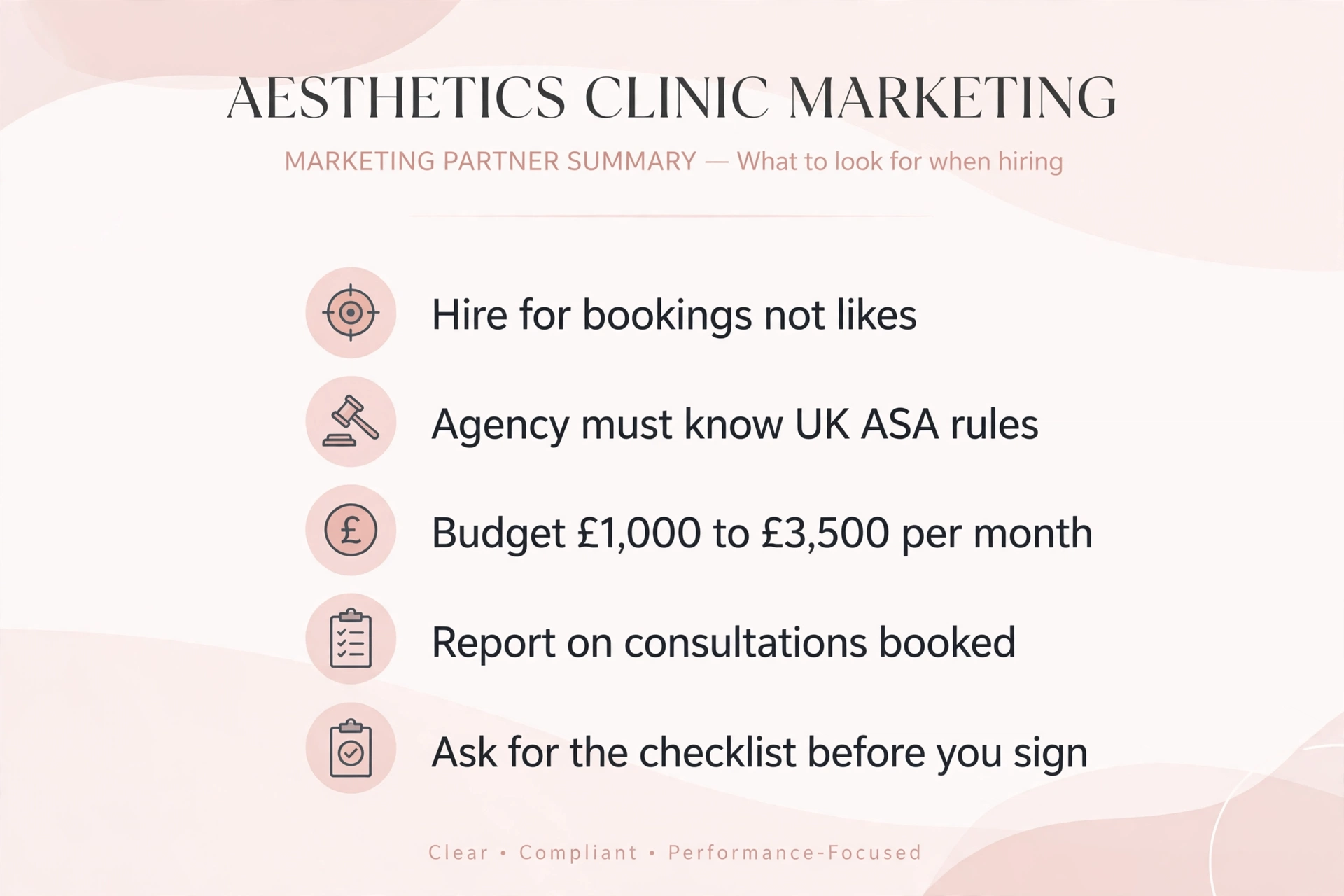
- Hire an agency for consultations booked, not likes or clicks.
- Your agency must know UK advertising law — Botox cannot be advertised to the public, full stop.
- Realistic UK budgets run £1,000–£3,500 per month plus ad spend, with a one-off setup fee.
- Never sign without the 10-point checklist below — especially account ownership and the exit clause.
- A specialist aesthetics agency costs more than a generalist, and for regulated treatments it is usually worth it.
Not sure you even need an agency yet? Book a free 30-minute strategy call — we will give you an honest answer, even if it is “not yet”.
What does a medical spa digital marketing agency actually do?
A medical spa digital marketing agency is a marketing partner that specialises in clinics offering aesthetic treatments — anti-wrinkle consultations, dermal fillers, laser hair removal, skin rejuvenation, body contouring, facials and peels. A generalist agency can run ads; a med spa marketing company should understand how aesthetic clients actually buy: they research for weeks, they compare before-and-afters, they read reviews, and they book a consultation before they commit to treatment.
Here is what medical spa marketing services should cover, at minimum:
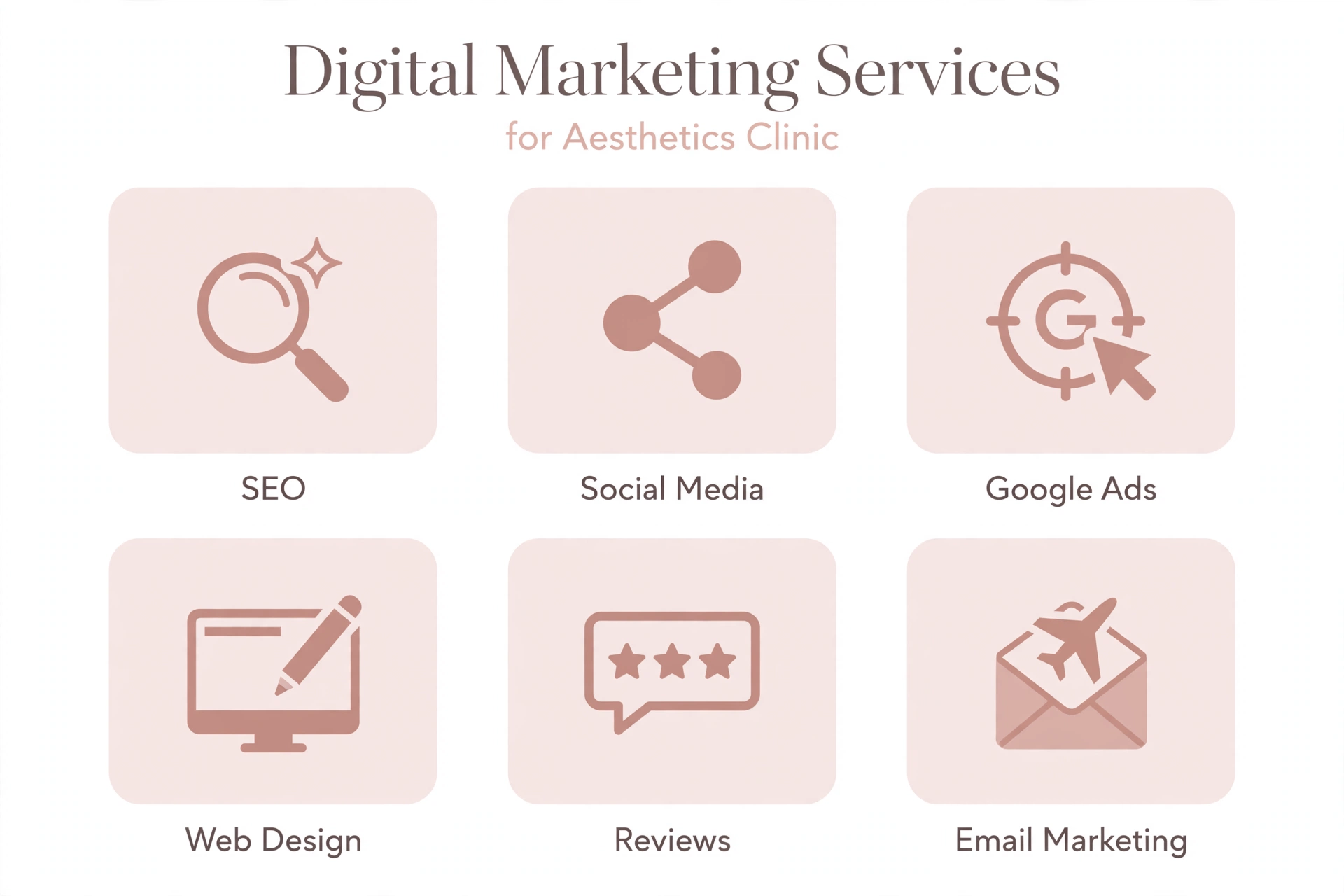
- Local SEO: ranking your Google Business Profile and website for searches like “lip filler Manchester” or “laser hair removal near me”, so clients find you at the exact moment they want to book. See how local SEO for salons and clinics works in practice.
- Google Ads and paid social: compliant ad campaigns on Google, Instagram and TikTok that drive consultation bookings. For aesthetics, the ad copy has to navigate strict UK rules — which is exactly why the agency’s UK knowledge matters.
- Social media management: Instagram and TikTok content that shows real treatments, real results (within the rules) and real practitioners — the trust signals aesthetic clients need. Done properly, this is a full service: content planning, filming direction, posting and community management. Our social media management for clinics and salons covers what this looks like week to week.
- Website design and conversion: a fast, mobile-first site with online booking, treatment pages that answer real questions, and a consultation funnel that turns visitors into enquiries. Most clinic websites lose bookings they already earned — a website built to take bookings fixes that first.
- Reviews and reputation: a system for collecting Google reviews after every appointment and responding to all of them. For clinics, reviews are not vanity — they directly affect local rankings and consultation bookings.
- Email and SMS marketing: win-back campaigns for lapsed clients, treatment reminders and seasonal promotions, run with proper UK consent (more on that below).
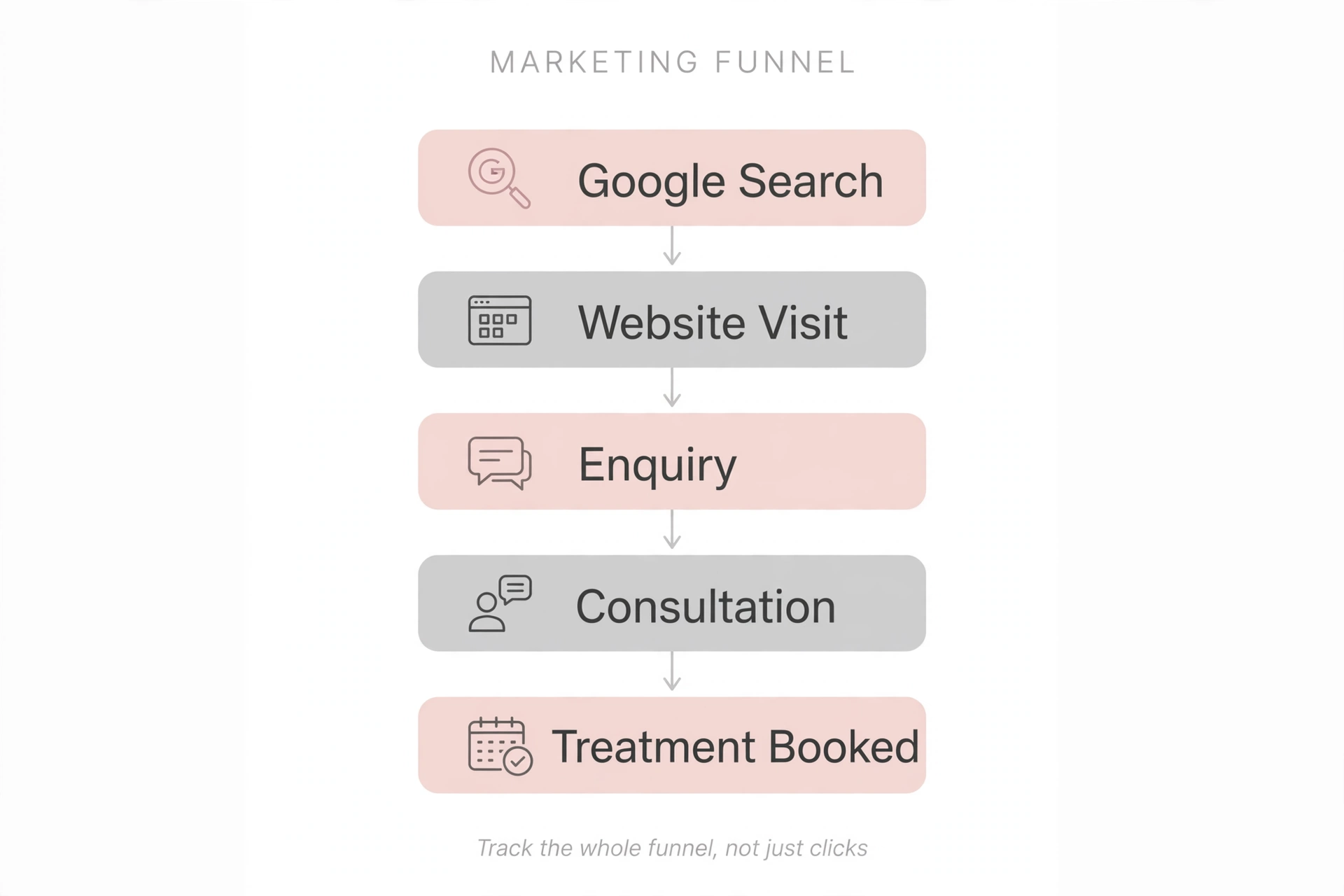
The diagram below shows how a good agency should think: not in channels, but in the full journey from search to booked treatment. If an agency reports on clicks but cannot tell you how many consultations those clicks produced, they are measuring the wrong thing.
The one test that matters: does your agency know UK advertising law?
This is where most US-focused advice — and most cheap agencies — falls apart. The UK regulates aesthetic advertising far more tightly than the US, and an agency that does not know the rules can get your ads banned, your social accounts flagged, and your clinic named in an ASA ruling.
Here is what any medical spa digital marketing agency working in the UK must know cold:
Botox cannot be advertised to the public. Botulinum toxin (Botox, Vistabel, Dysport, Bocouture, Azzalure) is a prescription-only medicine. Under CAP Code rule 12.12 and the Human Medicines Regulations 2012, prescription-only medicines cannot be advertised to the public — on social media, on Google Ads, or even by implication. The ASA’s own guidance states this plainly: you cannot advertise Botox on social media or in any other advertising space (ASA: rules for advertising Botox). The ASA has taken enforcement action against clinics that tried workarounds like “anti-wrinkle injections” with prices, or “wrinkle-relaxing” hashtags.
Promote the consultation, not the product. What you can advertise is the service: “a consultation for the treatment of lines and wrinkles”. A competent agency builds your entire paid and organic strategy around consultations and concerns — never around the medicine.
Treatment claims need evidence. Under the ASA’s guidance on non-surgical cosmetic procedures, efficacy claims (for peels, laser, body contouring) must be backed by robust evidence — marketing cannot promise results the evidence does not support (ASA: cosmetic interventions — non-surgical procedures). “Lose 3 inches in one session” style copy is a red flag, not a selling point.
Under-18s are off limits. Botulinum toxin and cosmetic fillers cannot be administered to under-18s in England except under a clinician’s prescription (Botulinum Toxin and Cosmetic Fillers (Children) Act 2021). Your agency’s ad targeting must exclude under-18s — ask them how.
Marketing texts and emails need consent. Under PECR, the UK’s electronic marketing rules, you need consent (or the “soft opt-in” for existing clients) before sending marketing texts or emails, with an opt-out in every message. This is general information, not legal advice — but any agency running your email/SMS should be able to explain it without Googling.
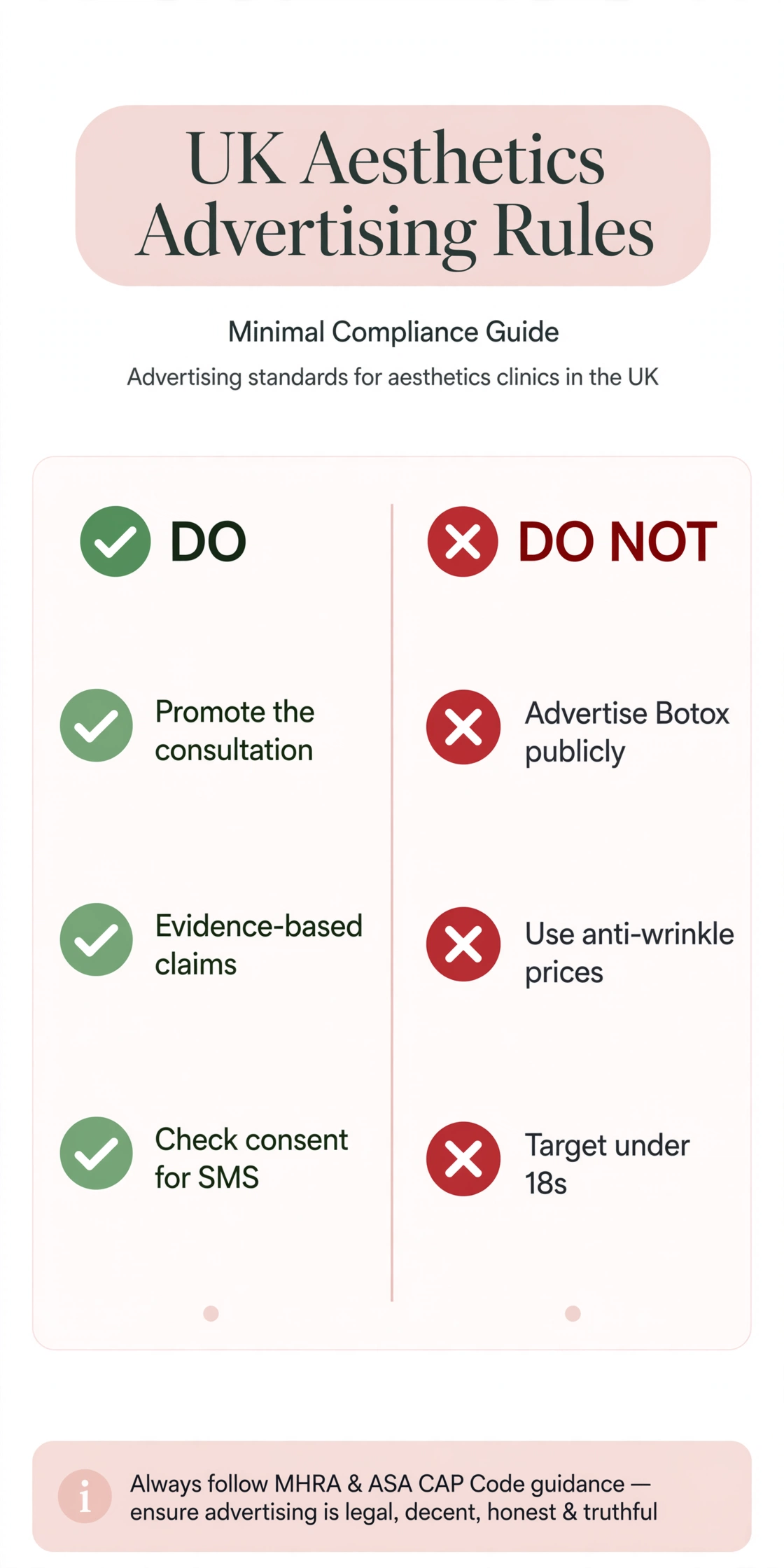
A quick before/after shows what compliance looks like in practice:
Non-compliant ad copy: “Botox £150 — 3 areas! Book now” Compliant rewrite: “Concerned about lines and wrinkles? Book a consultation with our prescribing clinician to discuss your options.”
The second version sells the same appointment without breaking the law. If a prospective agency cannot explain the difference — or worse, suggests the first version — end the call.
What medical spa marketing services cost in the UK: an honest breakdown
Agencies rarely publish prices, so clinic owners compare quotes blind. Here is what UK aesthetics clinic marketing actually costs, based on published UK programme pricing.
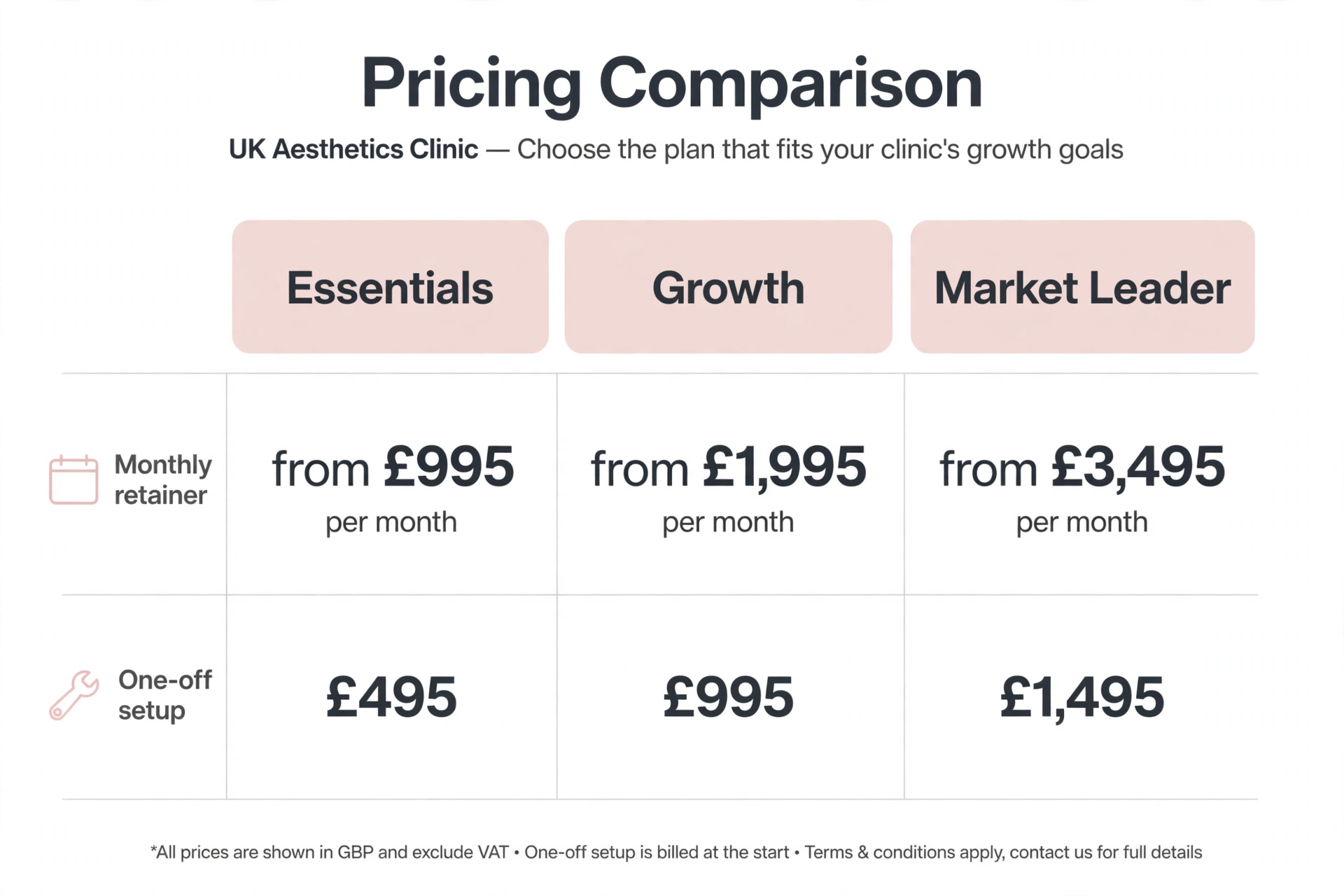
One UK agency specialising in clinic marketing, Clinic Grower, publishes its programme prices: £995 + VAT per month (£495 + VAT one-off implementation) for its entry programme, £1,995 + VAT per month (£995 implementation) for growth, and £3,495 + VAT per month (£1,495 implementation) for its top tier — with advertising spend charged separately (clinicgrower.co.uk/pricing, accessed October 2026; named as source, not an endorsement). That range — roughly £1,000 to £3,500 per month — is a realistic anchor for a UK specialist agency retainer.
| Programme level | Typical monthly retainer | One-off setup | Best for |
|---|---|---|---|
| Essentials / foundation | from £995 + VAT | ~£495 | Single clinic, getting the basics right: local SEO, reviews, social |
| Growth | from £1,995 + VAT | ~£995 | Established clinic adding paid ads, content and email |
| Market leader | from £3,495 + VAT | ~£1,495 | Multi-treatment or multi-site clinics, full-funnel management |
Prices above are published UK programme prices from Clinic Grower (accessed October 2026), shown excluding VAT. Advertising spend to Google/Meta is always separate.
A few honest notes on how pricing works:
- Ad spend is separate, always. Your £2,000 monthly fee pays the agency; the money that goes to Google and Meta is on top. In a competitive city, budget an extra £500–£2,000 per month in ad spend before you judge the results. An agency quoting £500 “all in” is either spending nothing on ads or spending your money with no management.
- Setup fees are normal. Audits, tracking installation, ad account builds and website fixes take real hours. A one-off setup of £500–£1,500 is standard; what should worry you is no setup and instant promises.
- Contracts should be short. Marketing takes time, but a 12-month lock-in protects the agency, not you. Three months initial, then rolling monthly with 30 days’ notice, is fair on both sides.
- Beware the extremes. Under £500/month for “full service” usually means templated work spread across dozens of clients. Over £5,000/month for a single clinic is rarely justified unless it includes serious creative production or multi-site management.
Example (illustrative, not a client result): a clinic paying £1,995/month in fees plus £1,000/month in ad spend invests £2,995/month. If a consultation is worth £250 in treatment revenue on average and 40% of consultations convert, each consultation is worth roughly £100 — so the marketing needs to generate about 30 consultations a month to break even. Run your own numbers with your own treatment prices before you sign anything.
Get a second opinion on an agency quote
Comparing proposals and they all sound the same? Book a free 30-minute strategy call and we will help you read between the lines — what is missing, what is overpriced, and what questions to ask next.
Free, 30 minutes, no obligation. We reply within one working day.
How to choose a medical spa digital marketing agency: the 10-point checklist
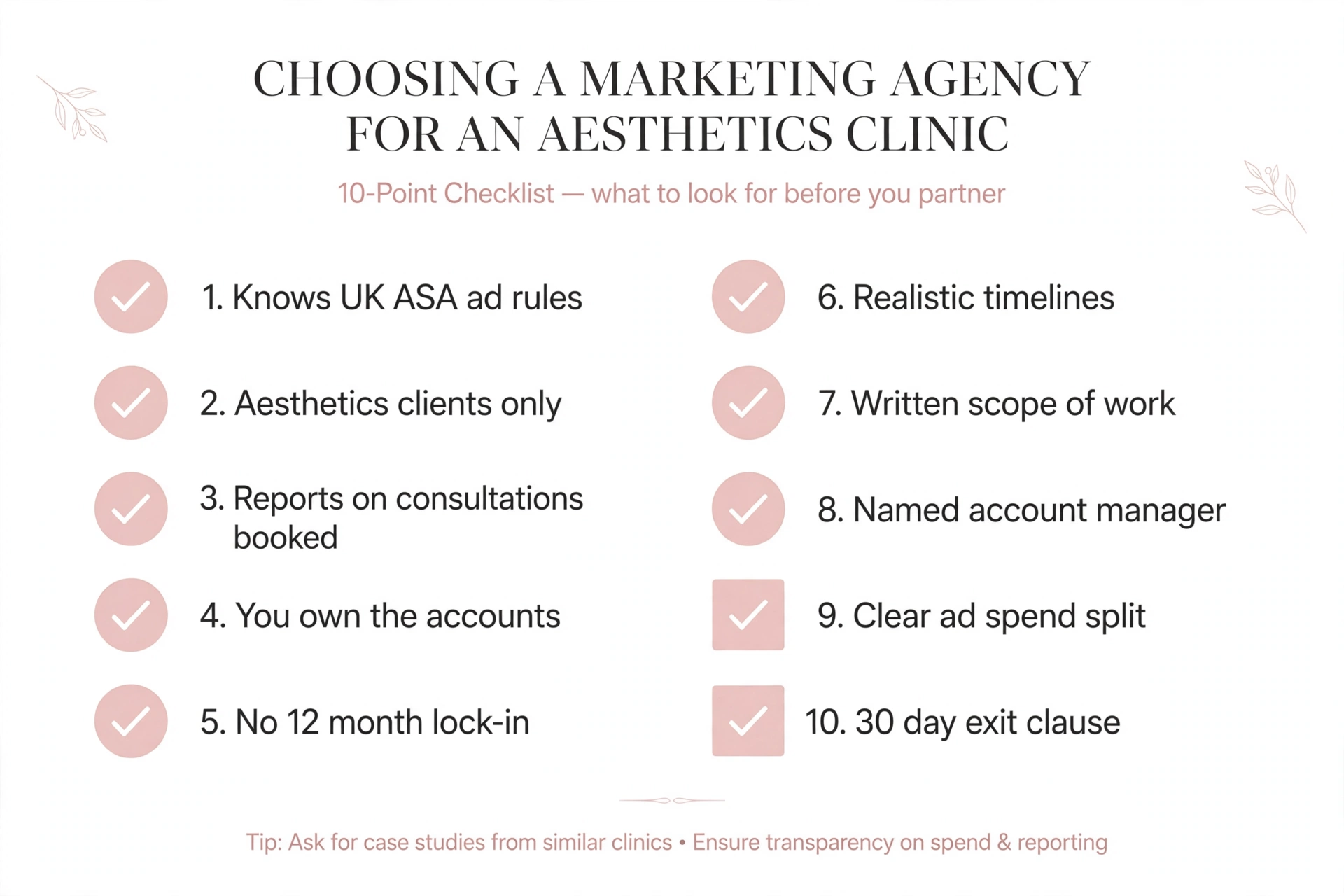
Use this checklist to score every agency you speak to — including us. Copy it into a spreadsheet, score each agency 1–5 per item, and the right choice usually becomes obvious.
- They know UK aesthetics advertising law. Ask: “How do you advertise a clinic that offers anti-wrinkle treatments without breaking ASA rules?” If they hesitate, they do not know the answer in the previous section.
- Aesthetics is their niche, not a sideline. The best med spa marketing company for you is one where clinics are the core client base, not one logo on a page of plumbers and solicitors. Ask how many current clients are clinics.
- They report on consultations booked, not vanity metrics. Impressions and followers do not pay rent. Insist on monthly reporting tied to enquiries, consultations booked and treatments sold.
- You own the accounts. Google Ads, Meta Business Manager, Google Business Profile, the website, the data — all registered to you, with the agency given access. If you leave, you keep everything.
- No 12-month lock-in. Three months initial to prove value, then rolling. An agency confident in its work does not need to trap you.
- Realistic timelines in writing. SEO takes 3–6 months to move meaningfully; Google Ads can produce enquiries in weeks. Anyone promising page one in 30 days is selling, not marketing.
- A written scope of work. Exactly what they do each month: how many posts, how many ad campaigns, what reports, who does what. “Full-service marketing” without a scope is a blank cheque.
- A named account manager. You should know who actually does your work — and it should not change every month.
- Clear split between fees and ad spend. Your invoice should show what you pay the agency and what goes to Google/Meta separately. Blended “£3,000 all in” quotes hide where the money goes.
- A 30-day exit clause. After any initial term, you can leave with 30 days’ notice and take your accounts, data and creative with you.
Specialist aesthetics agency vs generalist vs freelancer: which fits your clinic?
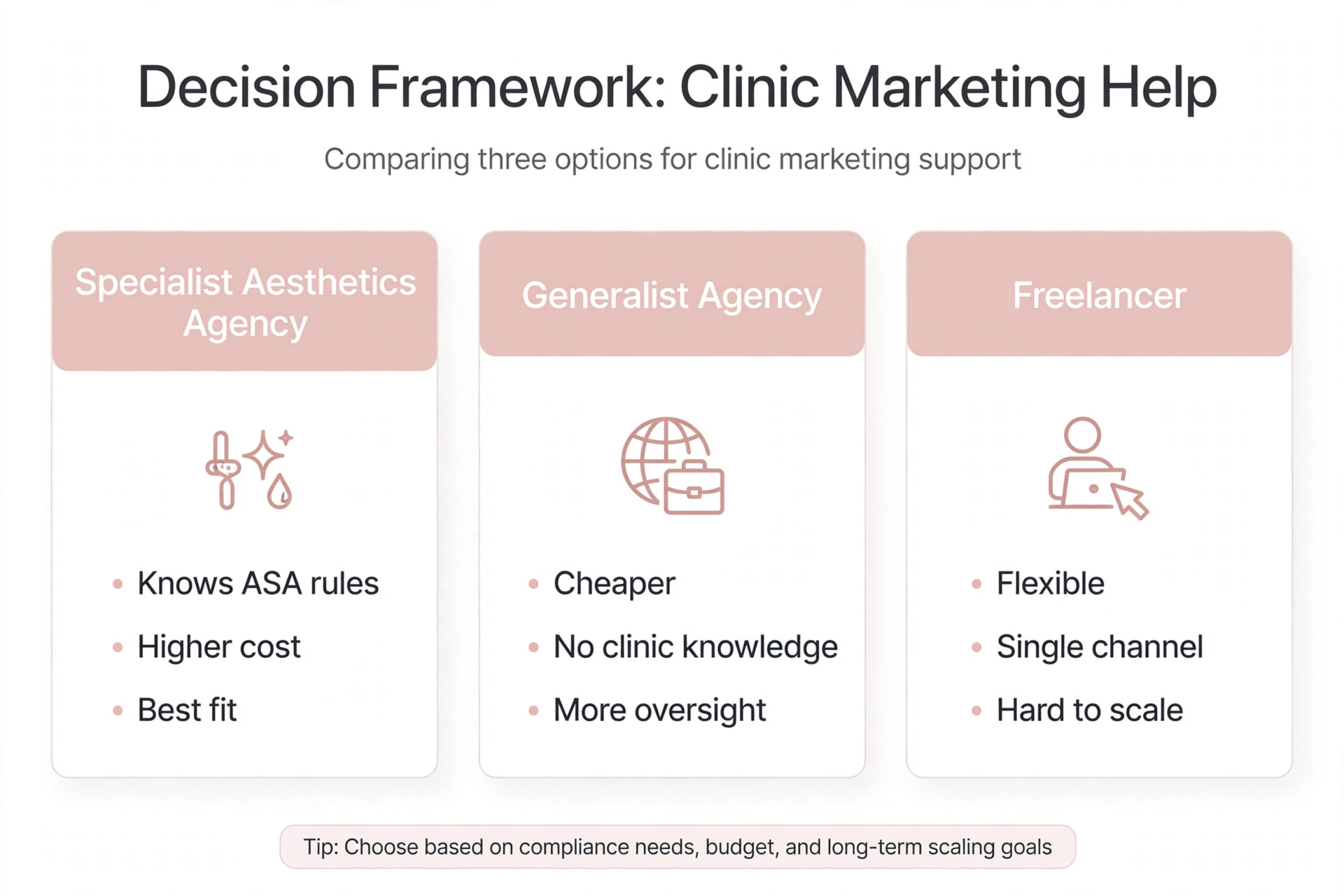
Not every clinic needs a specialist. Here is the honest decision framework:
| Specialist aesthetics agency | Generalist digital agency | Freelancer | |
|---|---|---|---|
| Cost | £1,000–£3,500+/month | £800–£2,500/month | £300–£1,000/month |
| UK aesthetics law knowledge | Usually strong | Rarely — you will need to police them | Varies wildly |
| Best for | Clinics offering injectables, laser, or multiple high-value treatments | Beauty salons or clinics with simple, non-regulated services | One channel done well (e.g. just Instagram, or just Google Ads) |
| Watch out for | Higher fees; make sure reporting is tied to bookings | They may suggest non-compliant ad copy — check everything | No cover if they are ill or busy; hard to scale |
Choose a specialist if you offer regulated treatments (anything injectable, laser, or prescription-adjacent) — the compliance risk alone justifies it. Choose a generalist if your menu is facials, nails and massage and you mainly need visibility. Choose a freelancer if you have one clear gap — say, your Google Ads are unmanaged — and you can brief and supervise them.
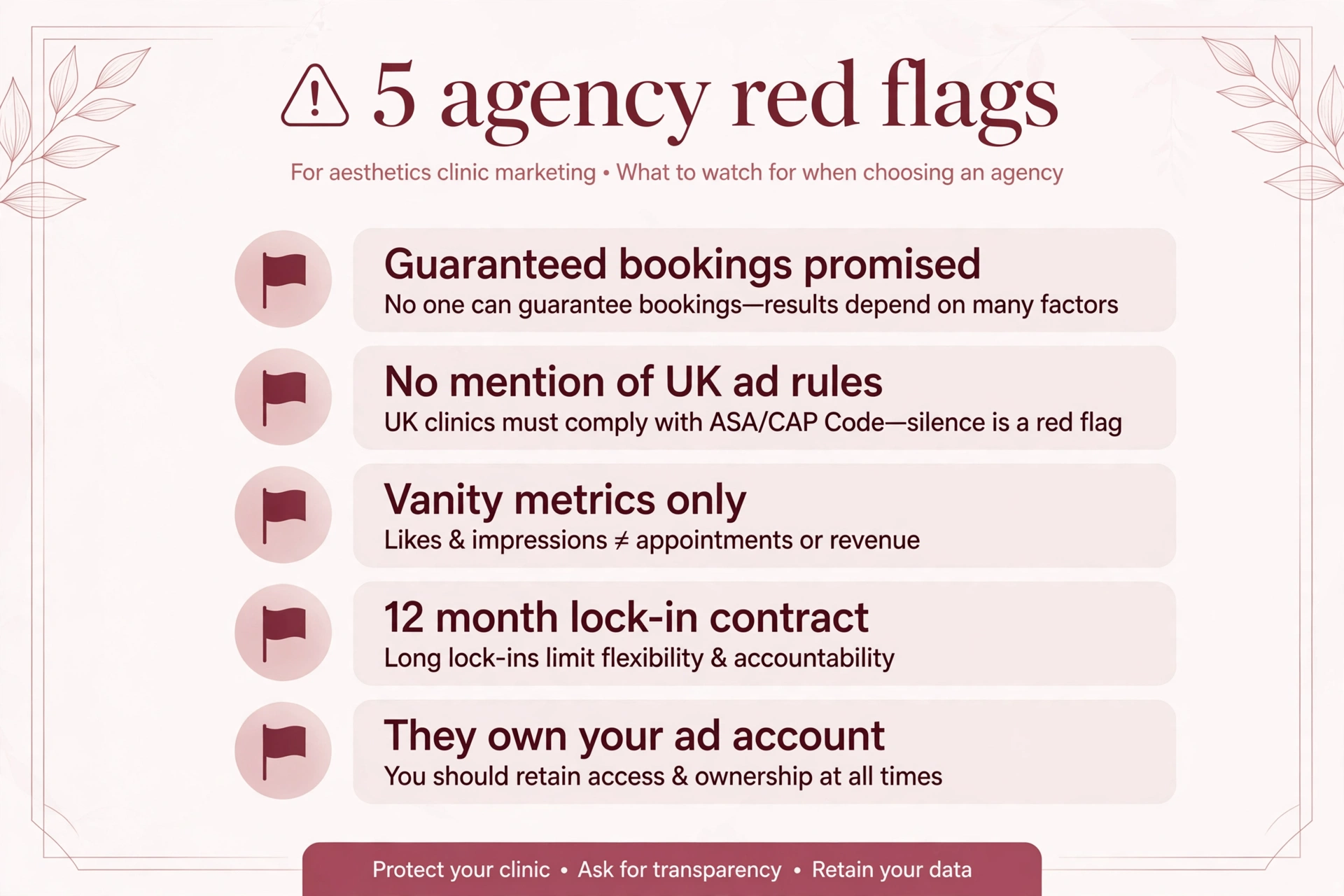
Five red flags that should make you walk away
- They guarantee bookings or revenue. Nobody can guarantee how many strangers book treatments. This violates the honesty rule — and the ASA’s rules on misleading claims. Guarantees of rankings are just as empty.
- They never mention UK ad rules. If a med spa digital marketing agency pitches you “Botox ads on Instagram” without blinking, they have told you everything about their competence.
- The proposal is all vanity metrics. “10,000 impressions”, “500 new followers” — with no line connecting any of it to consultations. Ask: “How will we know this worked in 90 days?” and listen for numbers that matter.
- They own your ad account or website. Some agencies build everything inside their accounts so leaving means starting over. This is a hostage situation, not a partnership.
- No reporting, or reporting you cannot understand. A monthly PDF of screenshots with no commentary is not reporting. You should get: what was spent, what happened, what changes next — in plain English.
The 7 questions to ask on your first call
Print these out. A good agency will enjoy answering them; a bad one will deflect.
- “How many aesthetics clinics do you currently work with, and what treatments do they offer?”
- “How do you market anti-wrinkle treatments without advertising a prescription-only medicine?”
- “What exactly is included each month, and what would you do in the first 30 days?”
- “How do you report — and what does a good month look like in numbers?”
- “Who owns the ad accounts, the website and the data if we part ways?”
- “What is the contract length, and what is the notice period after that?”
- “Can I speak to a current clinic client?” (A “no” is not automatically damning for a young studio — but “we don’t do references” with nothing else offered is.)

What an agency honestly cannot do for you
No agency, however good, can fix these — and an honest one will say so:
- A weak offer or poor reviews. Marketing amplifies what exists. If your Google rating is 3.2 and nobody answers the phone, ads will just show more people the problem. Fix operations first.
- Overnight SEO. Anyone promising page one in weeks is either lying or using tactics that will get you penalised. Expect 3–6 months of steady work.
- Results without your input. Before-and-afters, practitioner videos, treatment explanations — the best content needs your clinic’s face and voice. Budget an hour or two a month for filming.
- Bookings without follow-up. A lead that waits 48 hours for a reply is a lead lost. The fastest agencies in the world cannot fix a slow front desk. Respond to enquiries within the hour, every time.
Frequently asked questions
How much does a medical spa digital marketing agency cost in the UK?
Expect £1,000–£3,500 per month plus VAT for a specialist agency retainer, with a one-off setup fee of roughly £500–£1,500. Advertising spend to Google and Meta is always separate — budget an extra £500–£2,000 per month in competitive cities. These bands are anchored on published UK clinic-marketing programme pricing.
What services should a med spa marketing agency offer?
At minimum: local SEO and Google Business Profile management, compliant Google Ads and paid social, social media management, a conversion-focused website with online booking, a review system, and email/SMS marketing with proper UK consent. If any of these are missing, ask who covers it — you or them.
Can an agency advertise Botox for my clinic in the UK?
No — not publicly. Botulinum toxin is a prescription-only medicine and under CAP Code rule 12.12 and the Human Medicines Regulations 2012 it cannot be advertised to the public, including on social media. A competent agency promotes the consultation (“a consultation for lines and wrinkles”) instead, never the product.
Is SEO or Google Ads better for an aesthetics clinic?
Both, for different jobs. Google Ads buys immediate visibility for high-intent searches like “lip filler Birmingham” — enquiries in weeks. SEO builds lasting visibility and lowers your cost per enquiry over 3–6 months. Clinics that rely only on ads rent their visibility; clinics that do both own part of it.
How long before a marketing agency shows results for my clinic?
Google Ads and paid social can produce enquiries within the first month once tracking and campaigns are live. SEO typically takes 3–6 months to move rankings meaningfully. Social media compounds over months, not days. Any agency promising faster organic results should be asked exactly how.
The bottom line
Choosing a medical spa digital marketing agency for your UK aesthetics clinic comes down to three things: do they know UK advertising law, are their prices honest and in the open, and do they report on consultations booked rather than vanity metrics. Run every candidate through the 10-point checklist, ask the seven questions, and trust the one that gives you straight answers — including “we can’t do that”.
If you want a straight answer about your own clinic’s marketing — whether you need an agency at all, and what it should cost — book a free 30-minute strategy call.
Book My Free Strategy Call → Free, 30 minutes, no obligation. We reply within one working day.
Last updated: October 2026